




MUSCAT: The Sultanate of Oman did not wait to see the crescent moon to begin Ramadhan this year. This year, the date has been set as per astronomical calculations.
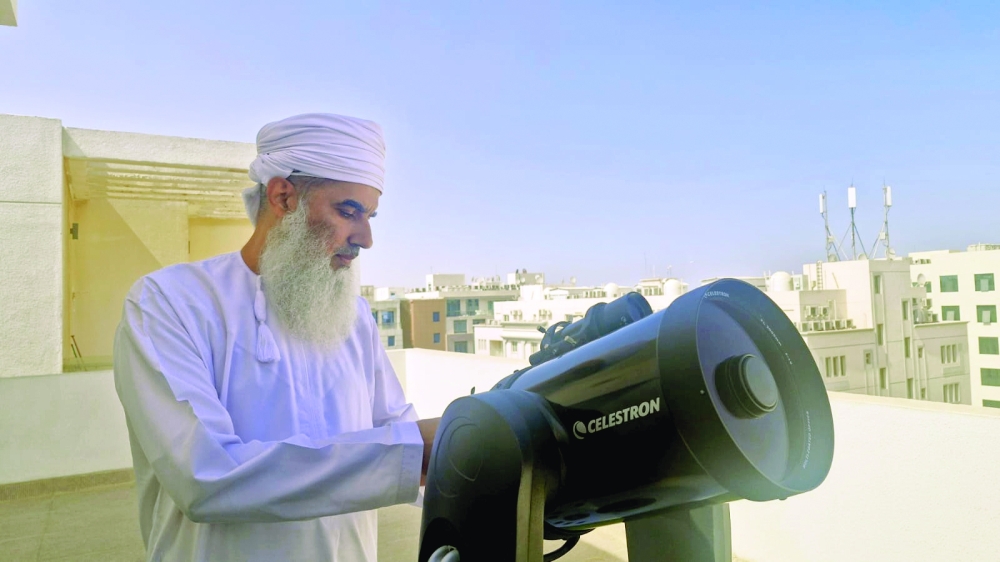
In an exclusive interview with the Observer, Yousuf bin Hamad al Rahbi, Director of the Astronomy Department at the Ministry of Awqaf and Religious Affairs, said the scientific basis for sighting the crescent, and clarified the difference between astronomy and astrology, outlining the conditions used to determine the start of the Hijri months.
He stressed that astronomy provides a scientific and reliable framework for determining the beginning of lunar months, ensuring accuracy and clarity in religious and civil observances across the Sultanate of Oman.
Nothing has changed in Oman's policy, he noted. The Sultanate of Oman relies on astronomy, in cases of impossibility, such as the current situation, where the crescent moon cannot be sighted. This was the case previously, but when there is a possibility of sighting the crescent moon, the committees meet as usual, and they announce the crescent on the 29th. This is the only instance where it is announced, but not observed. The crescent is announced early when it is impossible to see, as is the case with the beginning of Ramadhan.
"This year, we also announced it previously, and it is in the month of Jumada Al Akhirah; we also announced it with a sufficient period. Whenever there is no possibility of sighting the crescent, we will announce in advance the beginning of the new month, and whenever there is a possibility of sighting, we will announce it. Meetings will be held on the 29th of every Hijri month. Oman has not changed its methodology for sighting the crescent," he noted.
He pointed out that for almost 13 years, he has been following this pattern. In the year 1434, it was also announced that it would be impossible to see the crescent moon approximately two weeks before the 29th of Shaaban. But now, social media is full of this topic more than before. Therefore, this is an approach that Oman has followed for many years, meaning that nothing has changed in the approach. When it is impossible to see the crescent moon, the crescent moon is announced, and the committee does not meet.
But when visibility is possible, the committee will meet and announce on the 29th.
"Astronomical calculations are not astrology. This is astronomy, not astrology. There is a clear difference," he noted.
When asked what distinguishes modern astronomy from older practices, he replied, “In the past, people relied on astrology. Today, we depend on mathematics, astronomical calculations, geometry, and circular motion. Because of this, astronomical calculations are now very precise and give real, accurate values.”
What are the main conditions for determining whether the crescent can be seen?
He replied that there are several conditions. The first isa conjunction, when the sun and the moon come into the same alignment. This is the starting point.
What comes after a conjunction?
“The second condition is the angular distance between the sun and the moon. This distance must exceed a specific limit.”
So what is the required angular distance for observation?
“Through a telescope, the distance between the sun and the moon must be more than six degrees. With the naked eye, it must be greater, around seven and a half degrees. This is a recognised astronomical standard.”
When asked if angular distance alone is enough, he said, “No. Another important factor is the time after sunset. With a telescope, the moon must remain above the horizon for at least 20 minutes after sunset. With the naked eye, a longer period is required.”
“If the time is less than that, we cannot see the crescent. In such cases, observation is not possible.”
The age of the crescent is very important. From conjunction to sunset, the crescent should usually be at least 15 hours old. If it is younger than that, seeing it becomes impossible.
Regarding calculations used in practice, he said, “We carry out planning to know whether sighting is possible or not. If calculations show it is impossible, we do not go out for observation, and the month is completed as 30 days.”
And if sighting is possible?
“If there is a possibility, observation teams are sent to several locations. We have many designated observation points, equipped with telescopes and instruments.”
The final decision on the start of the month is taken by the competent committee based on verified astronomical data and field observations. This method applies to every Hijri month, including Ramadhan. "Astronomical planning helps us know in advance whether the crescent can be seen or not,” he added.
Oman Observer is now on the WhatsApp channel. Click here