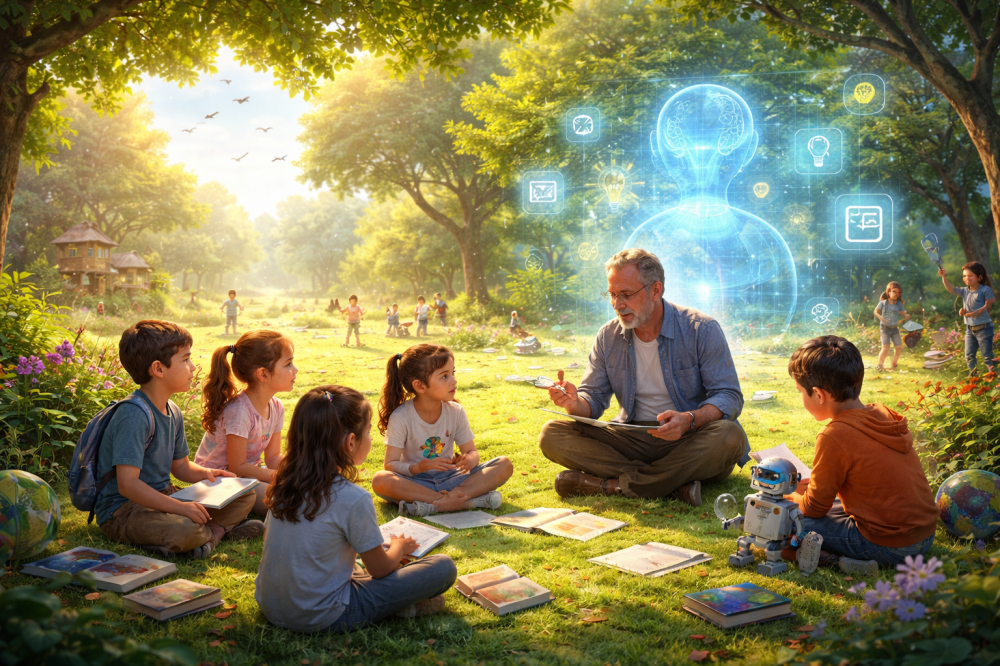





Last week, I shared a personal reflection on the possible impact of AI on the future generation (and my grandchildren). The reflection was based on a vivid dream where I sat in a garden surrounded by my grandchildren, only to realise that whenever a question arose, the immediate response was to consult AI instead of thinking, wondering, or exploring. What got me worried was not the presence of advanced technology (AI per se), but the possibility that the future generations might grow up in a world where their own curiosity and mental effort are quietly replaced by instant answers (and machines).
I wrote about my conversation with my daughter (Daniya), who confirmed that this reality is already happening. Students today use AI for studying, writing, problem-solving and even everyday communication. This may be happening not out of them being lazy, but because it has become normal to some very big extent. As a technologist, I emphasised that my concern is not about resisting innovation. I believe deeply in progress. My worry is about what happens when young minds rely so heavily on intelligent tools that they rarely experience the productive struggle that builds judgment, creativity and resilience. So the question is, “What can we do, and what is our responsibility?”
Protecting future generations does not mean limiting access to technology or creating fear around AI. Instead, it requires intentional guidance by teaching young people and our kids how to live alongside intelligent tools without surrendering their own intelligence.
First, we must teach our kids to think before they use AI. Children should be encouraged to attempt answers, form opinions and challenge problems before turning to AI. Whether in classrooms or at home, we should ask simple questions like, “What do you think?” or “How would you solve it?” This small habit reinforces ownership of thought and builds confidence in their own reasoning.
Second, we should normalise struggle. Today speed and efficiency are celebrated, but learning has never been meant to be easy. Struggling with a math problem, revising an essay multiple times, or figuring something out through trial and error develops “learning” endurance. When AI removes all difficulty, we must consciously reintroduce healthy challenges so our children experience the satisfaction of earning understanding. It should not be about the speed, which can come and be developed with experience later.
Third, we need to teach critical thinking and verification as core life skills. AI can produce convincing answers, but not all answers are correct or even complete. Children should learn to question outputs, compare sources and ask deeper questions. Instead of seeing AI as an authority, they should see it as a collaborator whose suggestions require human judgment as well.
Fourth, if we as parents and/or teachers constantly refer to technology without reflection, our children will do the same. Demonstrating curiosity by reading, discussing ideas, thinking aloud and occasionally choosing to solve problems without digital help sends a powerful signal about the value of independent thought. We need to be role models!
Fifth, we should preserve spaces for imagination. Unstructured play, creative hobbies, storytelling and meaningful conversations will surely help our minds stay fresh (and not depend on AI). I can tell you for a fact that when I was bored, that’s when I ended up creating innovative projects. Protecting time away from constant digital assistance is not a step backward; it is, in fact, an investment in human potential.
To conclude my article this week, let me note that intelligent machines will no doubt shape the future. That is not something to be afraid of. However, a future filled with passive consumers of knowledge and/or creators/inventors that depend entirely on technology is something we must be afraid of. If we guide our children with intention, ie, teaching them to think deeply, question boldly and use technology wisely, we can ensure that the next generation grows up not just with powerful tools but with powerful minds. That’s what our responsibility should be today — to ensure that the future belongs to humans and not machines!
Oman Observer is now on the WhatsApp channel. Click here