




MUSCAT: The recently announced strategic partnership between the Oman Food Capital, the food investment arm of the Oman Investment Authority (OIA), and Brazilian food giant JBS is more than a commercial agreement. It represents a shift in how nations approach food security, now regarded as equally strategic as medicine, energy and political stability and a cornerstone of economic sovereignty, according to one of Oman’s leading food investment experts.
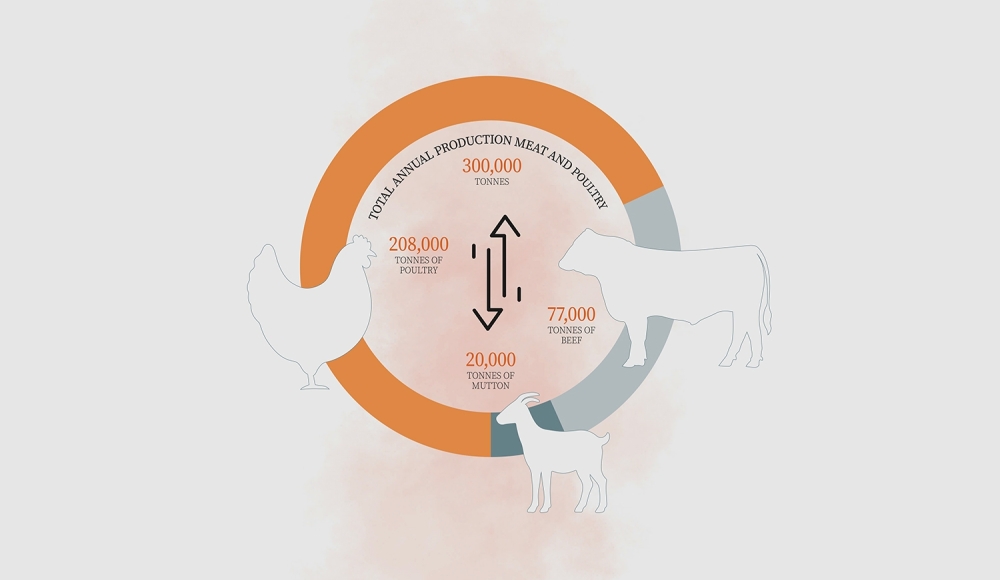
Saleh al Shanfari, Chairman of the Food Security Committee at the Oman Chamber of Commerce and Industry (OCCI), made this observation in a recent post. He was referring to last week’s partnership, which entails an investment of $150 million — equivalent to about RO 57.7 million — aimed at raising the annual production capacity of two key meat and poultry facilities in Oman to 300,000 tonnes. Of this total, 208,000 tonnes of poultry will come from the Ibri plant of A’Namaa Poultry Company, while approximately 77,000 tonnes of beef and 20,000 tonnes of mutton will be produced at the existing facilities of Al Bashayer Meat in Thamrait.
Al Shanfari noted that this production increase would reduce dependence on imports and strengthen the local market with more competitive pricing and higher-quality products. Beyond domestic self-sufficiency, the partnership aims to position Oman as a global export platform for halal food products. Leveraging JBS’s logistics capabilities and worldwide distribution network, Oman could serve as a regional operational base, a hub for high-quality production, and a launchpad for exports to markets across the Middle East, Africa, and Asia. This would place the Sultanate of Oman among key players in a rapidly expanding halal food market.
Technology transfer is another central benefit. As a global leader in food production, JBS’s partnership with national companies such as Al Bashayer and A’Namaa, supported by the OIA, is expected to introduce modern processing, packaging, and livestock-production techniques into Oman. The initiative is also likely to enhance food safety, quality standards, and operational efficiency across current and future facilities. Such investments typically localise knowledge and expertise, fostering broader industry development.
From an economic perspective, the partnership is expected to generate more than 3,000 direct jobs over the next five years across the production chain. The agreement also signals confidence from a major global company in Oman’s investment environment, potentially encouraging other international firms to enter the food sector and strengthening the ecosystem around it.
Al Shanfari highlighted local value creation as a key priority. He argued that the partnership can increase value added within Oman by enhancing integration among companies under the OIA and expanding domestic manufacturing rather than relying on exporting raw materials or importing finished products. This could stimulate downstream industries and foster a wider network of suppliers and services supporting the sector.
Sustainability is also embedded in the partnership’s structure. JBS will hold a majority stake of around 80 per cent in the joint venture, which reduces operational financing pressure on the government while ensuring the national companies operate under a commercially driven management model prioritising profitability and long-term continuity.
Looking ahead, Al Shanfari sees the partnership as a magnet for other global food companies seeking a base in Oman. The Sultanate of Oman’s strategic location along major sea, air, and land routes makes it attractive for firms aiming to serve regional markets efficiently, particularly when a large operator demonstrates that production, cold-chain logistics, and export execution can meet international standards.
At its core, Al Shanfari’s message is that Oman is treating food as a strategic national commodity. The partnership addresses capacity expansion, export ambitions, technology transfer, job creation, deeper local value chains, and financial sustainability through a commercially driven structure. The real test will be whether these goals are translated into on-the-ground results, combining national resilience objectives with the discipline needed to compete in regional and global food markets. Nevertheless, he expressed confidence that the strength and expertise of both the OIA and JBS would ensure all objectives are achieved.
Oman Observer is now on the WhatsApp channel. Click here