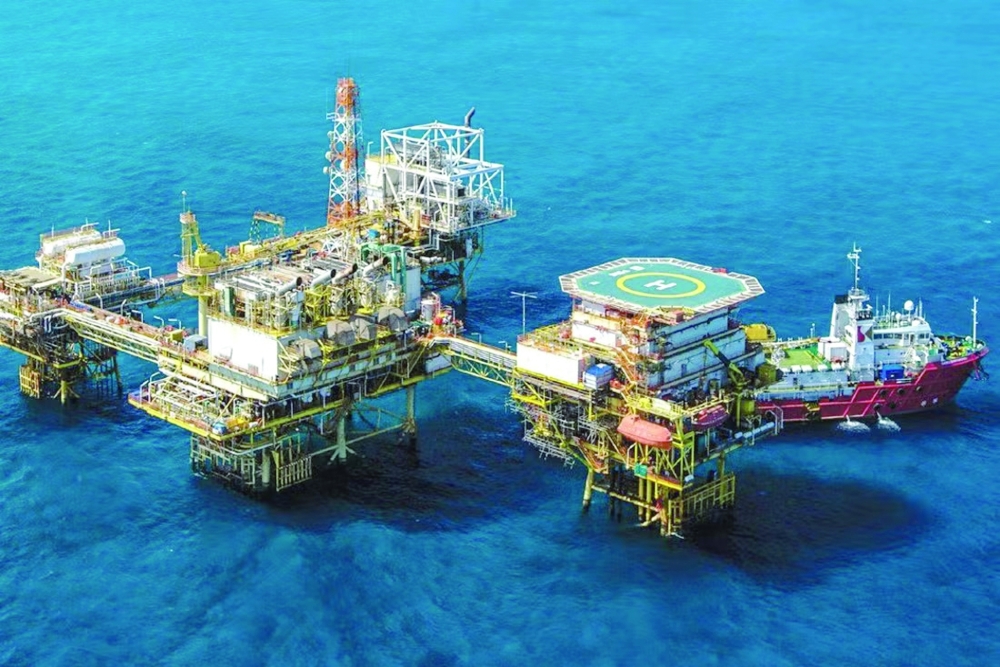





MUSCAT: Last week’s landmark concession agreement between the Ministry of Energy and Minerals and Malaysian state-owned energy giant Petronas to explore hydrocarbons in Block 18 off Oman’s Al Batinah coast marks a major boost for the Sultanate of Oman’s ongoing strategy of attracting international players to unlock and sustain hydrocarbon production — a critical pillar of the national economy.
By bringing in Petronas, Oman gains not only a financially and technically capable partner to develop Block 18’s oil and gas potential but also access to advanced technology and knowledge transfer, given the largely greenfield nature of the concession. A key beneficiary is national upstream group OQ Exploration & Production (OQEP), whose wholly owned Batinah Offshore LLC holds a 30% non-operating interest, while Petronas’ wholly owned subsidiary, PC Oman Ventures Ltd (PCOVL), has a 70% operating stake.
Block 18 is located in the North Sohar Basin, between the Al Batinah Coast and the Makran Accretionary Prism, covering 21,140 sq km with water depths ranging from 30 to 3,000 metres. Approximately 10,000 km of 2D and 2,048 sq km of 3D seismic have already been acquired and three wells drilled by previous operators identified multiple plays. The block was previously operated by Reliance Industries Ltd (via Reliance Exploration and Production DMCC), awarded the concession in 2005. OOCEP held a 30% farm-in interest under a 2009 farm-out agreement. Reliance conducted seismic studies and at least one drilling campaign, but results were not commercially successful and it withdrew in 2011.
Although no commercial discoveries have yet been declared, the new concession agreement is expected to trigger advanced seismic and geophysical surveys, technical studies and exploratory drilling to assess hydrocarbon potential. Success in Block 18 could expand Oman’s offshore production base, which is currently dominated by established onshore and shallow-water fields.
Oman’s offshore track record includes Block 52, a 90,000 sq km deepwater concession awarded in 2017 to Eni, with partners Qatar Petroleum and OOCEP. Eni drilled Oman’s first deepwater well there, but no commercial hydrocarbons were found and by 2024 the operators signaled their intention to relinquish the area.
Block 50 (the Masirah Block), by contrast, remains one of the few offshore successes, with the Yumna Field achieving first oil in February 2020 and producing over 9 million stock tank barrels of oil by end 2024.
Boding well for Block 18’s prospects is Petronas’ strong exploration track record, particularly offshore. Internationally, it has delivered material discoveries in Suriname (Block 52) and is active in deepwater exploration in Suriname’s Guyana Basin (Block 66), where it holds an 80% operating interest under a production-sharing contract and plans multiple exploratory wells.
Ranked among the top 20 largest oil and gas companies globally, Petronas reported $110–115 billion in revenue and over $10 billion net profit in 2025, positioning it as a financially robust NOC capable of pursuing large-scale frontier projects.
Oman Observer is now on the WhatsApp channel. Click here