




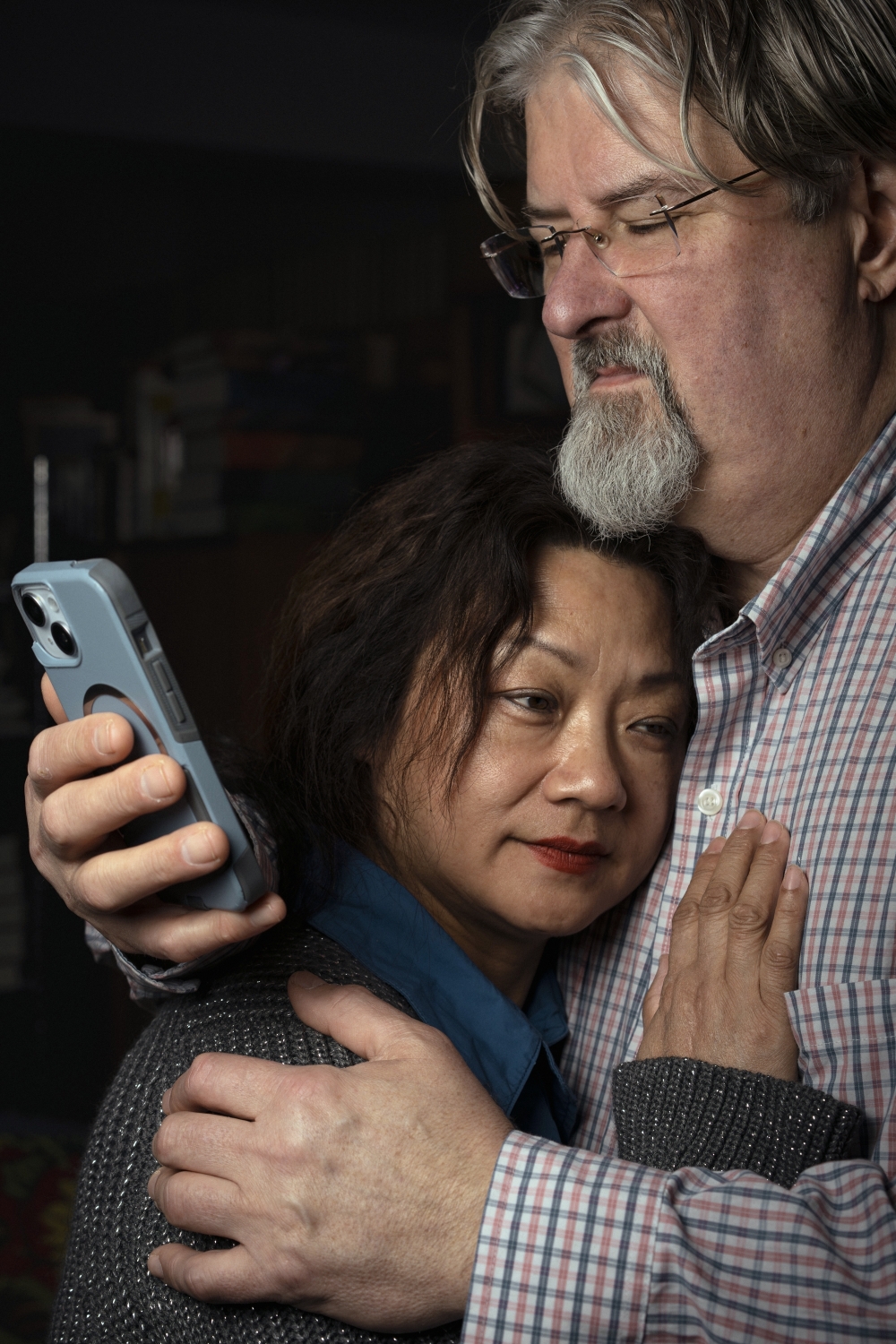
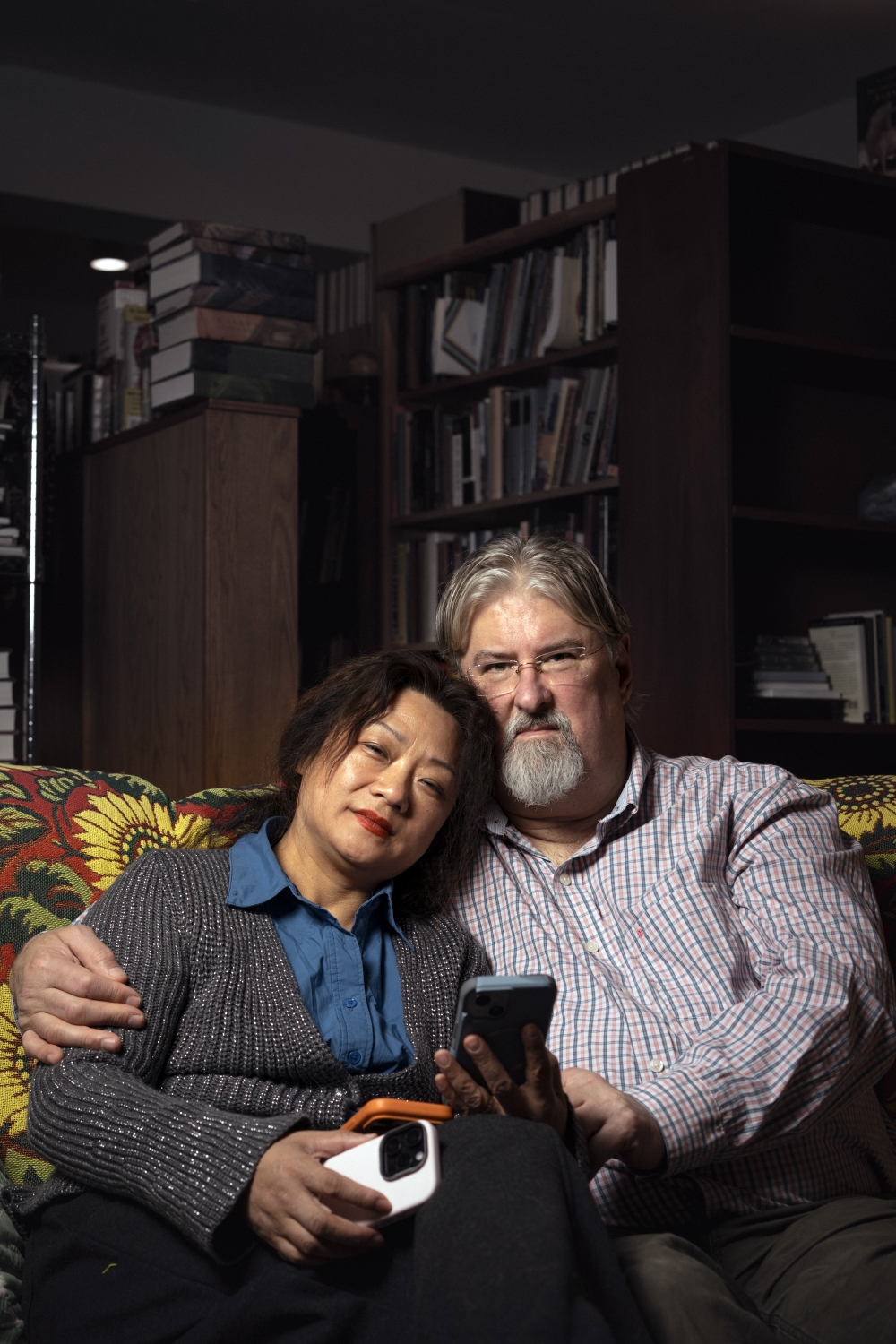
For many spouses, smartphone use is a point of tension. But for David Duda and Hong Liang, a couple in New Haven, Connecticut, the technology is so essential that they own eight external battery packs. If their phones die, so does their ability to communicate.
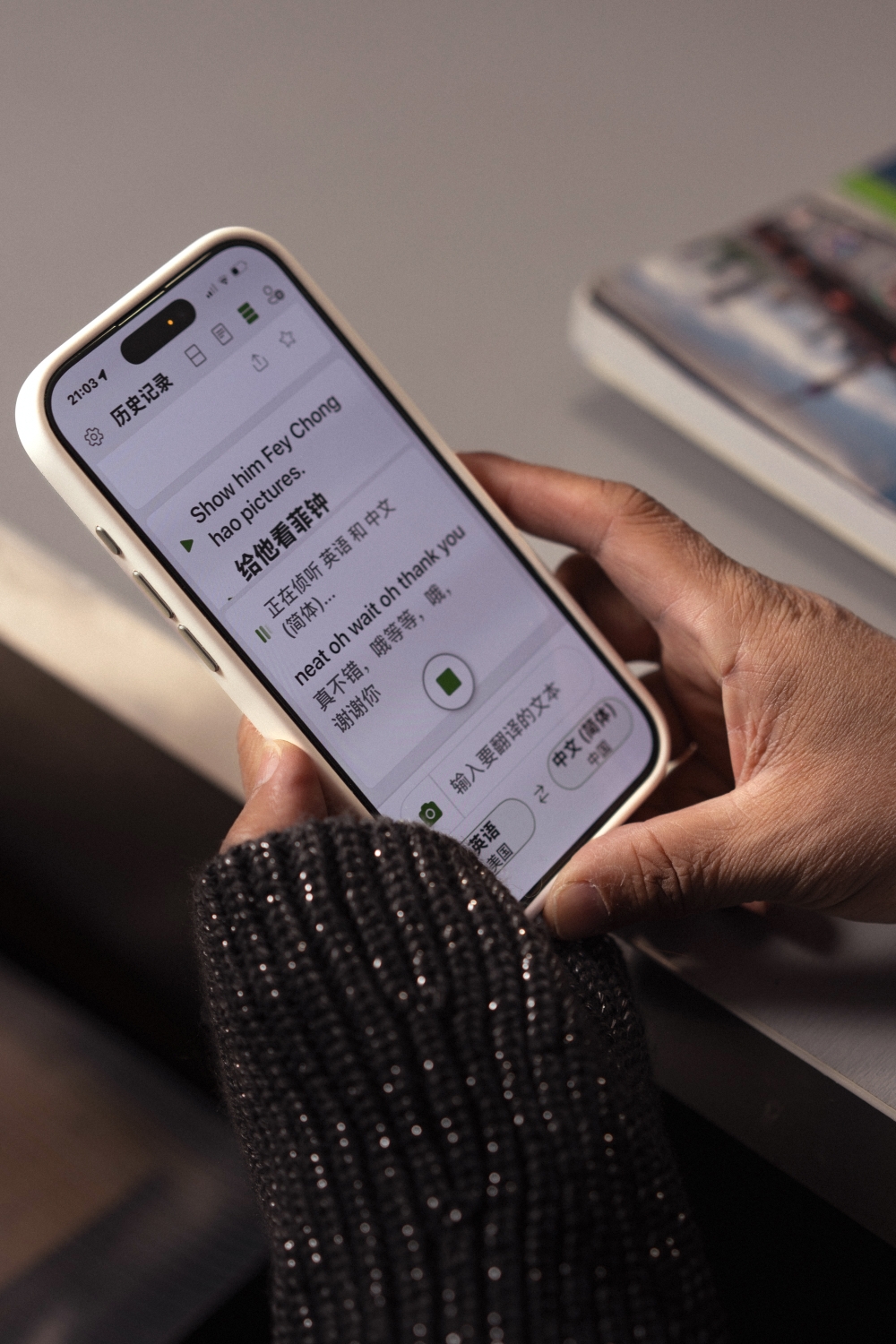
Duda, 62, speaks English, and Liang, 57, speaks Mandarin. They rely on a free smartphone app from Microsoft, called Translator, to render a text translation of what they say — like movie subtitles but for daily life.
Although they have been married for three years, they walked down the street on a recent December afternoon with their arms linked like newlyweds. This was out of necessity as much as affection: One of them chatted and navigated while the other’s eyes were locked on the phone, reading translated remarks.
When Duda told a joke, he held his chortle for a few seconds until Liang was able to read it.
Communicating this way requires close attention. Duda and Liang can’t half listen to each other or walk away while talking. When they want to really connect, they spend hours on the couch or lying in bed, going back and forth until they feel sure they understand what the other has said.
“The translator makes you have to be more in the moment because you’ve got to be reading it and listening,” Duda said. “You have to pay attention more, which obviously is a good thing when you’re relating to your spouse.”
Liang, as translated by a human interpreter from Mandarin, said, “He pays attention to all the details and takes good care of me. He really knows and sees what I need.” (Machine translation: He is very attentive. He thought about everything for me, so I was impressed by a lot of his details.)
Automated translation has advanced enough in recent years that it is being used by people whose attraction transcends fluency, like Duda and Liang, as well as by travelers to foreign lands and by companies hoping to appeal to new markets and audiences.
I used Apple AirPods, which have real-time language translation, as well as Microsoft Translator, to interview Liang. I was able to follow much of what she said, though the delay made the conversation challenging. And there were key misunderstandings, which I learned about only when I later asked a professional interpreter to review our conversation.
The idea of a universal translator has long existed in science fiction. How else could the crew of the Enterprise on “Star Trek” talk to alien species? The real-world versions from Microsoft and other companies can assist with 100 or so of the 7,000 languages spoken globally, seemingly realizing the dream of a world where billions of people can understand one another. Or at least muddle through.
A more intimate relationship sustained with apps seems less fathomable.
Duda and Liang’s conversation started at an opportune time, when technological tools existed to facilitate it, and they had developed the patience to use them.
“It’s kind of fun for us,” Duda said. “If people weren’t in love, it would be much more frustrating.”
Duda and Liang met in Xian, China, in 2019.
Duda’s brother was going there on a work trip, and he tagged along. His brother’s business partner suggested that her friend, Liang, drive Duda around. By the end of the week, Duda was smitten.
“She is the most joyous, happy person you’ll ever meet,” he said. Duda thought there was chemistry between them and tried to kiss Liang goodbye before his departure. Surprised, she turned her cheek.
But she was interested, so after Duda returned to New Haven, where he owns a bookstore, they stayed in touch via WeChat, a Chinese messaging app. They communicated by text in English, with Liang copying and pasting the messages to an English-Chinese translator.
A couple of months after they met, the world shut down because of COVID. Duda and Liang, both divorced with adult children, found themselves isolated. They started messaging each other daily, talking about their personal histories, their marriages, their families. With pandemic restrictions forcing retailers to close, Duda’s work turned to preparing books for online shipment, and he started working at night, which meant he was awake at the same time as Liang.
“We spent the next two years on our phones getting to know each other better,” Duda said.
In 2022, when China relaxed pandemic travel restrictions, Liang booked a one-way flight to the United States. She was nervous: Was everything Duda had said what she understood it to be?
Duda met Liang at the airport holding a sign that said, in Chinese characters, “Love of my life.”
“I was deeply touched, because at the airport, in front of so many people, he did something that touched my heart,” Liang recalled. (Machine translation: “I think this is a very, very romantic thing, and in front of so many people at the airport.”)
The translator could use improvement. I asked Wallace Chen, a professor of Chinese-English translation and interpretation at Middlebury College, to review my conversation with the couple. For simple exchanges, the AI did OK, he said. But it faltered on longer ones.
When Liang’s answers ran long, the speech-to-text transcription would fail to keep up with her, missing words or entire sentences. It was like a phone call where the sound cuts out and results in gibberish.
Chris Wendt, a former group program manager at Microsoft who worked on Translator for two decades, said, “The person speaking needs to verify what they said.”
This means looking at the app while you’re talking, not at the person you’re talking to, to make sure it accurately captures your words.
Duda and Liang know the translator often gets their meaning wrong. They have an expression for when it happens: bu bu hao, pronounced “boo boo how,” a play on a Chinese phrase that means “not good.” When it happens, they try again, or use body language, or pull up a photo on the internet for illustration. Words sometimes fail them, as they do us all.
Within two months of Liang’s arrival, Duda knew he wanted her to stay. During Thanksgiving dinner with his extended family, he got down on one knee and attempted to propose in Chinese.
Liang did not understand his words, but the meaning of the kneeling was clear. They married a month later.
Their lives are not so different from those of other couples: They eat out, go biking, take beach walks and watch shows with Chinese subtitles. (They liked “Ted Lasso.”) But in one way, they might be unusual: In three years of marriage, they have not had a fight. A heated marital spat is often fueled by a rapid exchange of barbs that would be difficult through Translator.
“Maybe the best way to have a lasting marriage is to speak different languages,” Duda joked.
That Duda and Liang were older and divorced when they met has helped their communication, they said. They have experienced how a marriage can go wrong and better understand the workings of a happy one. And they are attentive to body language. Liang said that Duda’s facial expressions and gestures tell her more about his emotions than Translator does.
Anyone who has seen “Love Actually” has an expectation of how this story should have gone: When a couple in that rom-com have chemistry and a language barrier, they both hit the books to become fluent.
Duda is trying to learn basic Mandarin from children’s books and apps like Duolingo. Liang, who works as a masseuse and acupuncturist, took an English class when she arrived in New Haven and uses language learning apps. But they estimate they know only 200 words in the other’s language. Duda said he felt too old to become fluent in a new language.
Duda and Liang say their infatuation for each other makes it work.
“We say that two people are together because they don’t know each other. We want to explore each other’s secrets,” Liang said.
This article originally appeared in The New York Times.
Oman Observer is now on the WhatsApp channel. Click here