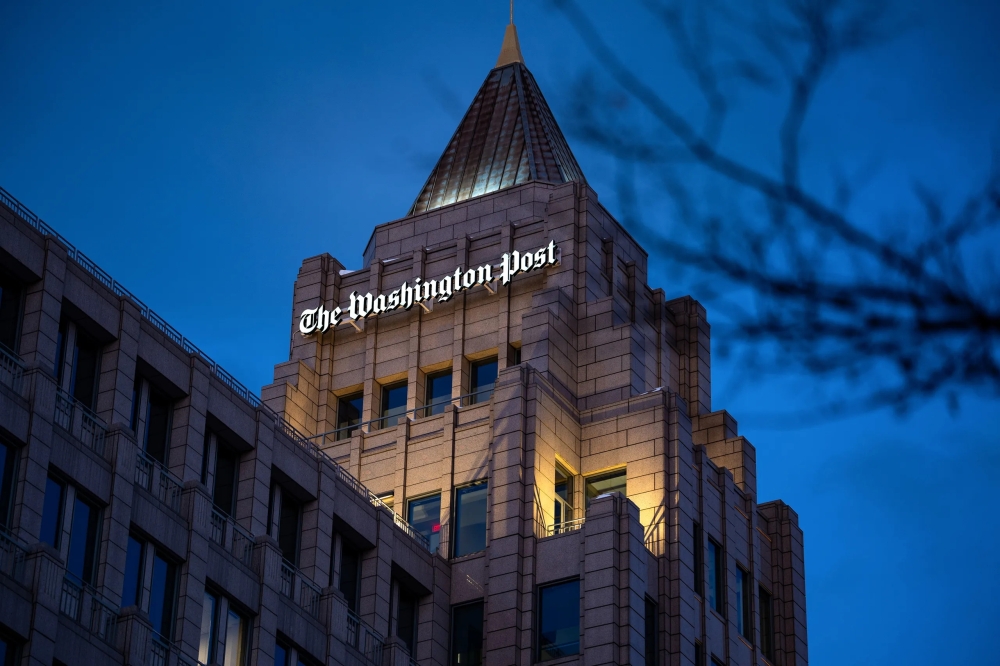





Hovering among the song lyrics, sports scores and movie quotes that clutter up my brain, there are a few key texts that I have committed to memory. The Gettysburg Address, for one. Psalm 23.
And there’s another manifesto rattling around up there, one that I learned some 21 years ago, when I began working at The Washington Post. It is less well known to the world, but no less vital to my worldview.
It is called “The Seven Principles for the Conduct of a Newspaper.”
These principles, about 150 words in total, were the work of Eugene Meyer, the former Federal Reserve chair who bought the Post at auction in 1933 and whose family would run the paper for four generations. On March 5, 1935, the Post’s new owner issued his seven principles, which addressed the newspaper’s mission, its style, its leadership, its independence — in all, its spirit.
Now, The Washington Post is in crisis: Its newsroom is being decimated and its coverage ambitions curtailed, and all this after its proud, tireless journalists were reduced to the indignity of publicly pleading for their jobs, only to be ignored by an unfathomably wealthy owner. I grieve for the Post, and part of my grief is personal. I worked in its newsroom for many years and forged deep friendships there, and, as a longtime resident of the Washington area, I remain a devoted Washington Post reader.
But I also grieve for the ideals and beliefs and priorities that have sustained the institution and that are embodied in Meyer’s principles. They make up the animating ethic of The Washington Post and, to me, of the practice of journalism. And they are at risk.
After Donald Graham, the beloved Post chair (and Meyer’s grandson), sold the Post to Jeff Bezos in 2013 and the newsroom moved to a sleek location on K Street, the Meyer principles followed us there, a reminder of the Post’s culture and traditions. “The values of The Post do not need changing,” Bezos said in a reassuring letter to the Post staff on the day of the announcement — but much else did.
Journalism, I must admit, is a romanticised and self-congratulatory profession. My colleagues and I love to go on about our importance to the survival of the Republic, about our “craft” (that’s what we call reporting, writing and editing) and especially about our past. There is always some golden age of journalism that we look back upon with longing, that we hope to recover and that the best among us so obviously represent.
I realise that pining for the Meyer principles may seem like more wistfulness for bygone times. But what I admire about the list is precisely how straightforward it is, how shorn of embellishment and self-aggrandisement, and, despite its nine decades and counting, how relevant it remains to the goals of modern journalism.
Principle No. 1: The first mission of a newspaper is to tell the truth as nearly as the truth may be ascertained.
Principle No. 2: The newspaper shall tell ALL the truth so far as it can learn it, concerning the important affairs of America and the world.
No “my truth” squishiness here. There is a real truth, and we must tell it; that is the mission of the journalist. But with that zeal comes an inherent humility, captured in the last eight words of the first Meyer principle. Truth is elusive. We may circle around it and get nearer each time, but we may never quite grasp it in full. The findings of journalism are necessarily incomplete, a fact that should inspire our efforts and limit our certainty. There is always more to the story.
Principle No. 3: As a disseminator of the news, the paper shall observe the decencies that are obligatory upon a private gentleman.
Principle No. 4: What it prints shall be fit reading for the young as well as for the old.
When I read the fourth principle, I think of my own children. I did not have kids when I joined the Post; now I have three. Will I make them proud with what I write and how I work? Will my journalism be relevant to their challenges, their lives? That relevance can make something “fit reading,” too.
No. 5: The newspaper’s duty is to its readers and to the public at large, and not to the private interests of its owners.
No. 6: In the pursuit of truth, the newspaper shall be prepared to make sacrifices of its material fortunes, if such a course be necessary for the public good.
Principle No. 7: The newspaper shall not be the ally of any special interest, but shall be fair and free and wholesome in its outlook on public affairs and public men.
Just days before the 2024 presidential election, Bezos chose to cancel a planned endorsement of Kamala Harris, the Democratic nominee. The decision, according to Will Lewis, the Post publisher, was “a statement in support of our readers’ ability to make up their own minds.”
Yes, I suppose one could interpret the move as an affirmation of this final Meyer principle, an effort to keep the paper independent. But that conclusion becomes less tenable given Bezos’ support for President Donald Trump, including a $1 million donation to his inauguration fund, Amazon’s presence among the donors to the White House ballroom project and Bezos’ own prominent perch at Trump’s swearing-in at the Capitol Rotunda on Jan. 20, 2025. Whether out of conviction or convenience, Bezos’ favourable outlook on this one public man is quite clear.
I hope that the Post will endure, even thrive, as a business, but I worry that it may do so at the cost of its essence, its heart, its core. — The New York Times
Carlos Eduardo LozadanThe writer is a Peruvian-American journalist and author
Oman Observer is now on the WhatsApp channel. Click here