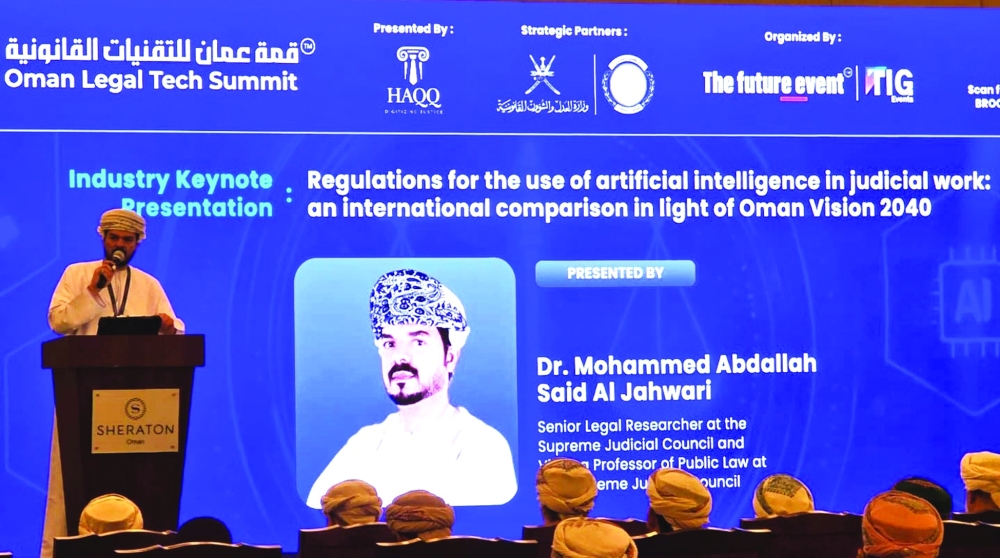





MUSCAT,: As the Sultanate of Oman accelerates its digital transformation under Oman Vision 2040, the integration of Artificial Intelligence (AI) into the judicial system has moved from a futuristic concept to a regulatory priority. This shift took centre stage at the Oman Legal Tech Summit 2026, where industry leaders and policymakers gathered to discuss the delicate balance between technological speed and human justice.
In a keynote presentation titled "Regulations for the Use of Artificial Intelligence in Judicial Work", Dr Mohammed Abdallah Said al Jahwari, Senior Legal Researcher at the Supreme Judicial Council and Visiting Professor of Public Law, provided a comprehensive analysis of how Oman is navigating this "algorithmic frontier". The presentation compared Omani strategies with international frameworks, including Unesco’s 2025 guidelines and the UK’s judicial AI protocols.
THE "SMART JUDGE" DILEMMA
According to Dr Al Jahwari, the core challenge is not the capability of the technology, but its governance. He posed a fundamental question to the delegation of over 500 legal professionals: Can we build a "Smart Judge" that harmonises the speed of a machine with the nuanced wisdom of a human?
"Is AI a foundation for collective efficiency and a power for swift justice, or is it a nightmare of manipulation and legal loopholes?" Dr Al Jahwari remarked during his address.
He emphasised that while AI can drastically improve Oman’s global standing in the AI Government Readiness Index (where Oman currently ranks in the mid-50s), it must not come at the cost of judicial integrity.
ALIGNING WITH OMAN VISION 2040
The summit, presented by Haqq in strategic partnership with the Ministry of Justice and Legal Affairs and the Oman Lawyers Association, underscored that judicial modernisation is a pillar of the national road map. The Supreme Judicial Council’s operational plan (2024–2030) already includes AI-enabled digital libraries and virtual court proceedings.
However, Dr Al Jahwari noted that the current national AI policy issued by the Ministry of Transport, Communications and Information Technology (MoTCIT) is a "general framework". He called for a specialised Judicial Ethical Charter to address the unique risks of the legal sector.
LESSONS FROM GLOBAL MODELS
Dr Al Jahwari highlighted the Unesco 2025 Guidelines, which offer 15 principles for AI in courts, specifically the "Human-in-the-loop" requirement. He also referenced the UK’s updated 2025 judicial guidance, which warns against "AI hallucinations" — statistically probable but factually incorrect information.
"AI is a prediction engine, not a fact engine. It produces words that are likely, not necessarily truths", Dr Al Jahwari cautioned, referencing international cases where AI-generated fake precedents led to sanctions.
THE FUTURE OF HUMAN OVERSIGHT
The keynote concluded with a firm stance on accountability. While AI can assist in case prediction, documentation and judgment drafting, the "Human Character" of the judge remains irreplaceable, particularly in criminal law where context and empathy are paramount.
"The judicial logic must remain protected... the human character of the judge, their understanding of circumstances and nuances, is what prevents the 'logic corruption' that purely mechanical systems might introduce", he stated.
As Oman moves towards the end of its National Programme for AI (2024-2026), the summit's message was clear: Technology will support the judge, but it will not replace the bench.
Oman Observer is now on the WhatsApp channel. Click here