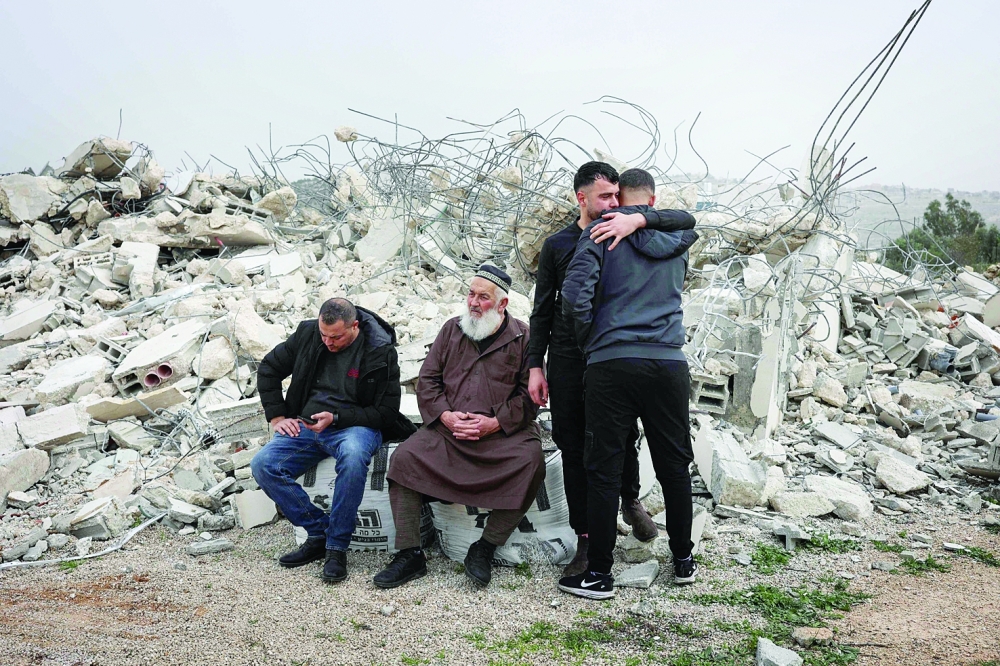





RIYADH: Saudi Arabia and seven other Muslim-majority countries condemned new Israeli measures to tighten control of the West Bank and pave the way for more settlements in the occupied Palestinian territory. Also, the European Union on Monday condemned new Israeli measures to tighten control of the West Bank and pave the way for more settlements in the occupied Palestinian territory. "The European Union condemns recent decisions by Israel's security cabinet to expand Israeli control in the West Bank. This move is another step in the wrong direction," EU spokesman Anouar El Anouni told journalists. Israel approved the measures, announced by Finance Minister Bezalel Smotrich and Defence Minister Israel Katz, on Sunday. They include allowing Israelis to buy West Bank land, a joint statement from the ministers said.
The foreign ministers of Saudi Arabia, Jordan, the UAE, Qatar, Indonesia, Pakistan, Egypt and Türkiye "condemned in the strongest terms the illegal Israeli decisions and measures aimed at imposing unlawful Israeli sovereignty", a Saudi statement said. They are an attempt at "entrenching settlement activity, and enforcing a new legal and administrative reality in the occupied West Bank, thereby accelerating attempts at its illegal annexation and the displacement of the Palestinian people", the foreign ministry statement added.
The Israeli measures also envisage transferring authority over building permits for settlements in parts of Palestinian cities, including Hebron, from the Palestinian Authority's municipalities to Israel. Smotrich said the move was aimed at "deepening our roots in all regions of the Land of Israel and burying the idea of a Palestinian state". The Palestinian presidency in Ramallah, which exercises limited control over some discontiguous areas of the West Bank, also condemned the decision, saying it was aimed at "deepening attempts to annex the occupied West Bank".
The announcement comes days ahead of Israeli Prime Minister Benjamin Netanyahu's visit to the United States, where he is due to meet President Donald Trump, who has upheld US opposition to Israeli annexation of the West Bank. More than 500,000 Israelis live in settlements and outposts in the West Bank, which are illegal under international law. Around three million Palestinians live in the territory. Another 200,000 Israelis live in Israeli-annexed east Jerusalem, which the UN says is part of the Palestinian territories.
Meanwhile, in Gaza, Israel's military said it had killed four Palestinians who attacked its troops as they emerged from a tunnel in southern Gaza, accusing the suspects of a "blatant violation" of the ceasefire. Despite a US-brokered truce entering its second phase last month, violence has continued in the Palestinian territory, with Israel and Hamas trading accusations of ceasefire violations. It said none of its troops had been injured in the attack, which it called a "blatant violation of the ceasefire agreement".
Hamas said in late November that dozens of its fighters were holed up in southern Gaza's tunnels, beneath areas controlled by the Israeli military. This was a sticking point in the early days of the ceasefire, with Israel insisting the militants posed a security threat, while Hamas sought safe passage for them. Since then, many of the fighters have been killed in clashes with Israeli troops during operations targeting tunnels near Rafah, according to the military.
Rafah lies in an area held by Israeli forces following their withdrawal behind a so-called "Yellow Line" under the terms of the US-brokered ceasefire, in effect since October 10. Israeli troops still control more than half of Gaza, while the rest remains under Hamas authority. The Israeli military has in recent weeks launched waves of strikes on Gaza over what it says are violations of the fragile truce. Last Wednesday, Gaza health officials said Israeli air strikes killed 24 people, with Israel's military saying the attacks were in response to one of its officers being wounded by enemy gunfire. — AFP
Oman Observer is now on the WhatsApp channel. Click here