




MUSCAT: The Middle East’s space sector is undergoing a quiet but decisive transformation — from headline-grabbing missions to economically grounded programmes focused on sustainability, private investment and downstream impact.
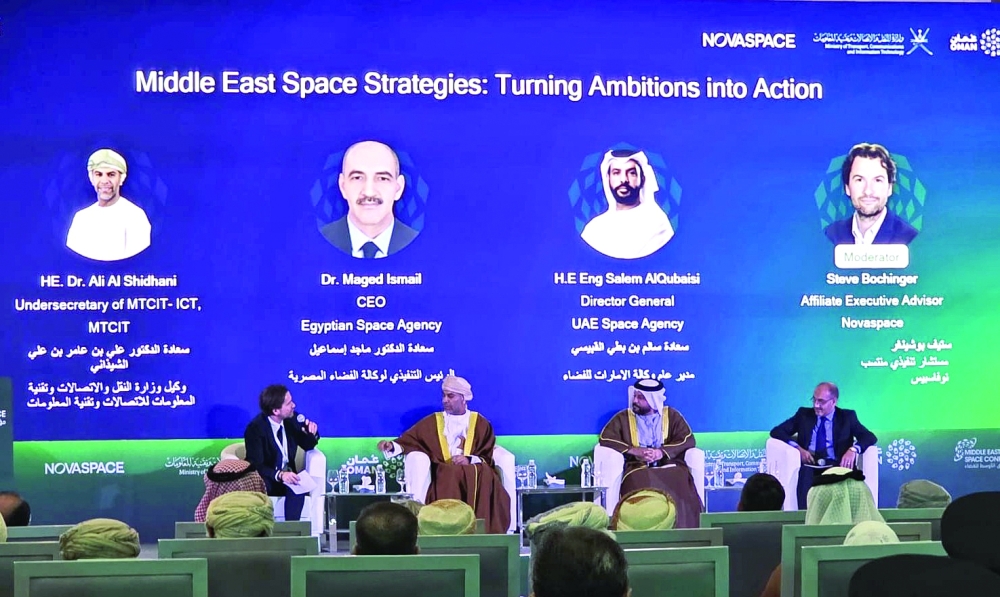
That shift was evident during a high-level panel at the Middle East Space Conference in Muscat, where senior officials from Oman, the UAE and Egypt outlined how regional space strategies are being recalibrated to deliver tangible economic and social returns.
For the UAE, the evolution has been deliberate. Eng Salem Al Qubaisi, Director General of the UAE Space Agency, said the country has moved beyond broad-based support towards a more targeted “new space” approach.
“Our strategy now focuses on enabling innovators, attracting international investors and ensuring that companies can grow — not just survive — within the UAE”, Al Qubaisi said.
Central to this shift is a robust legislative and regulatory framework designed to reduce friction for both start-ups and established players. Licencing processes that once took months have been digitised and compressed, while regular reviews ensure regulations keep pace with technological change.
“The ease of doing business is critical”, he said. “If companies can license, operate and scale quickly, the ecosystem grows naturally”.
The UAE’s investment priorities increasingly lie in Earth observation, geospatial intelligence and downstream applications, particularly those linked to food security, water management and climate resilience. These are areas where space-derived data can directly support national policy goals.
In Egypt, the emphasis has similarly turned towards applied outcomes. Dr Maged Ismail, CEO of the Egyptian Space Agency, highlighted human capital, Earth observation and public-private partnerships as the backbone of Egypt’s space investments.
“Space applications today directly affect economic growth”, Ismail said. “From agriculture to urban planning, the value is no longer theoretical — it is measurable”.
Across the region, one recurring challenge remains: long-term investment discipline. Space programmes require sustained funding, often without immediate financial returns. Convincing governments to maintain year-on-year investment, speakers agreed, depends on demonstrating visible impact.
“When decision-makers see clear outcomes, future investment becomes easier”, Ismail noted.
Another shared priority is human capital development. The UAE’s astronaut programme, for example, has had a demonstrable effect on student interest in science and engineering disciplines.
“Role models matter”, Al Qubaisi said. “When young people see nationals reaching space, it changes aspirations across an entire generation”.
International partnerships were also cited as indispensable. None of the panellists viewed space as a sovereign-only endeavour. Instead, cooperation — whether in technology transfer, joint missions or accelerator programmes — was framed as essential to accelerating regional maturity.
“International cooperation is not optional in space”, said Ismail. “No country can build a complete ecosystem alone”.
Perhaps the most telling signal of change is the region’s growing emphasis on downstream markets — where satellites, data and analytics intersect with real-world demand. This pivot reflects a broader understanding that the future of space in the Middle East will be judged less by launches and more by economic relevance.
As regional programmes mature, the competitive edge will increasingly lie not in ambition alone, but in execution, regulation and the ability to translate orbital assets into ground-level value.
Oman Observer is now on the WhatsApp channel. Click here