




MUSCAT, JAN 5
Non-hydrocarbon revenues — encompassing taxes, levies, fees and other non-oil income streams — continue to trend upward, reflecting the Omani government’s sustained efforts to diversify public revenues away from hydrocarbons.
This momentum is evident in rising collections from Value Added Tax (VAT) and excise taxes, budgeted at RO 735 million in 2026, representing an 8 per cent increase over the 2025 budget estimate of RO 680 million. Corporate Income Tax revenues are also projected to rise, reaching RO 684 million, up 4.3 per cent from RO 656 million in the 2025 budget.
Dividends of RO 800 million from subsidiaries of the Oman Investment Authority (OIA) remain another significant pillar of non-oil revenues, unchanged from the 2025 budget.
A further — albeit initially modest — uplift is expected from 2028, when Oman’s Personal Income Tax (PIT) comes into force. The first such levy in the GCC, PIT will apply primarily to high-earning individuals at a flat rate of 5 per cent on annual incomes exceeding RO 42,000 (approximately $109,000). According to S&P Global Ratings, PIT is expected to generate around RO 80 million in its first year, equivalent to roughly 0.1 per cent of GDP, supplementing existing tax revenues — principally corporate income tax and VAT — which currently account for about 14 per cent of total government revenue.
Fiscal diversification remains a cornerstone of Oman’s economic sustainability strategy, with non-oil revenues recording strong growth over the past five years. Collections increased from approximately RO 2.7 billion in 2020 to RO 3.507 billion in 2024, representing a near-30 per cent rise in absolute terms, driven largely by higher VAT and excise receipts, corporate taxes, government fees and non-tax income such as dividends and service charges.
For FY 2025, non-hydrocarbon revenues are estimated at around RO 3.573 billion, including RO 680 million from VAT and excise taxes, RO 656 million from corporate income tax, RO 800 million in OIA-related dividends and approximately RO 1.4 billion from various government fees.
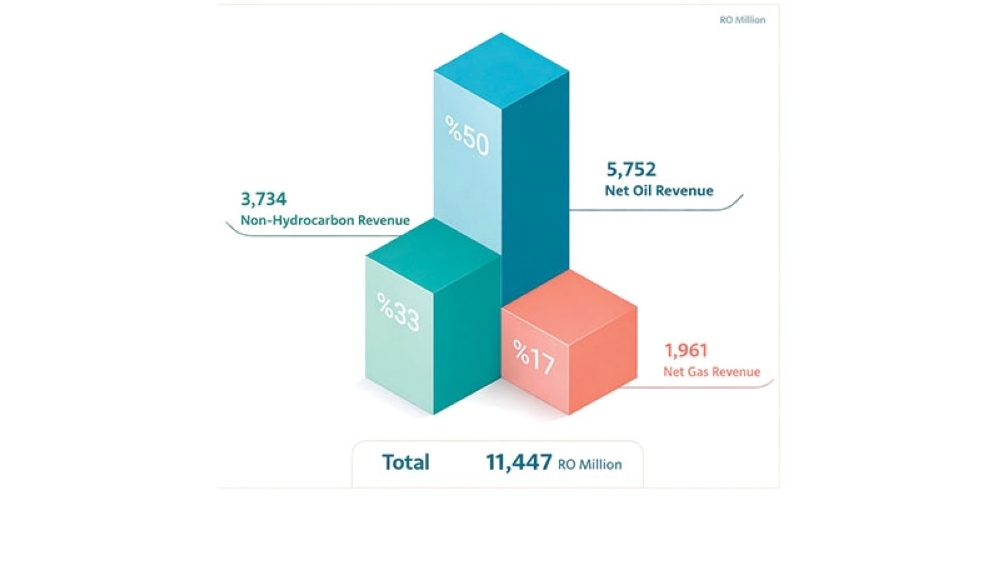
Despite this progress, hydrocarbon revenues continue to dominate Oman’s fiscal structure. In FY 2026, oil and gas revenues are projected to account for 67 per cent of total government revenues, budgeted at RO 7.7 billion, a 1.4 per cent increase compared to the 2025 budget estimate of RO 7.6 billion.
According to KPMG, oil and gas revenues budgeted at RO 7.7 billion for 2026 nevertheless represent a 5.8 per cent decline compared with the 2025 preliminary outturn of RO 8.2 billion, reflecting lower realised oil prices and the accounting of production costs associated with Energy Development Oman and other producers. Oil revenues, estimated at RO 5.7 billion, are down 10.2 per cent from the 2025 preliminary figure of RO 6.4 billion, based on a more conservative assumed average oil price of $60 per barrel, compared with $70 per barrel realised in 2025.
By contrast, gas revenues are budgeted at RO 1.9 billion, marking a 10.4 per cent increase over the 2025 budget estimate of RO 1.7 billion, driven by the signing of 17 new gas sales and purchase agreements and annual increases in gas sale prices. Compared with the 2025 preliminary outturn of RO 1.8 billion, gas revenues are expected to rise by around 10 per cent.
Oman Observer is now on the WhatsApp channel. Click here