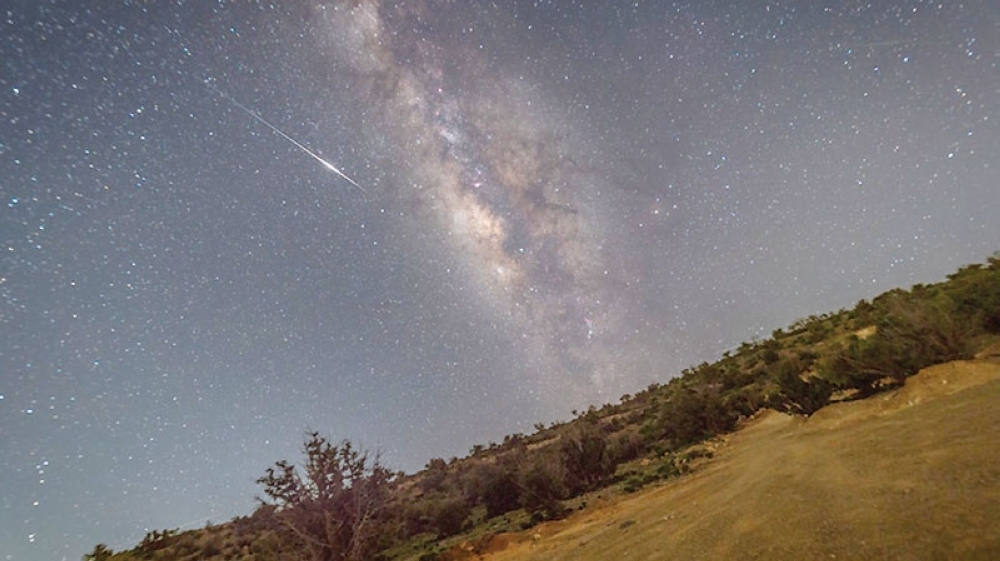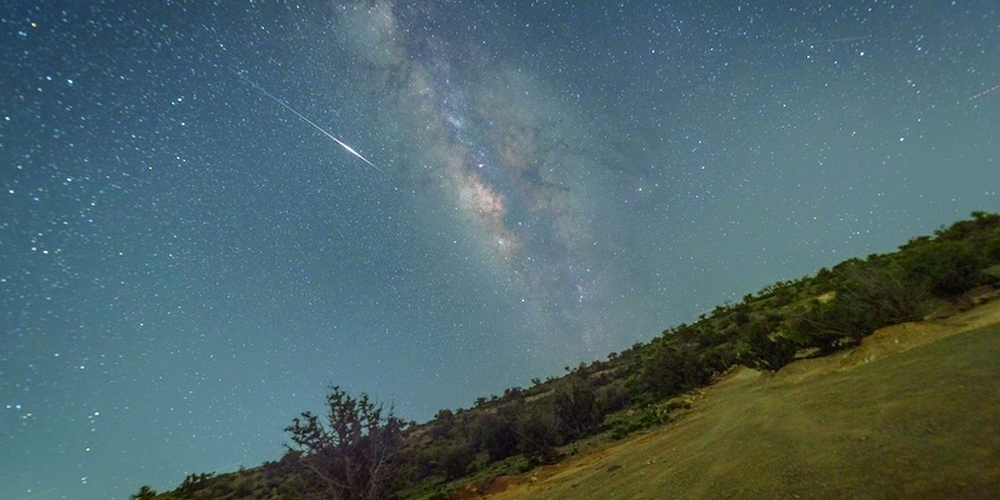





The sky of the Sultanate of Oman will witness from Saturday evening until the dawn of the day Sunday a Quadrantid meteor shower.
One of the most abundant annual meteor showers peaks with the beginning of the new Gregorian year.
The Quadrantid meteor shower is known for its intense activity and short peak period, lasting only a few hours, with the possibility of seeing up to 120 meteors per hour under ideal viewing conditions.
The peak time is between the evening of January 3 and the dawn of January 4.
Quadrantids are linked to the celestial object known as 2003 EH1, a near-Earth object classified astronomically as an asteroid. Its dynamic characteristics indicate that it is likely the remnant of an ancient comet that gradually lost its activity over time.
Discovered in 2003, the object follows a highly elongated orbit around the Sun, completing one cycle approximately every 5.5 years. This orbit exposes it to extreme temperature variations throughout its journey.
Al Hinai noted that the particles associated with the Quadrantid meteor shower are denser and more solid than the debris of many active comets. This explains the shower’s notable brightness and its brief peak, as the dust stream is narrow and highly concentrated.
She added that Quadrantid meteors are characterized by their high speed and striking brightness, often appearing bluish-white in color. Some meteors may leave short-lived smoky trails that persist for a few seconds before fading.
Closet point to the Sun
The Earth will reach its closest point to the Sun in its annual orbit next Saturday, a point known astronomically as perihelion, where the distance between the centers of the Earth and the Sun will be about 147.1 million kilometers, which is equivalent to approximately 0.9833 astronomical units.
Ibrahim bin Mohammed al Mahrouqi, vice chairman of the Board of Directors of the Omani Society for Astronomy and Space, said that this astronomical event is a natural annual phenomenon that occurs at the beginning of January each year, and comes less than two weeks after the winter solstice, as a result of the slight elliptical shape of the Earth’s orbit around the sun, where the Earth’s orbital eccentricity is about 0.0167, which is a slight deviation from a full circle, according to Kepler’s laws that govern the movement of the planets.
He pointed out that the Earth, on the other hand, reaches its farthest point from the sun, known as aphelion, in early July of each year, when the distance is about 152.1 million kilometers, indicating that the difference in distance between aphelion and perihelion is only about 5 million kilometers.
He said that the Earth's proximity to the sun has no relation to the rise in temperature or the succession of seasons, stressing that the real and fundamental reason for the change in climatic seasons is the tilt of the Earth's axis of rotation at an angle estimated at 23.5 degrees relative to the plane of its orbit around the sun, and not the distance between the Earth and the sun.
He explained that the Earth does not revolve around the sun in a straight line, but rather tilts on its axis as it rotates. This tilt causes the angle at which sunlight strikes the Earth's surface to vary throughout the year. In summer, sunlight reaches the Northern Hemisphere more directly, so the sun is higher in the sky, daylight hours are longer, and solar energy is concentrated on a smaller area, resulting in higher temperatures. Conversely, during winter, sunlight reaches the Earth at an angle, so the sun is lower on the horizon, daylight hours are shorter, and solar energy is spread over a larger area and passes through thicker layers of the atmosphere, leading to lower temperatures and a feeling of cold.
He added that the effect of the difference in distance between the Earth and the Sun is limited compared to the effect of the tilt of the axis, as the difference in distance does not exceed about 3% of the general average distance of 149.6 million kilometers.
Also, the slight increase in solar radiation at perihelion, which is estimated at 7%, occurs in winter in the northern hemisphere, and is partially compensated for by the shortening of the winter period as a result of the increase in the speed of the Earth’s movement in its orbit at perihelion according to Kepler’s laws.
He explained that this effect is relatively more apparent in the Southern Hemisphere, where summers are slightly hotter and winters are less cold compared to the Northern Hemisphere, but this difference remains limited and is not comparable to the effect of the tilt of the Earth's axis, which is the decisive factor in the succession of climatic seasons.
Al Mahrouq stressed that such phenomena represent an important opportunity to enhance astronomical awareness, correct common scientific misconceptions, and highlight the accuracy and regularity of the cosmic system that governs the movement of celestial bodies.
Oman Observer is now on the WhatsApp channel. Click here