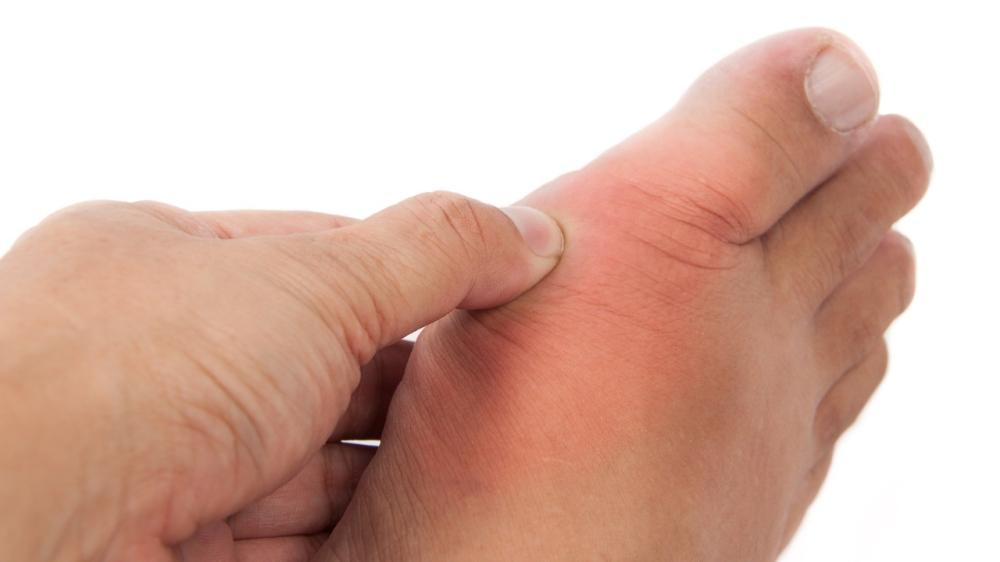





About 13 years ago, Kyle Edmondson woke up after a night of drinking with friends and felt an intense pain on the top of his foot. Climbing out of bed, he could barely walk.
His doctor told Edmondson, then a product designer in his 20s living in Kentucky, that he must have banged it up and advised him to stay off it. The pain subsided after several weeks but kept returning about twice a year. At times, the pain was so severe that he would use crutches around the house and wear construction boots because the slightest touch could be excruciating.
“It kind of makes you want to cut your foot off,” Edmondson said. “It’s like all your joints are full of broken glass.”
About five years later, after an unrelenting series of flare-ups, Edmondson saw a new doctor who diagnosed him with gout.
Globally, gout rates have climbed more than 20% since 1990, rising alongside rates of other chronic conditions like obesity, which can worsen the disease. In the United States, the condition affects more than 12 million people and is up to four times as common in men as in women, whose higher estrogen levels are thought to have a protective effect.
Despite the prevalence of gout, once called the “disease of kings,” it still carries widespread stigmas that it’s only a problem for gluttons or heavy drinkers. Even doctors often emphasize dietary half-measures over proven, long-term treatments: Only about one-third of gout patients receive medication for gout, and among those who do, many are kept on doses too low to be effective.
Because attacks are often triggered by heavy meat or alcohol consumption, the holidays can be a dangerous time for people who leave the condition untreated. We asked experts about gout, how to treat it and what foods, if any, are best for it.
Q: What is gout?
A: Gout is an ancient disease — there’s evidence for it in one T. Rex specimen — but humans have a number of mutations that make us more predisposed to it than your average primate.
The condition is caused by a high level of urate, commonly referred to as uric acid, in the blood. Most of that urate is formed during the breakdown of purine, a chemical found naturally in the body. Some purine also comes from the plants and animals we eat. Red meat and shrimp are relatively high in purines, but it’s also found in high levels in some vegetables like spinach and asparagus.
Normally, the kidneys filter out urate without issue. But in people who develop gout there is too much for the body to handle, so the urate crystallizes and is deposited in the joints, like rocks in a gearbox. Over time this can result in lumps that may erode joints and bones, even though the pain lasts only a few weeks at a time.
“The trigger is dietary exposure, but it’s not the underlying cause,” said Tony Merriman, an epidemiologist at the University of Alabama at Birmingham.
In 2018, Merriman and his colleagues analyzed test results from 16,760 people of European descent and found that the risk of developing gout mostly came down to genetics: A high-purine diet explained less than one-third of 1% of the differences in urate levels, but genetics explained roughly a hundred times more.
Some populations, such as people of Polynesian or Hmong descent, are at higher risk. In addition to obesity, high blood pressure and heart disease are also risk factors, all of which affect how the body controls urate levels.
Q: What is the right way to treat it?
A: There’s no shortage of bad online advice about gout. An analysis of the top 116 TikTok videos about the condition, published this month, found that most emphasized low-purine diets and touted questionable herbal remedies, like chicory and gardenia tea or tart cherry juice concentrate. Only two videos mentioned allopurinol, the first-line medication to lower urate levels in people with gout.
Ivan Haworth, 45, has gout as well as chronic kidney disease and said he followed the cherry juice advice mostly out of desperation. “I was suicidal,” he said. “There were several times where my entire leg and hip would be locked up.”
Haworth, who lives in Knoxville, Tennessee, said it was years before a doctor finally explained the damage gout does and prescribed proper medication.
A single gout attack is typically treated by a primary care physician with over-the-counter painkillers or colchicine, an anti-inflammatory. For people with two or more flare-ups per year or who have developed lumps, called tophi, the American College of Rheumatology advises urate-lowering medication. It also recommends treatment for people with chronic kidney disease or a history of bladder stones.
Finding the right dose takes time, though. Allopurinol must be started at a low dose and then gradually increased over multiple weeks to avoid kidney damage.
Q: What role does diet play?
A: Hyon Choi, director of the Gout and Crystal Arthropathy Center at Harvard Medical School, said that a low-purine diet should be followed only in the short-term by people just starting medication or who are struggling to control their urate levels.
Simply avoiding purines in the long term often means eating more carbohydrates and fat, potentially worsening metabolic health, he said. A diet high in high-fructose corn syrup, for instance, can increase urate levels in the blood. And purine-rich vegetables do not appear to increase a person’s risk of developing gout.
He encourages people with gout to focus on weight loss and adopt diets like the DASH or Mediterranean diet, which are proven to lower blood pressure.
Choi said people taking Ozempic and other GLP-1 weight-loss medications might be better able to control their urate levels, but experts are only beginning to study this.
In addition to taking allopurinol every day for the last eight years, Edmondson has his urate levels tested annually, he said, to make sure he’s not drifting into the danger zone — above 6.8 milligrams per deciliter of blood.
He hasn’t had a flare-up in years, and his reading last month came in at 4.8. “I’d rather not take medication,” he said. “But, you know, the alternative is much worse.”
Oman Observer is now on the WhatsApp channel. Click here