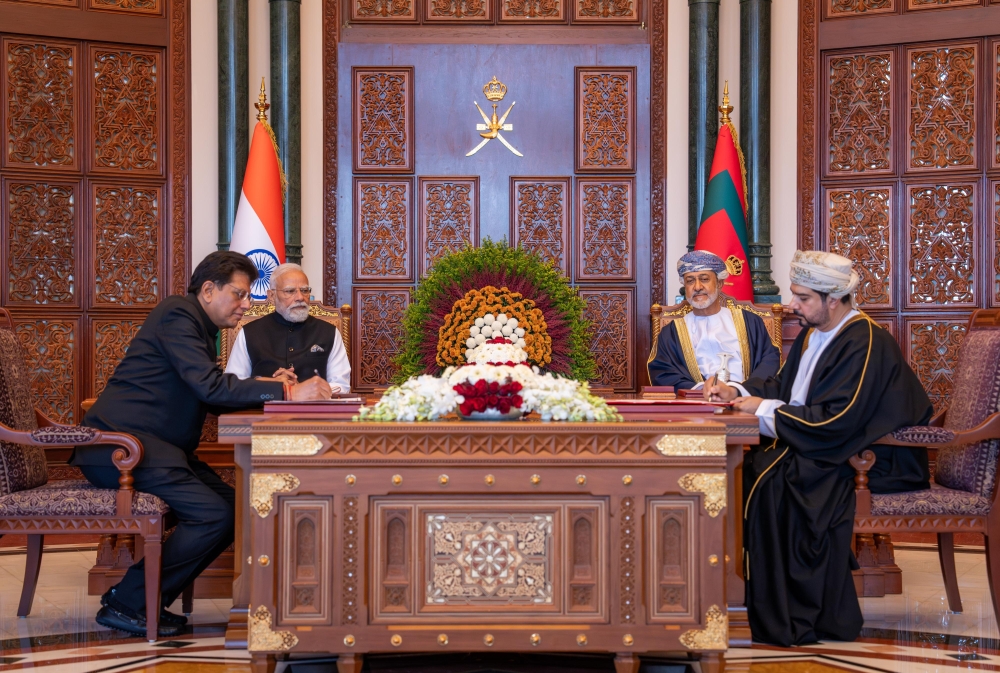





The Ministry of Commerce, Industry and Investment Promotion clarified that the Comprehensive Economic Partnership Agreement (CEPA) between the Sultanate of Oman and the Republic of India embodies the strength of the trade relations between the two friendly countries.
The agreement represents a new milestone in the path of enhancing trade exchange, facilitating access to goods and services, attracting quality investments, in addition to expanding the horizons of cooperation in priority sectors for both sides.
Specialised studies
The ministry stressed that the negotiations were based on specialized studies, including an economic study prepared by Deloitte & Touche commissioned by the ministry, which addressed the expected effects of liberalizing customs duties, export growth and investment expansion, and proved the feasibility of the agreement and its ability to maximize added value within the national economy and enhance the competitiveness of Omani exports in foreign markets.
Custom duties
Reducing customs duties on raw materials imported from India will also provide additional opportunities to reduce production costs within the Sultanate of Oman, support supply chains for manufacturing industries, and enhance the role of the Sultanate of Oman as a trade and logistics hub linking the Gulf countries, the Middle East and the Far East.
Implementation phase
The Ministry of Commerce, Industry and Investment Promotion confirmed that a national rapid intervention team will be formed to follow up on the implementation of the agreement and address any challenges that may face the affected sectors or companies, noting its aspiration to complete the necessary legislative and legal procedures to ratify the agreement in preparation for its entry into force, which will enhance the position of the Sultanate of Oman in the international trade system and support its efforts in building a diversified economy based on added value, competitiveness and sustainable investment.
Negotiation phase
The Ministry explained that the negotiations went through five main rounds that extended between 2023 and 2025, and included discussions of general frameworks, legal and regulatory chapters, technical reviews of rules of origin, health and technical measures, trade facilitation, trade in goods and services, trade remedies, in addition to chapters on cooperation, intellectual property and dispute settlement, and resulted in reaching a balanced final formula that takes into account the interests of both parties and preserves the Gulf and international commitments of the Sultanate of Oman.
Volume of trade
The Ministry of Commerce, Industry and Investment Promotion stated that the volume of trade exchange between the Sultanate of Oman and the Republic of India reached about $7 billion in 2024, which makes India one of the most prominent trading partners of the Sultanate of Oman, especially in the field of non-oil exports, which include polyethylene, urea, gypsum, ethylene and several industrial products related to the petrochemical and metals sectors, and it is expected to witness greater expansion in light of what the agreement provided in terms of advanced preferential access to the Indian market.
The Ministry noted that, under the agreement, the Sultanate of Oman achieved a high level of trade liberalization, reaching 97.4 percent of total Omani goods based on current export volumes, while overall market access to India reached approximately 77.8 percent, with special liberalization for several goods of strategic importance to national industries.
In return, the Sultanate of Oman granted India gradual customs liberalization according to clear timetables, reaching a level of 99.22 percent, in line with national economic objectives and policies to protect local industries.
Agreement chapters
The ministry stated that the agreement includes 16 main chapters and a set of technical annexes, which included regulating trade in goods, national treatment, elimination or reduction of customs duties, import and export procedures, rules of origin, trade remedies, sanitary and technical measures, trade facilitation, in addition to chapters on intellectual property, the movement of natural persons, small and medium enterprises, economic and technical cooperation, as well as a special chapter on trade in services that regulates market access, preferential treatment and transparency requirements.
The ministry stressed that the agreement gave special attention to protecting national industries by including provisions relating to anti-dumping measures, countervailing measures, safeguard measures, and balance of payments protection mechanisms, as well as emphasizing the continued application of national systems related to Omanization, including negative lists and professions restricted to Omanis.
Investments
Regarding mutual investments, the Ministry clarified that the Republic of India is among the top ten investing countries in the Sultanate of Oman, with total foreign direct investments amounting to approximately RO286 million in the first quarter of 2025. These investments include projects in the iron and steel, fertilizer, clean energy, healthcare, and petrochemical sectors, contributing to supporting industrial value chains, enhancing production capacity, and providing job opportunities.
The ministry added that the agreement is expected to contribute to enhancing food and drug security, and supporting cooperation in the fields of agriculture, health, and biotechnology, in addition to digital trade, logistics, mining industries, innovation, space, and tourism, in line with the objectives of “Oman Vision 2040”.
Raw materials
Reducing customs duties on raw materials imported from India will also provide additional opportunities to reduce production costs within the Sultanate of Oman, support supply chains for manufacturing industries, and enhance the role of the Sultanate of Oman as a trade and logistics hub linking the Gulf countries, the Middle East, and the Far East.
Private sector participation
The ministry noted the active participation of the Omani private sector in the various stages of negotiation, through the contributions of a number of major industrial companies, which contributed to shaping a negotiating position that reflects the reality of the market and the opportunities available to national companies in the Indian market.
The Ministry of Commerce, Industry, and Investment Promotion affirmed that the agreement does not conflict with the unified Gulf obligations, nor does it affect the smooth flow of trade between the Gulf Cooperation Council (GCC) countries. It explained that the separation of government procurement was excluded to preserve national legislative sovereignty, and that legal reviews confirmed the agreement’s compliance with the state’s basic law and relevant international laws and agreements.
Economic estimates indicate that the liberalization of customs duties between the two countries will enhance the competitiveness of Omani goods in the Indian market, which previously had an average tariff of approximately 17 percent, a trade barrier that limited the flow of some Omani products. With the agreement's implementation, national companies will gain access to a market exceeding US$17 trillion and a massive consumer base of over 400 million people, thereby boosting opportunities for industrial growth and increased production capacity.
Oman Observer is now on the WhatsApp channel. Click here