




It was another great year for the movies and another horrible, hair-on-fire year for the industry, as each month brought more bummer box-office news. The litany of woes is familiar: There aren’t enough studio releases, moviegoing is overly expensive, people want to stream, whatever. The bigger picture is always more complicated, and it’s worth repeating (again!) that the business, and that avatar known as Hollywood, isn’t synonymous with cinema. As usual, I had a tough time winnowing all the movies I liked down to 10, but here are your reminders that what matters to us moviegoers isn’t the industry’s bottom line but the art.
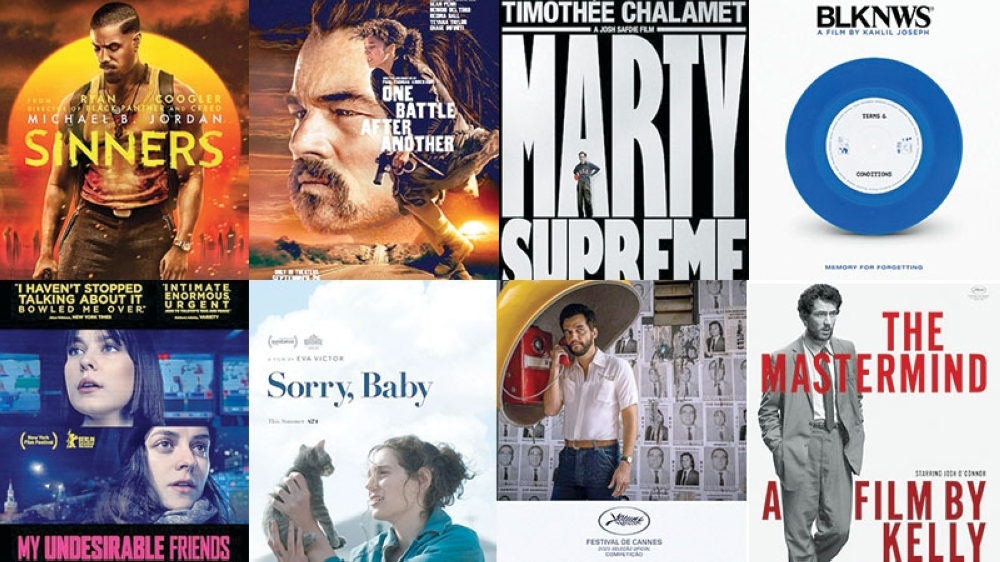
1. ‘Sinners’ (Ryan Coogler)
One of the most exhilarating movies of the year, “Sinners” defies expectation at every turn. Set largely in Jim Crow Mississippi in the 1930s, it draws from different genres for a uniquely American horror story about race and resistance, art and community that’s anchored by twins (both played by Michael B. Jordan) whose world is threatened by white vampirism. If the big studios want a sustainable future, they need to make room for more filmmakers like Coogler.
2. ‘One Battle After Another’ (Paul Thomas Anderson)
As American as apple pie and anti-authoritarianism, Anderson’s carnivalesque film opens on a ragtag group of would-be revolutionaries (among them Teyana Taylor’s dynamo) liberating migrants from a detention center. The shock of that scene reverberates throughout this beautifully directed and acted film, which narrows on one burnout member (Leonardo DiCaprio). Roused to action, he stumbles out of his cannabis-infused stupor like the ghost of radicalism past for yet another battle, one that others have been fighting — and will fight — far better.
3. ‘Marty Supreme’ (Josh Safdie)
From the minute this picaresque opens, Safdie rarely takes his foot off the gas. It opens on the Lower East Side in the early 1950s, where a Jewish shoe clerk — a sensational Timothée Chalamet — nurses grandiose dreams and hatches endless schemes. A story of an American outsider-striver, the movie evokes the likes of Saul Bellow’s “The Adventures of Augie March” and Budd Schulberg’s “What Makes Sammy Run?” but is also a Safdie movie through and through. I’ll have more to say about it when it opens Dec. 25.
4. ‘It Was Just an Accident’ (Jafar Panahi)
An allegory that takes place on and off the road, Panahi’s latest centers on a group of men and women deciding the fate of a man one of them took captive. They believe that the hostage may be their former prison guard, a sadist in service to the regime. As they drive in and around Tehran, they bond and bicker, and travel onto political and philosophical terrain. Panahi, who’s served time in prison for running afoul of the Iranian government, drew from his experiences and those of other inmates for this slow-boiling ethical thriller about action and inaction.
5. ‘BLKNWS: Terms & Conditions’ (Kahlil Joseph)
Intimate and sweeping, intellectually exciting and formally audacious, Joseph’s essay movie takes as its point of departure “Africana,” an encyclopedia of Africa and people of African descent edited by Kwame Anthony Appiah and Henry Louis Gates Jr., which was inspired by a project that W.E.B. Du Bois began before his death in 1963. For his mind-expanding meditation on Black lives, identities and experiences, Joseph deploys a dizzying mix of new and archival material, traverses centuries and continents, invents new worlds and showcases thinkers like Saidiya Hartman. It’s a trip!
6. ‘My Undesirable Friends: Part I — Last Air in Moscow’ (Julia Loktev)
Don’t let the five-hour-plus running time put you off this collective portrait of journalists, mostly women, who have committed themselves to reporting the truth about President Vladimir V. Putin’s Russia in the face of escalating, government threats. Loktev began making the movie in 2021, the year the government started cracking down on journalists as “foreign agents,” and she continued as Russia invaded Ukraine. She shot the movie on an iPhone (she has a very good eye), which deepens the movie’s intimacy.
7. ‘Sorry, Baby’ (Eva Victor)
Victor takes the lead in her emotionally delicate, tragicomic feature directing debut. She plays a professor, Agnes, who lives in a cozy house not far from the small New England college where she teaches and where, years earlier, her life indelibly changed. An exploration of trauma that evades the usual tidy clichés of many trauma stories, “Sorry, Baby” is a portrait of a woman groping toward making peace with the past as she finds her place in the present.
8. ‘The Secret Agent’ (Kleber Mendonça Filho)
When Marcelo (Wagner Moura) rolls up to fill the tank of his Volkswagen Beetle at a gas station, he immediately blanches at the corpse rotting nearby. Flies are buzzing and stray dogs soon come running even as the police pass it by. Set in 1977 during the Brazilian dictatorship — “a period of great mischief,” as the movie coyly puts it — Mendonça Filho’s latest follows Marcelo as he goes into a hiding in this surprising, adamantly non-formulaic escapade.
9. ‘Caught by the Tides’ (Jia Zhangke)
In this sui generis hybrid, Jia joins the story of a woman with that of China itself and a mix of fiction and nonfiction film and video that he began shooting more than 20 years ago. Using the lovelorn Qiaoqiao (played by Zhao Tao, the filmmaker’s wife) as his narrative through line, Jia relays a twinned story of an individual and a country that’s by turns melancholic and hopeful, and insistently grounded in the material world. Betrayed by her petty criminal boyfriend, Qiaoqiao never utters a word; she doesn’t need to. Like Jia’s own penetrating gaze, her lapidary expressiveness speaks volumes about the seismic changes affecting the reality around her.
10. ‘The Mastermind’ (Kelly Reichardt)
What do we owe one another is the question that movingly hangs over Reichardt’s subtle portrait of a family man turned petty criminal and fugitive (a low-key, heroically unheroic Josh O’Connor). Set in 1970, it opens with O’Connor’s J.B. scoping out the small, regional museum that he and some colleagues will soon rob. Despite their comically amateurish bumbling, the thieves manage to successfully (miraculously!) steal a small number of abstract paintings. Their ostensible triumph proves short-lived and finally beside the point in a movie that quietly and steadily shifts into an ethical reckoning about the harms of individualism in the face of urgent collective need.
Oman Observer is now on the WhatsApp channel. Click here