




MUSCAT, DEC 16
Nama Water Services (NWS) is reinforcing operational efficiency and system resilience across a total installed water production capacity of approximately 1.41 million cubic metres per day, supported by a comprehensive operations and maintenance (O&M) programme spanning water and wastewater infrastructure nationwide. The scale of capacity under management positions O&M performance as a central pillar in sustaining water security, service reliability and cost efficiency. The update was presented by Yousuf al Siyabi during the Water Majlis 2025 organised by the Oman-German Friendship Association (OGFA), in collaboration with Nama Water Services, with support from the German Water Partnership and IntercityHotel Muscat.
The Water Majlis 2025 was held under the auspices of HH Sayyid Tarik bin Shabib al Said, Chairman of OGFA and brought together senior government officials, utilities and private-sector stakeholders to examine operational performance and investment priorities in Oman’s water sector. NWS’s presentation highlighted how disciplined O&M execution underpins the effective utilisation of national water production capacity.
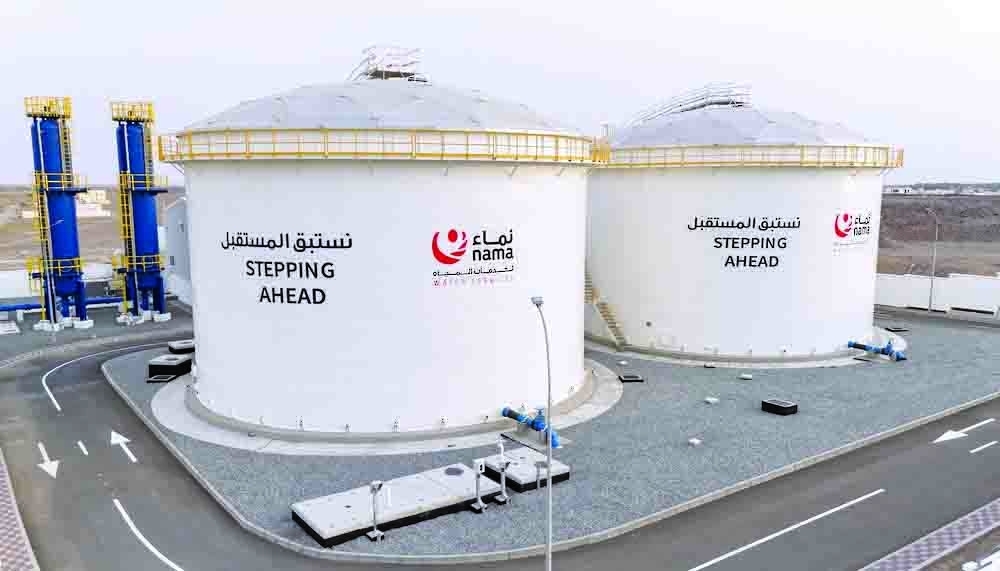
According to the data shared, the 1.41 million m³/day capacity is supported by 61 desalination plants, alongside 115 pumping stations, 922 reservoirs and tanks, 475 tanker filling stations and 865 wells. These assets form the backbone of Oman’s potable water supply and require continuous monitoring and preventive maintenance to ensure uninterrupted operations.
Delivering this capacity to end users is a nationwide network extending more than 26,200 kilometres, including 4,135 km of transmission pipelines and 17,250 km of distribution lines. The system is structured into 416 district metred areas (DMAs), enabling tighter pressure management, improved monitoring and more targeted operational interventions.
NWS currently serves approximately 754,000 water customers and 226,000 wastewater customers, reflecting the breadth of service coverage across urban centres and remote communities. On the wastewater side, the company operates 58 sewage treatment plants, 78 pumping and lifting stations, nearly 4,900 km of sewer networks, treated effluent infrastructure and a composting facility. In total, NWS manages more than 2,400 operational assets, underscoring the complexity of its O&M mandate.
The company’s O&M framework is built around five strategic pillars: operational efficiency, non-revenue water reduction, SCADA and automation, systems resilience and water quality management. Priority initiatives include performance-based contracts, energy optimisation, pressure management, asset rehabilitation, condition monitoring and technical workforce development. Field teams are equipped with advanced technologies such as correlators, noise loggers, flow and pressure data loggers, helium gas detectors and specialised software to support rapid fault detection and repair.
Digital integration plays a central role in maximising the value of installed capacity. Platforms including SCADA, GIS, AMR, CMMS and Qlik Sense feed into real-time performance dashboards and automated technical reporting, supporting faster response times, improved customer service and more informed maintenance planning. This integrated approach has contributed to steady performance improvements, with water losses declining from 47 per cent in 2021 to around 33 per cent by 2024–2025.
NWS has set clear efficiency milestones to further optimise its 1.41 million m³/day capacity, targeting water losses of 21 per cent by 2030 and 10 per cent by 2040. The trajectory highlights how robust O&M practices are becoming a cornerstone of Oman’s long-term water resilience and infrastructure sustainability.
Oman Observer is now on the WhatsApp channel. Click here