





Italy’s government has proposed an amendment to the 2026 budget law stating that the gold held by the Bank of Italy “belongs to the Italian people”, rather than to the “state”. The line might seem harmless — who would claim otherwise? — yet it has triggered a flurry of anxious speculation, as well as calls from the European Central Bank to drop the provision.
Legally, the amendment is meaningless. The ownership and governance of the gold reserves on the Italian central bank’s balance sheet are already precisely defined. The Bank of Italy is fully integrated into the European System of Central Banks (ESCB), which is governed by European Union Treaties, the Statute of the ESCB and Italian law. These frameworks both guarantee the operational independence of member states’ central banks and prevent national governments from appropriating monetary reserves. In other words, with or without the new amendment, Italy could not use its gold reserves to finance public spending or reduce debt unless the ECB consented, which it would not.
But in the eurozone’s evolving institutional context, symbolic gestures carry political weight. Italy’s ruling party appears increasingly to be aligning itself with the nationalist worldview espoused by US President Donald Trump’s administration, including in its latest National Security Strategy (NSS), which depicts the EU as a blight on “political liberty and sovereignty”. By declaring that the gold “belongs to the people”, Italy’s government is sending a message to voters who regard the euro as an externally imposed constraint and the ECB as insufficiently accountable: the EU does not own us and the nation still comes first.
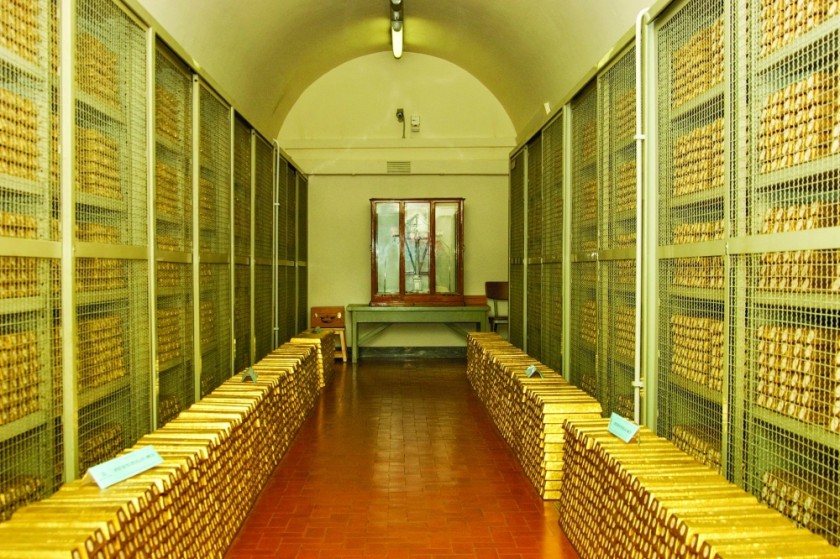
The message certainly resonates. Italy has long romanticised its substantial gold reserves — the world’s third largest, totalling 2,452 metric tonnes — as a kind of sovereignty backstop. For a state that has long struggled with fiscal fragility, the idea that a hidden asset is capable of guaranteeing autonomy and independence in times of crisis is politically potent.
As long as Italy is a member of the eurozone, this fantasy will clash with operational reality. Whenever Italian politicians have suggested using gold to reduce debt or backstop the economy, they have run up against treaty-based limits. But if Italy were to leave the eurozone, whether on its own or amidst a broader fragmentation, the country’s gold reserves would anchor a new national currency, serve as collateral to stabilise financial markets and become a symbol of restored economic sovereignty.
This might be the point of the budget law amendment: to gesture towards a future where gold could backstop Italy’s sovereignty — still an extremely remote possibility — without provoking institutional confrontation. Why hint, however faintly, at such a future? And why now? Three possible explanations stand out.
The first is that the amendment is a domestic political manoeuvre. Italy’s ruling coalition, led by Prime Minister Giorgia Meloni, includes parties with longstanding Euroskeptic tendencies. As Italy enters a period of tense negotiations over fiscal rules, budget targets and access to EU recovery funds, a nod to national sovereignty is a cost-free way to ease internal pressures, without altering Italy’s policy commitments.
Second, the amendment might be meant to send a subtle message to European officials. Italy remains a large, systemically important eurozone member and its economic stability is tied to that of the monetary union. By highlighting its substantial gold reserves, the government might be seeking to remind the EU institutions and the ECB that fiscal negotiations should account for political realities. In a system that depends on mutual trust, symbolic gestures can be a form of bargaining.
Finally, Italy might be hedging its bets in a rapidly shifting geopolitical environment. Meloni has taken a noticeably warmer stance towards Trump than most other European leaders, who resent his lack of commitment to the transatlantic alliance and concerted efforts to deepen Europe’s strategic uncertainty. With the budget law amendment, perhaps Meloni is seeking to ensure that hers is viewed as one of the “patriotic European parties” whose “growing influence” is touted by the Trump administration’s NSS.
None of this means that Italy is contemplating an exit from the euro — an economically disastrous proposition. Nonetheless, Italy’s indulgence of nationalist narratives and assertions of monetary autonomy might carry higher costs than Meloni’s government seems to recognise.
By underscoring the people’s ownership of Italy’s gold reserves, the government is essentially highlighting its contingency plan for a major crisis — in particular, a eurozone exit or breakup. At a time of weak growth, geopolitical upheaval, strategic uncertainty and declining confidence in European institutions, that is the last thing the eurozone needs. After all, a monetary union is held together as much by political commitments as by legal frameworks. Casting doubt on those commitments, even subtly, can shake its foundations.
Italy’s gold remains safely locked away in its central bank’s vaults. But Europe would be unwise to dismiss narratives that can generate considerable uncertainty about whether it will stay there. — Copyright: Project Syndicate, 2025.
Oman Observer is now on the WhatsApp channel. Click here


