




For the past three decades, as China’s economy has developed into a global powerhouse, investment has grown reliably each year.
That is about to change. This year, China’s investments in assets like new factories, public infrastructure and housing are expected to fall for the first time since the late 1980s, ushering in a more conservative era for an economy that has reshaped the global order with years of robust growth.
The shift also signals that investing in China is no longer a surefire bet, even as Beijing continues to project confidence with economic growth estimates of 5%. But, as is often the case with the country’s economic data, the investment slump has raised more questions than answers.
A real estate crisis in China has dragged on for five years with no end in sight, sapping the strength from one of the economy’s pillars. Local governments, strapped for cash because of the property downturn, are not pouring money into infrastructure projects as they did during previous periods of economic malaise. Beijing’s crackdown on excessive competition among Chinese manufacturers has chilled the climate for capital investment to fuel expansion.
From January to October, a broad measure called fixed-asset investment has fallen 1.7% from the same period last year. The slide began in the second half of this year and accelerated with a sharp, double-digit decline in October. Analysts believe that investment dipped again in November, with that data scheduled to be released Monday.
Investment in property, infrastructure and manufacturing — the three major components that make up the figure — are all declining at the same time. In the past, a downturn in one area was offset by spending in another segment. It is rare for all three pillars of investment to fall at once. The government typically has stepped in to manage downturns by bolstering real estate or spending lavishly on infrastructure. China has been reluctant to act boldly this year to help.
“This is a historically significant change,” said Dan Wang, a director on Eurasia Group’s China team. “This is a different style of managing the economy in the short term.”
Wang said that this more passive approach suggests Chinese leaders are confident in the continued strength of exports, which have fueled a record trade surplus despite rising protectionism and growing global concern about the flood of inexpensive Chinese goods.
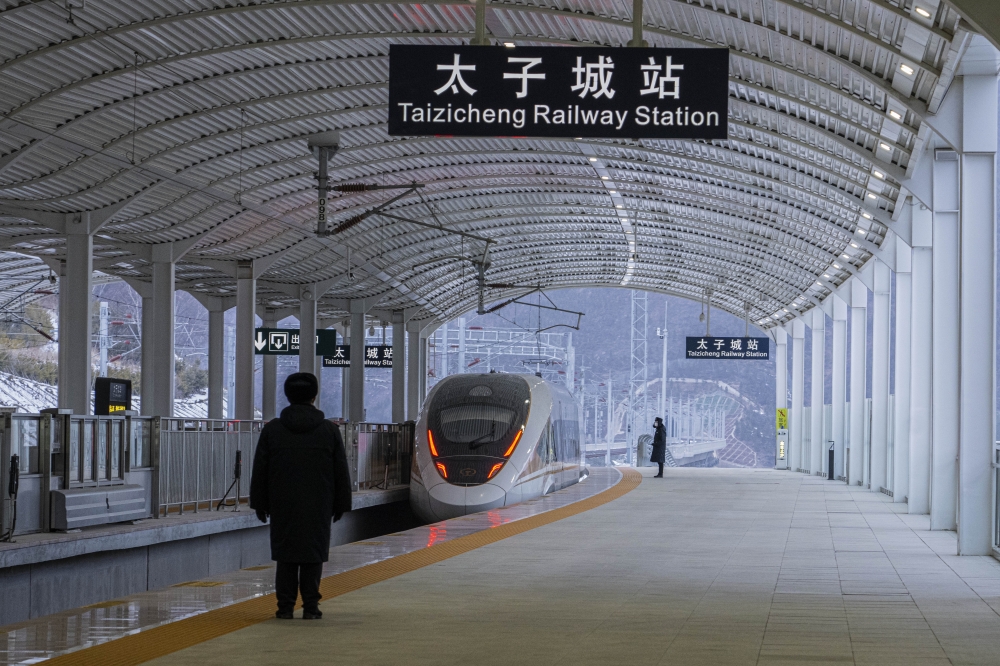
Instead of pumping money into the economy by building more airports and high-speed railroad stations, highways and bridges, local governments are holding back. And for the property sector, there has been no industrywide bailout or comprehensive plan to spur real estate investment.
The investment drought is playing out urgently in the boardrooms of China Vanke, one of the country’s largest property developers, which is now teetering on the edge of possible financial collapse.
Vanke, unable to pay its debts, has leaned on its top shareholder, the state-owned firm Shenzhen Metro, to cover its debt obligations. But last month it asked bondholders to delay repayment of a bond for the first time, signaling that state financial support may have reached its limit. A deadline on some of its debt looms on Monday, and Vanke may need creditors to accept a delay in getting paid.
Chinese officials have started to show some alarm at the plunge in investment, which was listed as a policy priority for 2026 in a plan announced on Thursday by Xi Jinping, China’s top leader.
The deep problems in the property sector — too many apartments and long-running drops in their value — have shaken business confidence.
Chien Ting-tsai, who has run a manufacturing and real estate development company in Zhuhai, a city in southern China, for more than three decades, said customers are not expanding their businesses now because the economy is weak. He said the pipeline of design contracts has thinned dramatically.
“Some manufacturers have shut down factories and frozen all investment in new facilities,” said Chien, 69, who is from Taiwan and has worked in China since the 1990s. “Everyone is frantically selling off fixed assets because they’re uncertain about the future.”
Pam Jiang, a sales assistant at Fashiontex International Limited, a textile company with roughly 150 employees in Jiangsu province, one of China’s main fabric manufacturing hubs, said the domestic textile industry is pulling back on investments in facilities.
“The textile industry in China is basically stagnant and downsizing,” she said.
She attributed the drop in investment to rising labor costs and uncertainty about tariffs. Instead of expanding domestically, Jiang said, many Chinese textile manufacturers are investing abroad in countries such as Vietnam and Egypt.
The slowdown in manufacturing investment has coincided with the government’s campaign against involution, a term for the ruthless competition in which Chinese companies wage profit-eroding price wars to gain market share and outlast rivals. Provincial or city governments have often fueled such races to the bottom by providing incentives and support to foster local champions. This produced an oversupply of well-funded companies, each ready to add more products than customers want to buy.
But some economists say China’s efforts to slow that process down have given local governments permission to hold back on throwing money at manufacturing.
(BEGIN OPTIONAL TRIM.)
Jeremy Smith, a research analyst at Rhodium Group’s China practice, said he believes local governments might be taking China’s cue. He noted that fixed-asset investment has declined in nearly all of China’s provinces and prefectural-level cities since May.
The downturn in investment numbers, he said, more accurately reflects what Rhodium had suspected following the collapse of the property sector.
Rhodium has reported that China’s investment activity likely fell in 2023 and 2024, based on other economic signals, such as credit growth. Due mainly to slower investment, Rhodium estimated that China’s economic growth was between 2.4% and 2.8% last year, well short of the government’s official figure of 5%.
“Declining investment is more the norm than the exception,” Smith said.
On the one hand, he said, China seeks to project an image of economic resilience. At the same time, it aims to demonstrate that it is curbing the harmful competition plaguing many of its industries.
A slump does not bode well for China’s economic growth, as investment accounts for a significant share of gross domestic product. Yet the broader measure of investment China uses to calculate GDP rose in the third quarter despite the sharp decline in fixed-asset investment, leaving economists scrambling for how to explain the discrepancy.
In a November report, Goldman Sachs said it does not expect fixed-asset investment to weigh on economic growth because the decline is “overstated.” The investment bank said that most of the downturn is “a statistical correction of previously overreported data” rather than a genuine slowdown.
Last month, Fu Linghui, the spokesperson and chief economist of China’s National Bureau of Statistics, attributed the decline to a “complex and severe external environment” and “fierce domestic competition” that has hurt investment returns and dragged down corporate profitability.
He noted, however, that investment in high-tech industries such as green energy and aerospace is growing rapidly, a sign that overall investment might be slowing but is also “optimizing.”
(END OPTIONAL TRIM.)
Economic Daily, a Chinese state-owned newspaper, said in November that the country has entered into a new, high-quality phase of development, echoing official talking points. It accused foreign media of seizing on the investment stall to sensationalize a “crisis theory” about the Chinese economy.
This article originally appeared in The New York Times.
Oman Observer is now on the WhatsApp channel. Click here