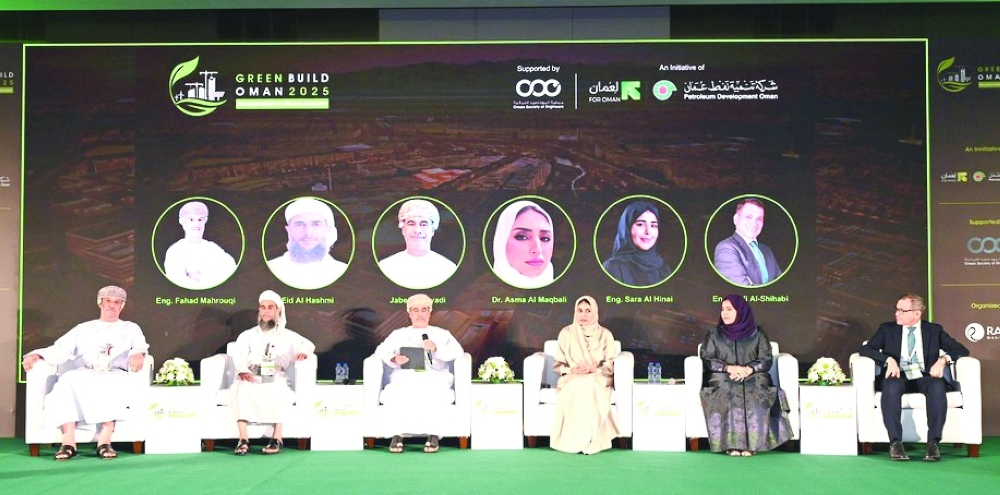





MUSCAT: The Sultanate of Oman is tightening its approach to building design, materials and sustainability as part of a staged effort to decarbonise the built environment, industry speakers said this week. The move combines new minimum standards with targeted research and financing incentives to drive retrofits, material innovation and better project execution across public and private sectors. In a panel discussion during the Green Build Oman Summit, panellists outlined how the new measures will be trialled, financed and scaled.
Speakers emphasised that the country’s built stock — more than 80% of which already exists — must be central to any credible net-zero pathway. Dr Asma al Maqbali, Energy Efficiency Project Manager, OmanNet Zero Centre, told delegates the centre’s road map begins by closing a regulatory gap: energy-efficiency codes for new buildings are now a cornerstone, but the immediate priority is retrofitting existing government buildings. “We will implement it to have a saving of 26% of these buildings”, she said, outlining a phased government retrofit programme intended to demonstrate savings and inform broader roll-out.
The Ministry of Housing and Urban Planning intends a cautious two-year voluntary trial of the code provisions, targeting projects linked to the ministry to test feasibility and market fit before full enforcement. Eng Sara al Hinai, Urban Project Engineer, Ministry of Housing and Urban Planning, said the code sets minimums — for fire, structural and energy performance — rather than the highest possible standards, saying the intention is to avoid abrupt cost shocks to developers. That balance is key: officials expect energy-efficiency investments to pay back within a few years for many building types.
Material choices and construction practices emerged as a central theme. Eng Fadi al Shihabi, Partner — Sustainability Solutions Lead, KPMG Middle East, highlighted the long-term nature of building materials and the financing upside of green certification: “If we don’t select the right material, it will last 400 years plus”, he warned, adding that banks and institutional investors increasingly favour certified sustainable projects and offer better financing terms. Panellists argued that green certification not only reduces lifecycle emissions but improves bankability and lowers financing costs.
Concrete, soil and backfill proved to be concrete examples of emissions reduction opportunities. Eng Eid al Hashmi, Civil Discipline CFDH (Cooperate Function Discipline Head), Petroleum Development Oman (PDO), described R&D and standard revisions that relaxed backfill requirements in challenging areas, cutting transport distances and trips — a measure that directly reduces fuel use and CO₂. He also noted a surprising result from local testing: elimination of a thin concrete coating in certain applications could reduce annual costs substantially.
Beyond regulations and materials, speakers stressed the need for appliance standards, behavioural awareness and electrification. Residential units account for a large share of energy demand; plans include tougher efficiency standards for HVAC, lighting and domestic appliances and incentives to electrify cooking to free gas for higher-value uses while lowering household bills.
The summit underscored that Oman’s approach is multidimensional: combine minimum codes, phased trials, targeted R&D, financing incentives and public awareness to accelerate decarbonisation without undermining affordability. With pilot outcomes due during the voluntary period, policymakers and developers will be watching whether the proposed measures deliver the promised cost savings and emissions reductions — and whether green finance appetite grows to match the country’s sustainability ambitions.
Oman Observer is now on the WhatsApp channel. Click here