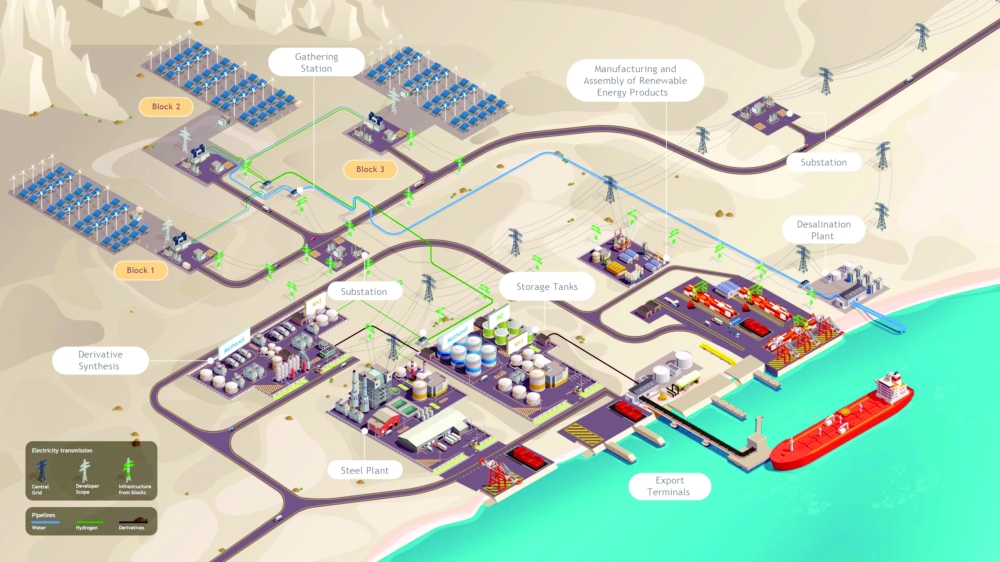





MUSCAT: Oman Electricity Transmission Company (OETC), the operator of the Sultanate of Oman’s power transmission system, has announced that it has been tasked by the authorities with undertaking the Front-End Engineering Design (FEED) of shared transmission assets envisaged as part of the Common User Infrastructure (CUI) supporting Oman’s giga-scale green hydrogen industry.
The majority state-owned utility noted in the latest issue of its Omangrid bulletin that it was assigned this responsibility by the Green Hydrogen Infrastructure Steering Committee, which oversees the delivery of the CUI underpinning a sizable portfolio of green hydrogen projects distributed across the Al Wusta and Dhofar Governorates.
To date, nine major projects awarded through Hydrom — the architect of Oman’s green hydrogen sector — collectively target annual production of around 1.4 million tonnes of green molecules by 2030, supported by up to 35 gigawatts of renewable generation capacity. According to OETC, integrating these large-scale projects into the traditional transmission network presents a fundamental challenge.
“Estimates indicate that 95% of the energy produced will be consumed directly at production sites, while only 5% will be fed into the grid. This unconventional distribution requires OETC to reimagine its planning strategies, infrastructure and technical support”, the utility — part of the Nama Group — stated.
Dr Rashid al Badwawi, General Manager of Green Hydrogen Projects Support, underscored OETC’s role as the national champion for electricity transmission within the government’s common-infrastructure programme for hydrogen.
“Green hydrogen is not just an alternative fuel; it is a driver of comprehensive transformation in the energy sector. We are committed to developing the infrastructure and operational capabilities needed to support this shift, despite the challenges, because we strongly believe in the tremendous opportunities the future holds”, he said.
To this end, OETC is adopting advanced technological solutions — including automation systems, digital asset management and storage technologies — to ensure grid stability given the intermittent nature of renewable energy sources, he added.
“These efforts align with the Ministry of Energy and Minerals’ policies to strengthen the hydrogen economy and achieve sustainability goals. OETC’s role remains essential not only in building a flexible transmission network, but also in shaping the future frameworks of energy distribution in Oman and the wider region”, Dr Al Badwawi noted.
Beyond OETC, several other Omani utilities will play key roles in developing the Common User Infrastructure for the hydrogen sector. OQ Gas Networks (OQGN), the operator of the national gas transmission system, has been assigned responsibility for the hydrogen pipeline network that will transport hydrogen from production sites to ports or export hubs.
Nama Water Services, the national water utility, will handle the desalinated and ultrapure water supply infrastructure required at hydrogen production zones — a critical input for electrolysis-based green hydrogen production.
Hydrom is coordinating with OETC, OQGN, Nama Water Services and other stakeholders in developing the CUI. It manages land allocation, leads the setup of the infrastructure company (provisionally “InfraCo”) and liaises with hydrogen project developers.
A shared, state-backed common infrastructure — managed by national utilities — significantly lowers entry barriers for developers and accelerates the growth of Oman’s hydrogen industry.
Oman Observer is now on the WhatsApp channel. Click here