




It also aims to build national capabilities in the fields of space and future technologies.
Airbus Defence and Space is the defence and space systems subsidiary of Airbus. Formed in 2014 during the restructuring of the European Aeronautic Defence and Space Company, the predecessor of Airbus.
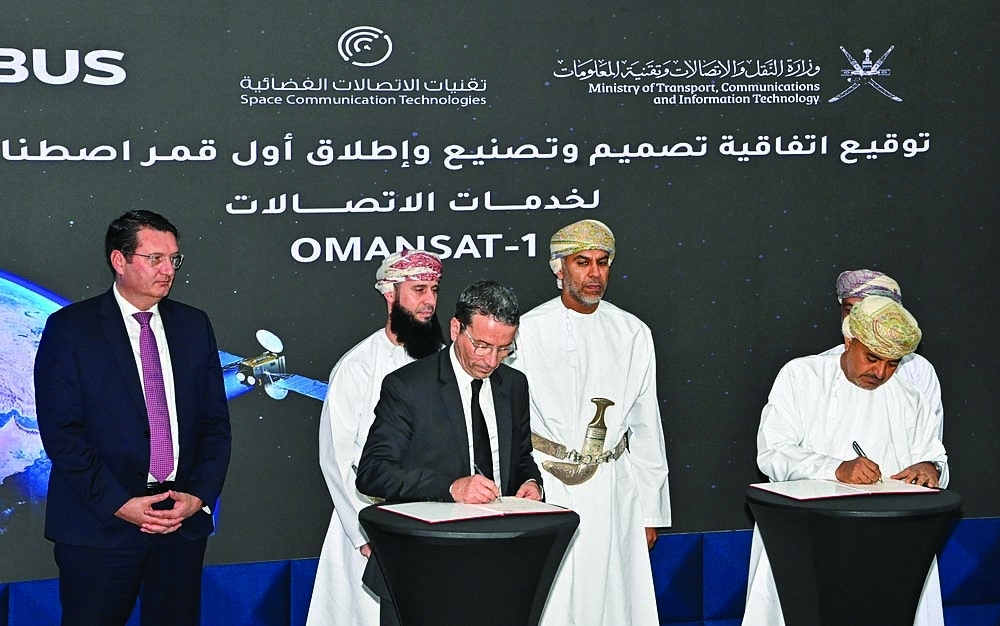
The Ministry of Transport, Communications, and Information Technology signed the cooperation agreement with Airbus to launch OmanSat-1, which was signed between Engineer Saeed bin Hamoud al Maawali, Minister of Transport, Communications, and Information Technology, and Alain Fauré, CEO of Airbus Space Systems.
Airbus will design “OmanSat-1” with high capacity in the Ka frequency band, and it will cover the Sultanate of Oman, including its economic waters, in addition to the Middle East, East Africa, and the Asia region. It will be based on Airbus’ OneSat platform and will feature full digital flexibility for reconfiguration while in orbit.
Under the agreement, the Ministry entrusted the operation of the project to Space Communications Technologies, a company owned by the Oman Investment Authority (OIA).
Space Communications Technologies will serve as the national operator of the project after launch and as the executive arm during the design and manufacturing phases.
To ensure optimal project management and alignment with various stakeholders, the Ministry established a Project Management and Follow-up Office within the company. This office will be responsible for the administrative and technical oversight of the project and will ensure the readiness of the satellite's operational infrastructure. Furthermore, it will develop a comprehensive operational system in the Sultanate of Oman to manage the satellite and provide services to government and private institutions after launch.
Al Maawali said said, “The project aims to enhance the digital sovereignty of the Sultanate of Oman by possessing a national space infrastructure capable of providing communications and data services independently and securely, which enhances the level of national information security, supports the continuity of vital services in various circumstances, and contributes to expanding coverage in rural areas and improving the quality of communications and internet services, in line with the digital transformation and consistent with the pillars of Oman Vision 2040.”
He said that the project is considered a major contributor to the transfer and localization of technical knowledge, as it includes intensive programs to train and qualify Omani personnel in all stages of the project, from design to manufacturing, testing, and operation, so that the project will be managed and operated with complete Omani efficiency after launch.
It also includes enabling local companies, especially small and medium-sized enterprises, to participate in the supply chain related to the project, in order to achieve the concept of local added value and enhance the role of the private sector in the national space economy system. In addition, the project aims to enable the scientific research and development system through the partnership between local universities and Airbus Defence and Space.”
Dr. Ali bin Amer al Shidhani, Undersecretary of the Ministry of Transport, Communications and Information Technology for Communications and Information Technology and Head of the Project Negotiation Team, said that the project represents a qualitative leap in the Sultanate of Oman’s journey towards technological and space empowerment. It reflects the government’s commitment to building a sustainable digital economy based on knowledge and technology, which will develop the national communications system to serve various vital sectors and support digital transformation efforts and smart services.” He emphasized the importance of the national role of the Space Communications Technologies Company as the national operator and executive arm of the project, ensuring the highest levels of efficiency, knowledge transfer, and national capacity building in this vital field.
He said the project represents the culmination of intensive national efforts that have continued for several years in studying and evaluating the optimal technical and engineering options for designing, manufacturing, and launching the Omani satellite, stressing that cooperation with Airbus ensures effective institutional integration between governmental, investment, and private entities to achieve the national vision for space and communications.
Fauré expressed his delight at signing a contract to supply the Sultanate of Oman with world-class, fully flexible space communications capabilities through its first geostationary satellite, and emphasized their work alongside the space communications company to support the implementation of its national satellite program and build its sovereign capabilities to serve its customers in the future.
Dr. Saud bin Humaid al Shuaili, chairman of the National Space Program and Head of the Project Implementation Management and Follow-up Office, said, “The project is one of the most important strategic initiatives in implementing the National Space Policy (2023-2033), which aspires to make the Sultanate of Oman the regional gateway for space services and technologies, enabling economic diversification and opening up future opportunities,” to enhance the contribution of this sector to the gross domestic product and expand the scope of national space services.
Al Shuaili added, “This project is integrated with the Ministry’s initiatives to enable and develop the space sector in partnership with the local private sector in the areas of launching satellites from the port of Duqm through the “Launch” program, national capacity-building programs to maximize the use of space services, the Oman Space Accelerators program, and geographic data and Earth observation projects, which constitute an integrated system to support and enable the space economy in the Sultanate of Oman.”
“We are proud of the trust of the MTCIT and the OIA in entrusting us with the responsibility of operating and managing this national project, as this project represents a major turning point in the history of satellite communications in the Sultanate of Oman, and we will work in cooperation with our partners at Airbus to implement the project according to the highest international standards,” said Engineer Salem bin Saeed Al-Alawi, CEO of Space Communications Technologies Company.
Engineer Salem Al-Alawi added, “Through this project, we aim to build a purely Omani operational system, managed by qualified national hands, enabling the Sultanate of Oman to provide advanced and secure communications services. He explained that the company will manage the latest software-defined satellite with full flexibility and high capacity in the Ka band, which will enable the company to provide competitive services to various targeted sectors.”
Oman Observer is now on the WhatsApp channel. Click here