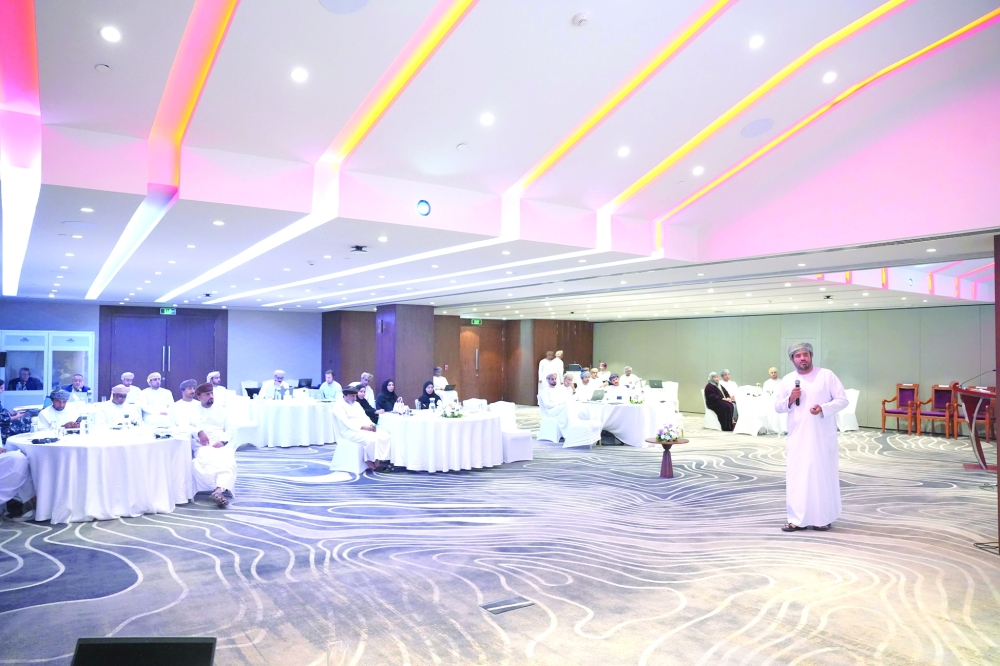





The General Federation of Oman Workers (GFOW), in cooperation with the International Labour Organization (ILO), concluded a training programme titled “Evidence-Based Policymaking for Decent Work,” held from 9 to 13 November 2025 under the patronage of Dr. Khalifa Abdullah al Barwani, CEO of the National Centre for Statistics and Information.
The programme aimed to strengthen trade union representatives’ capacities to use data, research, and analysis in shaping labour policies that promote a balanced, sustainable, and inclusive labour market. Participants were also equipped with practical tools to engage more effectively in social dialogue, collaborate with tripartite partners, and contribute to policymaking that aligns with Oman’s national development objectives.
Throughout the five-day programme, experts from the ILO, GFOW, and other stakeholders led sessions covering the ILO’s Decent Work Agenda, evidence-based policymaking principles, mapping and analysis of Oman’s labour market, identification and use of worker-centric data, and transforming research findings into actionable policy recommendations. The discussions also focused on strategies for unions to enhance negotiation capacities and influence policies that address the real needs of workers and enterprises.
Jasim al Maliki, Director General of GFOW, emphasized: “This programme embodies our vision to advance trade union work through analysis grounded in evidence. Collecting accurate information, understanding key indicators, and applying scientific approaches are essential for unions to adopt impactful negotiating positions. Modern policymaking must rely on reliable data, not estimation, to ensure effective and sustainable decisions.” Mustafa Said, Workers’ Activities Advisor at the ILO Regional Office for Arab States, noted that evidence-based policies build trust among tripartite partners, strengthen transparency, and improve the quality of decisions affecting workers, employers, and the broader labour market.
In parallel, GFOW and the ILO conducted a workshop addressing challenges in representing women, youth, and non-Omani workers in private sector institutions.
Oman Observer is now on the WhatsApp channel. Click here