


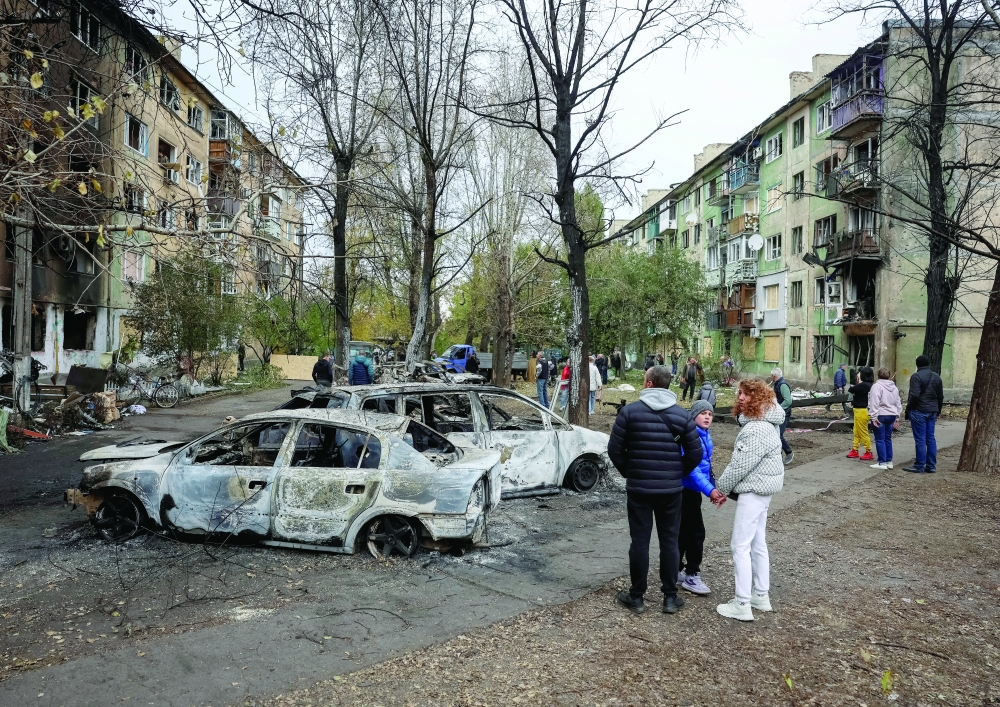





KYIV: Ukrainian President Volodymyr Zelensky has said he would be ready to join Russian President Vladimir Putin and US counterpart Donald Trump at their summit in Hungary if he is invited. Trump and Putin said they would meet in the Hungarian capital, possibly in a matter of weeks, as the US leader continues to try to broker a peace deal to end the three-and-a-half-year war, triggered by Russia's 2022 attack. "If I am invited to Budapest — if it is an invitation in a format where we meet as three or, as it's called, shuttle diplomacy, President Trump meets with Putin and President Trump meets with me — then in one format or another, we will agree," Zelensky told reporters in remarks released on Monday.
The Ukrainian president criticised the choice of Hungary, which has a terse relationship with Kyiv and is seen as the most Kremlin-sympathetic member of the European Union. "I do not believe that a prime minister who blocks Ukraine everywhere can do anything positive for Ukrainians or even provide a balanced contribution," Zelensky said, referring to Hungarian leader Viktor Orban.
Kyiv has said it is ready to join a three-way meeting between Zelensky, Putin and Trump in a number of neutral countries, including Turkey, Switzerland and the Vatican. in 1994, Moscow signed a memorandum in Budapest aimed at ensuring security for Ukraine, Belarus and Kazakhstan in exchange for them giving up numerous nuclear weapons left from the Soviet era. "Another 'Budapest' scenario wouldn't be positive either," Zelensky said.
Trump has been aiming for a speedy end to the years-long conflict in Ukraine since he returned to White House earlier this year, pushing for a series of direct talks between Ukrainian and Russian officials and hosting Putin for a summit in Alaska -- diplomatic efforts that have ultimately not lead to any breakthrough.
Meanwhile, EU countries on Monday agreed to phase out their remaining gas imports from Russia by the end of 2027, breaking a dependency the bloc has struggled to end despite Moscow's war on Ukraine. Energy ministers meeting in Luxembourg approved a plan by the European Commission to phase out both pipeline gas and liquefied natural gas (LNG) imports from Russia, subject to approval by the bloc's parliament.
Lars Aagaard, energy minister of Denmark, which holds the European Union's rotating presidency, called it a "crucial" step to make Europe energy independent. The plan is part of a broader EU strategy to wean the bloc off Russian energy supplies. "Although we have worked hard and pushed to get Russian gas and oil out of Europe in recent years, we are not there yet," Aagaard said.
The commission is in parallel pushing for LNG imports to be phased out one year earlier, by January 2027, as part of a new package of sanctions aimed at sapping Moscow's war chest. But sanctions need unanimous approval from the EU's 27 nations, which has at times been hard to reach. Trade restrictions like those approved on Monday instead require the backing of a weighted majority of 15 countries.
All but Hungary and Slovakia, which are diplomatically closer to the Kremlin and still import Russian gas via pipeline, supported the latest move, according to diplomats. "The real impact of this regulation is that our safe supply of energy in Hungary is going to be killed," Budapest's top diplomat, Peter Szijjarto, told reporters. His government says the landlocked country needs to import gas from Russia due to geographical constraints.
Under the proposal approved on Monday, which is expected to win the support of the European Parliament, Russian gas imports under new contracts will be banned as of January 1, 2026. Existing contracts will benefit from a transition period, with inflows under short-term contracts allowed until June 17 next year and those under long-term contracts until January 1, 2028.
Although gas imports from Russia via pipeline have fallen sharply since the attack on Ukraine, several European countries have increased their purchases of Russian (LNG) transported by sea. Russian gas still accounts for an estimated 13 per cent of EU imports in 2025, worth over 15 billion euros annually, according to Brussels. — AFP
Oman Observer is now on the WhatsApp channel. Click here


