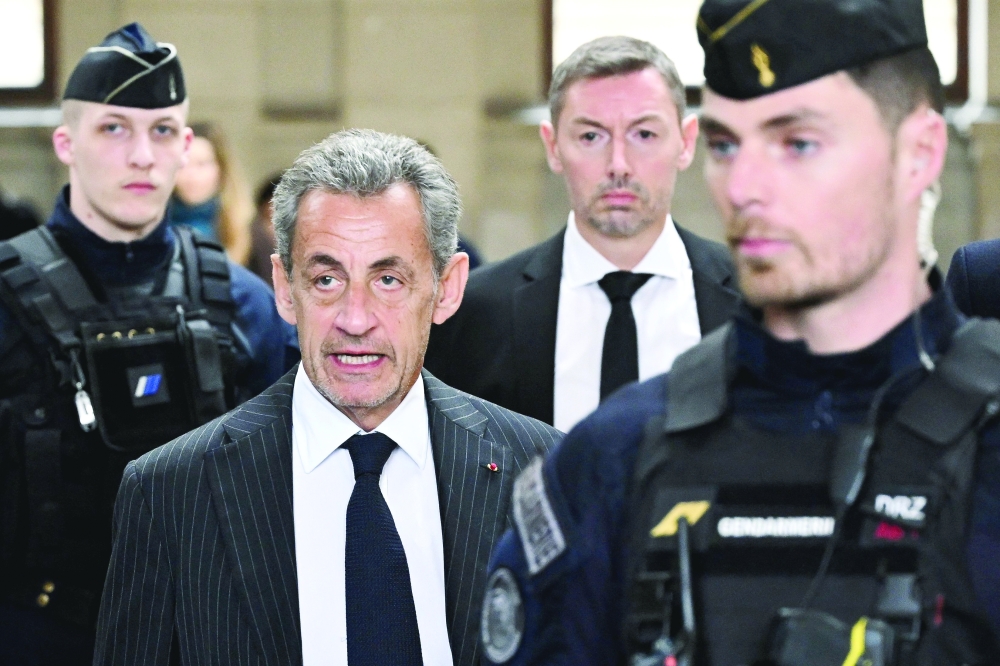





PARIS: France's ex-president Nicolas Sarkozy is to be jailed on Tuesday over a scheme to acquire Libyan funding for his 2007 presidential run, becoming the first former head of an EU country to serve time behind bars. Sarkozy, France's right-wing leader from 2007 to 2012, was convicted in late September of criminal conspiracy over a plan for late Libyan dictator Muammar Gaddafi to fund his electoral campaign. The former state leader, who has appealed the verdict and denounced an "injustice", is to be incarcerated in the Parisian prison La Sante. "If they absolutely want me to sleep in prison, I will sleep in prison — but with my head held high", he told the press after his September 25 verdict.
Sarkozy is to be the first French leader to be incarcerated since Philippe Petain, the Nazi collaborationist head of state of France's Vichy regime, who was jailed after World War II. He is likely to be held in one of the cells of nine square metres (95 square feet) in the prison's solitary confinement wing, prison staff have said. This would avoid Sarkozy having to interact with other prisoners or them taking pictures of him with one of the many mobile phones that are smuggled inside, they said, requesting anonymity because they are not allowed to talk to the press.
Presiding judge Nathalie Gavarino said during Sarkozy's sentencing that the offences were of "exceptional gravity" and therefore ordered him to be incarcerated even if he filed an appeal. But Sarkozy's lawyers are expected to request his release as soon as he sets foot inside the jail and the appeals trial has two months to examine it.
In theory, the court can decide against letting the former president out of prison if, for example, it deems it the only way to prevent evidence tampering or witness intimidation. If not, it could order his release under judicial supervision or home arrest with an ankle tag. Until the court makes a decision, Sarkozy is expected to spend a considerable amount of time alone. Under solitary confinement, prisoners are allowed out of their cells for one walk a day, alone, in a yard of several square metres.
Sarkozy has faced a flurry of legal woes since losing re-election in 2012. He has also been convicted in two separate trials. In one, he served a graft sentence for trying to extract favours from a judge with an electronic ankle tag, which was removed after several months in May. In the so-called "Libyan case" that ended in a prison sentence, prosecutors argued that his aides, acting with his authority and in his name, struck a deal with Gaddafi in 2005 to illegally fund his victorious presidential election bid two years later.
Investigators believe that in return, Gaddafi was promised help to restore his international image after Tripoli was blamed by the West for bombing a plane in 1988 over Lockerbie, Scotland and another over Niger in 1989, killing hundreds of passengers. But the court's ruling did not follow the prosecutors' conclusion that Sarkozy received or used the funds for his campaign. It acquitted him on separate charges of embezzling Libyan public funds, passive corruption and illicit financing of an electoral campaign. — AFP
Oman Observer is now on the WhatsApp channel. Click here