


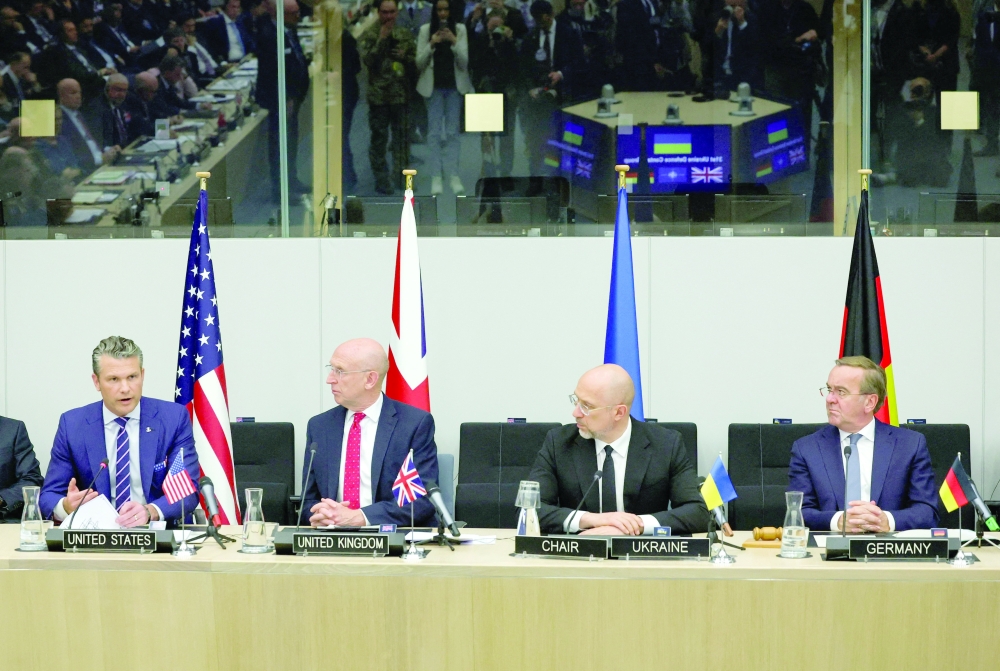





BRUSSELS: US Secretary of Defence Pete Hegseth on Wednesday called on Nato allies to increase spending on purchases of US weapons for Ukraine, following a report that highlighted a sharp decline in military support for Kyiv in July and August. "You get peace when you are strong. Not when you use strong words or wag your fingers, you get it when you have strong and real capabilities that adversaries respect", he told reporters ahead of a meeting with his Nato counterparts at the alliance's headquarters in Brussels.
Hegseth urged allies to ramp up investment in the Prioritised Ukraine Requirements List (PURL) programme, which replaced US arms donations to Ukraine and now requires allies to pay for US weapons deliveries. "Our expectation today is that more countries donate even more, that they purchase even more to provide for Ukraine, to bring that conflict to a peaceful conclusion".
Nato Secretary-General Mark Rutte said he expected further pledges, noting that $2 billion already had been committed through the mechanism. However, this amount falls short of the $3.5 billion Ukrainian President Volodymyr Zelensky had hoped to secure by October. Sweden, Estonia and Finland pledged contributions on Wednesday, but countries including Spain, Italy, France and Britain have faced criticism for holding back.
Ukraine remains heavily reliant on US weapons as it braces for another winter of conflict with Russia. The Kiel Institute for the World Economy reported on Tuesday that military aid to Ukraine fell by 43% in July and August compared with the first half of the year. According to the institute, most military support now flows through the PURL initiative, which by August had been joined by Belgium, Canada, Denmark, Germany, Latvia, the Netherlands, Norway and Sweden.
Meanwhile, Hungary would suffer if it was cut off from Russian energy, Budapest's foreign minister said during a visit to Moscow on Wednesday, reiterating that the country would not accept outside pressure when it came to decisions on its energy supplies. Peter Szijjarto was attending the Russian Energy Week forum as Nato defence ministers met in Brussels to discuss military aid for Ukraine, underlining Budapest's differences with most other members of the alliance when it comes to dealing with Moscow. Hungary has maintained its reliance on Russian energy since the start of the conflict in Ukraine, prompting criticism from several European Union and Nato allies.
Szijjarto told reporters in Moscow that national interest was paramount for Budapest when it came to energy supplies. "We have never been let down (by Russia). The deliveries have always arrived... Contracts were always respected. And my question is only why we should cut this relationship", Szijjarto said.
Separately, he was quoted saying by Interfax news agency that Russia has supplied around 3.6 million metric tonnes of oil to Hungary so far this year and will export between 5 million tonnes, or 100,000 barrels per day and 5.5 million tonnes in 2025. He also said Hungary plans to maintain that level in 2026.
Hungary has pushed back against plans by the European Commission to phase out the EU's imports of all Russian gas and liquefied natural gas by the end of 2027, deepening a rift with Brussels over relations with Moscow. Hungary signed a 15-year deal in 2021 with Russia to buy 4.5 billion cubic metres of gas annually and increased purchases from Gazprom last year, importing some 7.5 billion cubic metres of Russian gas via the Turkstream pipeline.
Meanwhile, one of President Vladimir Putin's top economic officials on Wednesday pushed back at US President Donald Trump's warning that the Russian economy was going to collapse amidst lines for gasoline in some regions. Trump on Tuesday said that Putin should settle the Ukraine war which the 47th US president said was making Russia look bad. He also mentioned "long lines waiting for gasoline" and said the Russian "economy is going to collapse".
Asked about Trump's remarks at an energy conference in Moscow, Deputy Prime Minister Alexander Novak, who oversees energy and the economy for the government, said that Russia had a stable supply of gasoline. "We have a stable domestic market supply, we see no problems in this regard", Novak said. "The balance is maintained between production and consumption; and we, on the part of the government and the relevant ministries, are doing everything to ensure that this remains the case". — Reuters
Oman Observer is now on the WhatsApp channel. Click here


