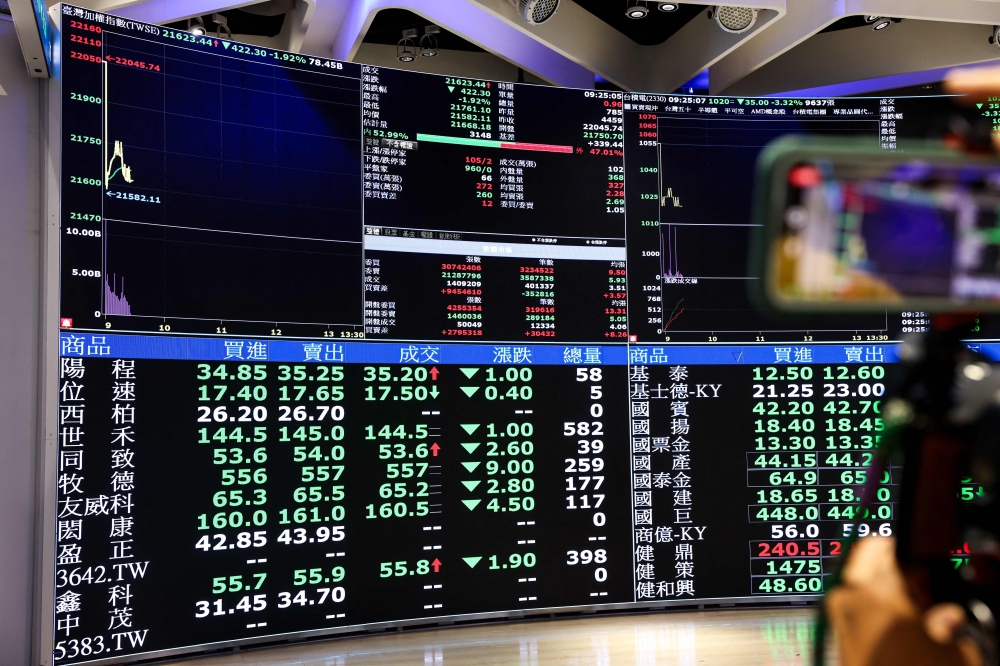





Stocks in Asia slid lower Monday morning, days after President Donald Trump threatened to impose higher tariffs on all Chinese imports and cancel a planned meeting with China’s leader, Xi Jinping.
Benchmark indexes in Taiwan and Hong Kong dropped around 2% in early trading on Monday. South Korea’s Kospi index and Shanghai’s composite index both fell about 1%.
Markets in Japan were closed for a holiday, but its Nikkei futures index had fallen around 5% on Friday before paring back some of those losses.
The shaky trading in Asia followed drops in U.S. stocks on Friday after Trump posted on social media that he was considering a “massive increase in tariffs” on Chinese products. The sell-off in the United States was pronounced enough to wipe out the S&P 500’s prior weekly gains.
After the U.S. market closed, Trump elaborated on his comments, saying that the United States would impose a 100% tariff on Chinese products starting Nov. 1, along with export controls on “any critical software.”
Trump was responding to China’s announcement that it would curb exports of some rare-earth minerals needed to make high-tech products, including semiconductors, electric vehicles, and jet fighters.
Over the weekend, Trump struck a more diplomatic tone, saying on social media that the United States did not want to “hurt” China, adding that “it will all be fine!” U.S. stocks appeared to steady, with S&P 500 futures bouncing back about 1.3%.
Stocks in Asia had, for the most part, recovered since April, when the United States and China announced that they would impose tariffs of more than 100% on each other’s goods, and markets plunged. They agreed in May to temporarily slash the tariffs, and investors took that move as a sign that their trade conflict was easing.
Beijing’s trade curbs and Trump’s tariff threats show how quickly calm can give way to confrontation between the world’s two largest economies.
The latest developments “raise the possibility that the two countries could once again enter into a trade war,” said Takahide Kiuchi, the executive economist at the Tokyo-based Nomura Research Institute. “If this were to happen, the impact on the global economy would be severe,” he said.
The key question for investors is whether the threats of higher tariffs and export controls are serious or merely attempts to gain negotiating leverage before bilateral talks between China and the United States set for later this month, the investment bank Goldman Sachs wrote in a note.
“We lean toward the latter interpretation and expect the ultimate resolution will be an extension of the current tariff pause,” it said.
As of last month, the trade tensions with the United States had not slowed Chinese shipments overseas, according to data released by the Chinese government on Monday. In September, overall exports grew 8.3%, compared with a year earlier. While shipments to the United States fell 27%, China offset that downturn with strong exports to the European Union, Southeast Asia, and Africa.
September exports to Europe were up by 14%, the most in three years. Shipments to Southeast Asia rose 16%, spurred by booming trade with Vietnam and Thailand. But the biggest gains came from Africa, where shipments jumped 56% on continued surging demand for Chinese-made batteries, solar panels, electric vehicles, and industrial equipment.
This article originally appeared in The New York Times.
Oman Observer is now on the WhatsApp channel. Click here