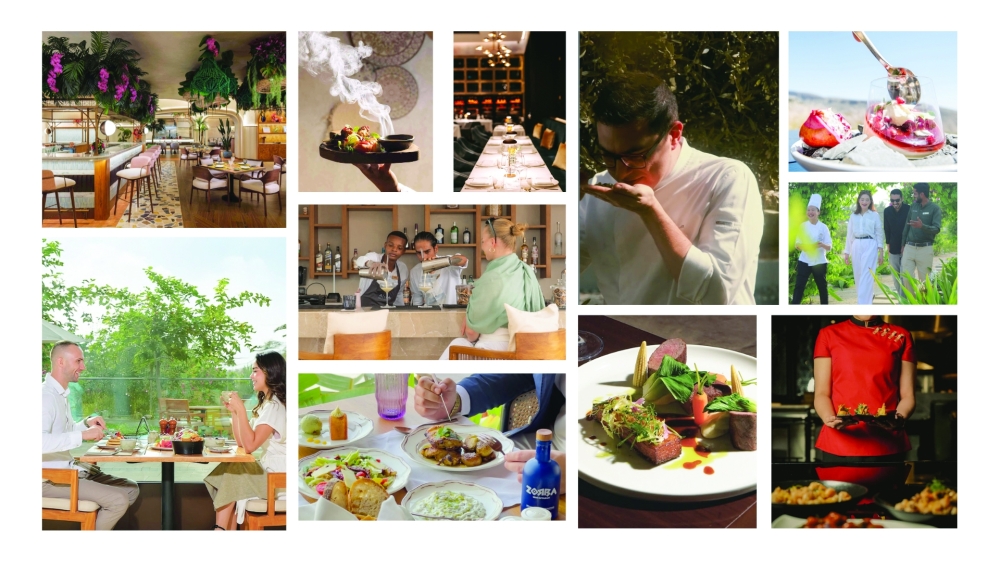





There is a quiet revolution stirring in Oman’s kitchens. Across Muscat, the clink of cutlery and the perfume of spice hint at something deeper than a dining boom — a cultural awakening that is reshaping how the Sultanate eats, celebrates, and defines hospitality. While its Gulf neighbours have long been known for headline-grabbing celebrity restaurants, Oman’s culinary story is unfolding differently: slower, subtler, but infinitely more soulful. Here, food has become a form of storytelling — one that connects the nation’s seafaring past with its confident, cosmopolitan present.
Earlier this month, that story took an elegant turn at Roberto’s Muscat, where chefs Gian Tafuri and Ciro Mancini united for Taste of Ischia, a one-night four-hands dinner that transported diners to the volcanic coast of southern Italy. Each course balanced Mediterranean finesse with Omani generosity, offering proof that Muscat can now host the kind of creative culinary dialogues once confined to Dubai or Doha. This latest collaboration was part of a series where Chef Gian partners with chefs from across Italy to bring something unique to Oman.
Just a few kilometres away, Mandarin Oriental, Muscat continues to anchor Oman’s ascent to global dining relevance. Its modern Italian restaurant, Essenza, hosted A Taste of Talea — a three-night collaboration between Chef Luigi Stinga of Talea at Emirates Palace and Chef Davide Borin, Essenza’s own maestro. The resulting menu, elegant yet disarmingly sincere, was a meeting of two Italys: the classical and the coastal. Diners moved from Amalfi-inspired lemon risotto to truffle-laced veal, framed by Mandarin Oriental’s meticulous artistry and Omani warmth. It was not just a meal but a moment — a reminder that Oman’s fine-dining future rests in experiences that marry precision with heart. In similar manner, this is also part of a series bringing unique offering to the most picky of eaters in Oman.
The same spirit of curation defines Shangri-La Muscat's “Taste of Shangri-La”, a month-long festival running through October where each of the resort’s signature restaurants offers bespoke six-course menus. Rather than chasing novelty, Shangri-La’s chefs have built a culinary voyage — a meditation on different culinary textures and aromas, filtered through Oman’s relaxed sense of luxury.
Across town, the JW Marriott Muscat is showcasing how large hotels are reimagining breadth as sophistication. Its four flagship restaurants — Kitchen 7, Pink Salt, Catch, and Butter Buns — have each launched refreshed menus this season, a coordinated reset that turns the property into a miniature food district. Kitchen 7’s open-kitchen theatre brings immediacy to international dining; Pink Salt elevates its wood-fire grill into something almost architectural; Catch extends its Mediterranean leanings into a celebration of the sea; and Butter Buns transforms the casual burger into a chef-driven indulgence. It is a statement of intent: that variety need not dilute quality.
Meanwhile, The St. Regis Al Mouj Muscat Resort is proving that heritage can be as compelling as haute cuisine. Its reintroduced restaurant Karibu is a love letter to the historic Spice Route, bridging Zanzibar, India and Oman — three cultures once bound by the monsoon winds that carried cloves and cardamom across the seas. The refreshed menu celebrates this shared history through weekly themed nights: comforting curries on Tuesdays, flame-licked grills on Wednesdays, charcoal-grilled Omani seafood on Thursdays, and vibrant Zanzibari nights each Friday complete with live music and barbecues. Every dish feels like a passage through time, each flavour a thread connecting continents.
In the same resort, Zorba has carved its niche through atmosphere rather than excess. Its Sunset Dinner experience has become one of Muscat’s most evocative dining moments — the horizon blushing pink as Mediterranean dishes arrive one by one, paced to the fading light. It is dining as performance, where nature becomes part of the script.
Elsewhere, W Muscat’s Ba Ban has taken the Silk Road as its muse earlier this season, unveiling a limited-edition menu of Silk Route Specials in late September. For a week, diners traced an edible map from Xi’an to Muscat, tasting the journey through spice, smoke and story.
In Jabal Akhdar, Alila has remained consistent in curating seasonal experiences that stay true to the spirit of the mountains. From crafting exquisite dishes during the rose harvest to designing events around the pomegranate and olive seasons, the resort has turned nature’s rhythms into moments of culinary and cultural celebration. The Pomegranate Special Menu was a particular triumph for Chef Pankaj, who continues to innovate with refined creativity. Meanwhile, the family-friendly Dusit D2 Naseem Park has strengthened its appeal with Omani-themed dinners, offering a warm and authentic dining experience that makes it a delightful choice for those exploring the mountains.
In Salalah, Anantara Al Baleed has long been known for its vibrant line-up of food festivals and continues to raise the bar with even more exciting offerings this winter season. At the height of the khareef season, the resort welcomed a roster of guest chefs who brought fresh perspectives to its culinary scene — including a celebrated chocolatier whose creations have become a Dubai favourite. Meanwhile, Alila Hinu Bay continues to enchant diners with its distinctive culinary concepts, featuring inventive dishes infused with camel’s milk, the delicate aroma of frankincense, and exclusive experiences centred around Omani abalone.
Taken together, these experiences form a portrait of a nation in culinary bloom. Oman’s food scene may not chase trends, but it interprets them with grace — blending the cosmopolitan polish of global dining with the generosity of its own culture. Chefs here are no longer reproducing foreign formulas; they are composing new narratives where Omani terroir, spice, and sensibility take centre stage.
What distinguishes Oman’s rise is its restraint. There is no brashness in its ambitions, no loud proclamations of being the next gastronomic capital. Instead, there is confidence — quiet, assured, and deeply rooted in authenticity. Whether it’s the creative precision of Mandarin Oriental, the heritage storytelling of Karibu, or the inventive boldness of Roberto’s and Ba Ban, Oman’s tables are now places where identity and innovation sit side by side.
As dusk falls over Muscat and the scent of frankincense mingles with charcoal and citrus, one realises that the Sultanate’s culinary power lies not in spectacle but in soul. Its ascent may be quiet, but in the measured hum of its kitchens and the elegance of its plates, Oman is cooking something extraordinary — a new definition of what it means to dine in the Gulf.
Oman Observer is now on the WhatsApp channel. Click here