




On September 23, Colombia’s President Gustavo Petro addressed the UN General Assembly with a moral clarity many leaders avoided. He spoke of Gaza, of tens of thousands of dead and wounded, and of a society battered by blockade, bombardment, hunger and grief. He framed the moment in universal terms: human dignity transcends creed and ethnicity; silence before organised cruelty corrodes the very idea of civilisation.
Petro’s intervention dispensed with euphemism. He criticised Washington’s unconditional backing of Israel and the diplomatic, military and economic shields that prolong the war. He deplored the ease with which senior Israeli officials circulate through Western capitals while families queue at morgues and rubble-strewn clinics. He pledged to keep speaking as long as missiles fall. The message resisted the choreography of “both sides” and “complexity” that so often dilutes responsibility; it named power and consequence.
The speech did more than indict policy; it challenged a narrative architecture. For years, significant parts of Western media recycled familiar slogans—“the only democracy in the Middle East”, “self-defence”, “security first”—while images from Gaza told a harsher story: neighbourhoods levelled, hospitals overwhelmed, children pulled from ruins. Petro aligned himself with that unblinking ledger of facts, insisting that language should serve reality rather than obscure it.
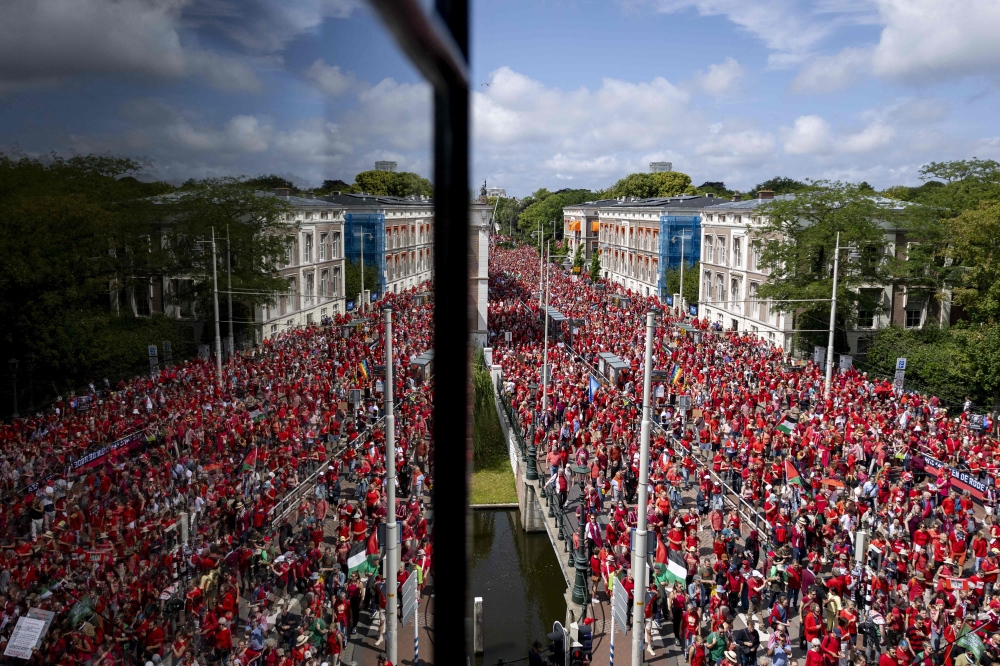
His words resonated with a wider civic awakening. Across American and European campuses, in union halls, cultural institutions and public squares, citizens demanded accountability: a ceasefire, aid without obstruction, sanctions for grave breaches of international humanitarian law, and a credible path to justice. Writers, film-makers and artists risked platforms and contracts to speak plainly where editors and officials softened the edges. The centre of gravity shifted; talking points lost purchase when measured against livestreamed devastation and the jurisprudence of war crimes.
Petro’s stance also highlighted the timidity of many Arab and Islamic governments. These states command populations, capital, energy routes and logistics, along with a deep cultural bond with Palestine. They possess diplomatic leverage across shipping lanes, commodity markets and security partnerships. Yet their public language often settled for carefully managed communiqués that soothe allies and displease no powerful patron. History rarely records such caution kindly. Leadership, in a moral crisis, begins with naming the harm and committing to tools to reduce it.
Practical implications follow naturally. States that profess concern can recognise Palestinian statehood with meaningful contours, support referrals to international courts, suspend transfers that facilitate unlawful attacks, and open sustained humanitarian corridors. They can tie cooperation, trade and technology to rights benchmarks, encourage intra-Palestinian political renewal, and assemble an economic lifeline across the region for recovery once the guns fall silent. None of this requires grandstanding; it requires decisions and the will to uphold them.
Petro’s courage of opinion matters because it models a different hierarchy of values. Geopolitics will always involve bargains and trade-offs. A world that treats mass civilian suffering as a tolerable externality loses credibility when it later invokes rules against others. The Colombian president reminded the chamber that legitimacy flows from consistency: the same principles must govern allies and adversaries, and the same standards must apply whether violations occur in enemy territory or within a partner’s arsenal.
There is a lesson for movements as well. Moral clarity without civic architecture fades. To convert outrage into outcomes, coalitions must stay broad, disciplined and focused on achievable steps: protecting life today, structuring accountability tomorrow, and securing a horizon where Palestinians live free of occupation and Israelis free of fear. The alternative remains a rolling emergency, managed by euphemism and revisited in cycles of ruin.
“The ranks of courage among men are many, and the noblest is the courage of opinion.” Petro’s address earned that rank. Its significance will deepen if others—especially those with leverage—match language with measures that shorten the distance between justice named and justice done.
Khaled al Marhoon
The writer is a specialist in international law and political affairs.
Translated by: Badr al Dhafari
The original version of this article was published in Oman Arabic on October 01, 2025.
Oman Observer is now on the WhatsApp channel. Click here