




SHENZHEN: Typhoon Ragasa, the world's most powerful tropical cyclone this year, struck the southern Chinese city of Yangjiang on Wednesday after killing 17 people in Taiwan and lashing Hong Kong with ferocious winds and heavy rains. The typhoon was tracking towards Maoming, one of China's biggest oil refining cities, in Guangdong province.
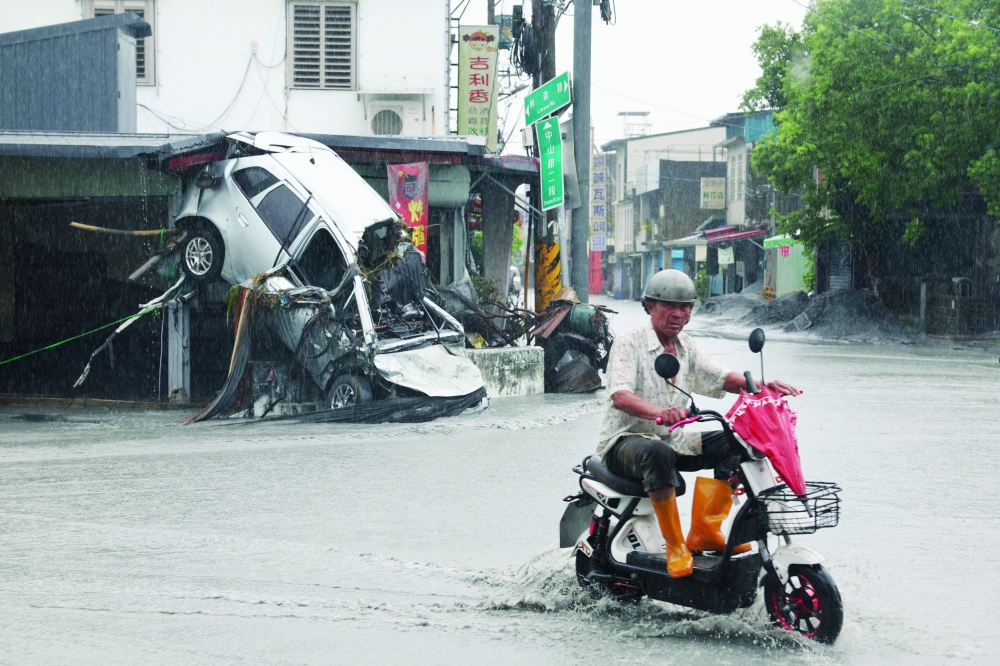
In Taiwan, 17 people were missing in the eastern Hualien county after a barrier lake overflowed and sent a wall of water into a town, while Ragasa brought Hong Kong to a standstill. More powerful typhoons are likely to hit southern China due to climate change, said Benjamin Horton, dean of the School of Energy and Environment at the City University of Hong Kong, after a summer of record-breaking rainfall. "The weather experienced in Hong Kong this summer is only a taste of what is to come," Horton said.
Officials are used to moving people out of potential danger zones swiftly as the island is frequently hit by typhoons, but many residents in the tourist town of Guangfu said they were given insufficient warning when a lake overflowed during Tuesday's torrential rains brought by Ragasa. In Hong Kong, where huge waves crashed over areas of the Asian financial hub's eastern and southern shoreline, some roads and residential properties were submerged.
At the Fullerton Hotel on the island's south, videos on social media showed seawater surging through glass doors. No injury has been reported, the hotel told Reuters. China's marine authority issued its highest red wave warning for the first time this year, forecasting storm surges of up to 2.8 metres (9 feet) in parts of Guangdong province, as Ragasa headed towards the densely populated Pearl River Delta.
"Authorities have taken lessons from Hato and Mangkhut, which both caused billions of dollars in damage in 2017 and 2018," said Chim Lee, a senior energy and climate change specialist at the Economist Intelligence Unit. "The Pearl River Delta is one of the best-prepared regions for typhoons, so we're not expecting major disruptions. One change this year is that the Hong Kong stock market has stayed open during typhoons - a sign of how resilient the infrastructure has become," he said.
After passing around 100 km south of Hong Kong, Ragasa made landfall along the south Chinese coast. Guangzhou, Shenzhen, Foshan and Dongguan, the largest cities in the storm's path, are home to around 50 million people.
More than 2 million people have been evacuated across Guangdong and the ministry for emergencies dispatched tens of thousands of tents, folding beds, lighting equipment and other rescue supplies, Chinese state media reported. Some shops and restaurants in the province parked large rented trucks in front of storefronts in a bid to shield them from the storm, local media reported.
China's marine authority warned of a high risk of flooding in Shenzhen, especially in low-lying areas, with a storm surge alert expected to remain in effect until Thursday. A woman and her five-year-old son were swept into the ocean on Tuesday after watching the typhoon from the Hong Kong waterfront, according to the South China Morning Post, which said they were now in intensive care. — Reuters
Oman Observer is now on the WhatsApp channel. Click here