




The space around Uranus just got a bit more crowded.
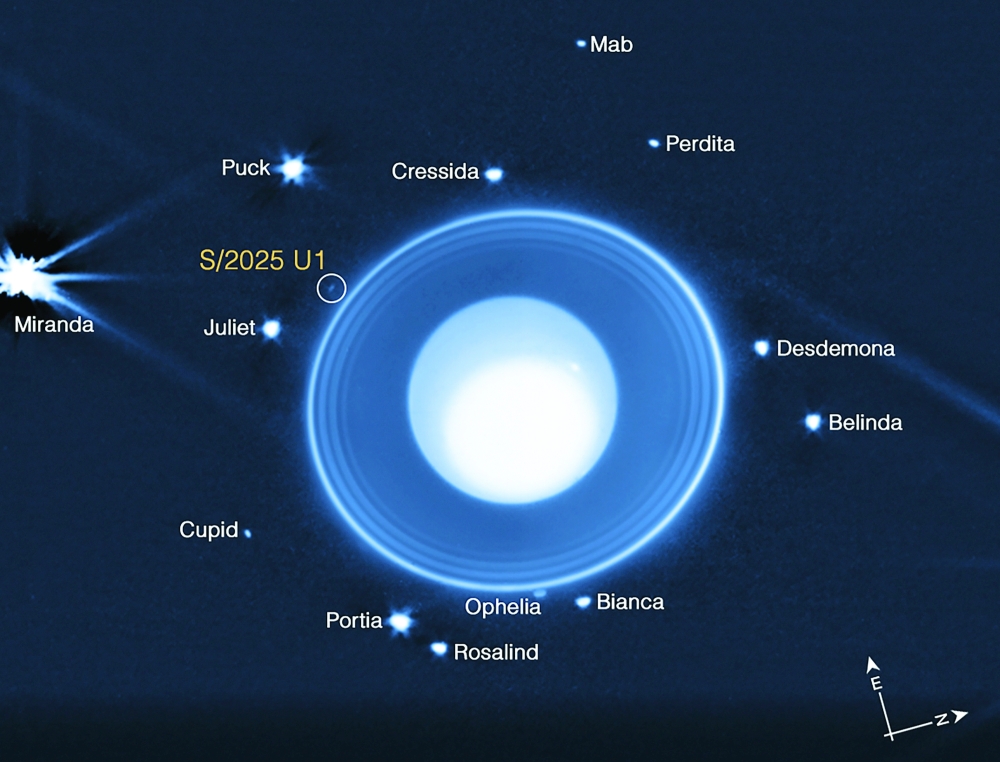
Astronomers using the James Webb Space Telescope recently announced the discovery of a moon orbiting around the pale blue ice giant, bringing its total number of satellites to 29. The latest addition, tentatively known as S/2025 U1, is tinier than any of the planet’s known moons. That is the likely explanation for why it was missed in observations by previous telescopes or spacecraft. “We were very happy to see it,” said Maryame El Moutamid, an astrophysicist at the Southwest Research Institute in Colorado. “It was acting exactly like a moon.”
All four of the largest planets in our solar system have a substantial number of moons of varying sizes. In recent years, scientists have discovered additional objects orbiting Jupiter, Saturn and Neptune that are considered moons.
Several of the now 29 moons of Uranus were discovered during a flyby of NASA’s Voyager 2 spacecraft in 1986. But the icy world also has 13 narrow, sharply defined rings. Some astronomers believe these rings to have been sculpted by the presence of unknown “shepherd” moons on either side, whose gravity prevents the material from spreading outward. — KATRINA MILLER
Oman Observer is now on the WhatsApp channel. Click here