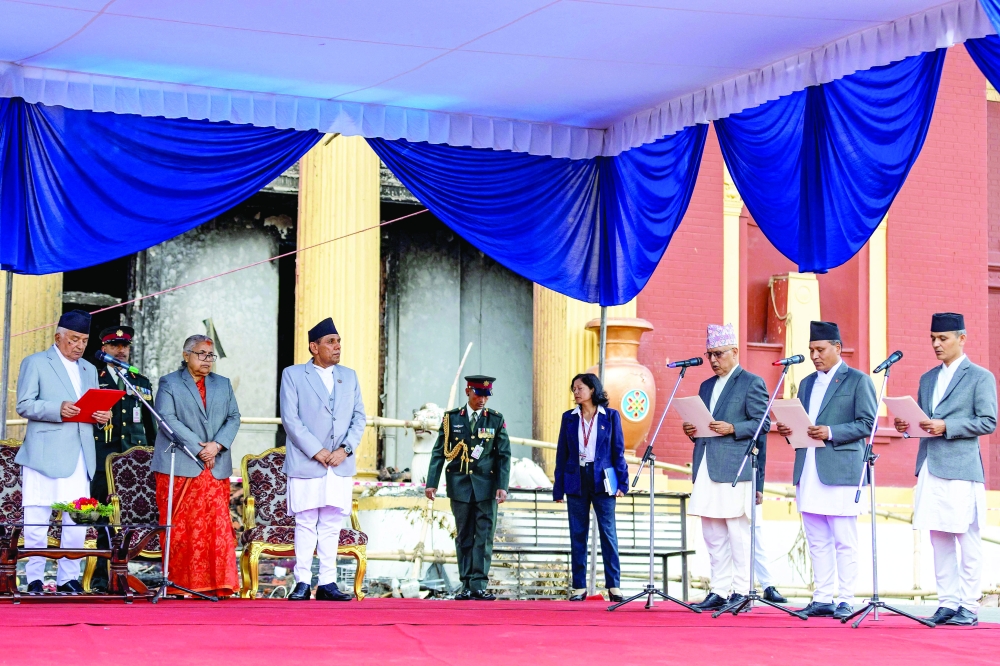





KATHMANDU: Nepal's new interim prime minister unveiled her first ministers on Monday, as the Himalayan nation seeks to restore order after deadly youth-led anti-corruption protests that ousted the previous government. Under an outdoor awning and against the backdrop of the fire-damaged presidential office, President Ram Chandra Paudel gave the oath of office to three key ministers in a ceremony broadcast on television.
Protests, sparked by a ban on social media and feeding into long-standing economic woes, began on September 8 and quickly escalated, with parliament and key government buildings set ablaze. It was the worst unrest since the end of a decade-long civil war and the abolition of the monarchy in 2008. At least 72 people were killed in two days of protests, with 191 still recovering in hospital, according to government figures.
Prime Minister Sushila Karki, the 73-year-old former chief justice, has been tasked with addressing protester demands for a corruption-free future ahead of elections in March. Om Prakash Aryal, an advocate known for his cases tackling corruption, governance and human rights, takes the critical home minister post, as well as law, justice and parliamentary affairs.
Kulman Ghising, the former director of the Nepal Electricity Authority — who is widely credited with ending the country's long-standing load-shedding problem — has the energy, infrastructure, transport and urban development portfolios. Rameshwor Khanal, a former finance secretary and a respected economist, was handed the key finance post, a challenging task to tackle the unemployment woes that drove the uprising.
A fifth of people in Nepal aged 15-24 are unemployed, according to the World Bank, with GDP per capita standing at just $1,447. The appointment of Karki, known for her independence, came after intense negotiations by army chief General Ashok Raj Sigdel and Paudel, including with representatives of "Gen Z", the loose umbrella title of the youth protest movement.
Thousands of young activists used the Discord app to name Karki as their choice of leader. Karki said on Sunday that she had "not wished" to take the post, but that her "name was brought from the streets". She said her government would work "according to the thinking of the Gen Z generation", saying that they wanted "the end of corruption, good governance and economic equality".
Nepal's new leader vowed on Sunday to follow protesters' demands to "end corruption" as she began work as interim prime minister, after "Gen Z" youth demonstrations ousted her predecessor. Sushila Karki, the 73-year-old former chief justice, has been tasked with restoring order and addressing protesters' demands for a corruption-free future ahead of elections in six months.
President Paudel, who swore Karki into office, said late on Saturday that "a peaceful solution has been found through a difficult process". Soldiers have scaled back their presence on the streets, where they had been deployed in large numbers after the protests. But more than 12,500 prisoners who escaped from jails during the chaos are on the run, and present a daunting security headache. Regional leaders have congratulated Karki, including Nepal's two giant neighbours, India and China.
Prime Minister Narendra Modi said New Delhi supported "peace, progress and prosperity" in Hindu-majority Nepal, while Beijing's foreign ministry said it wanted to "push China-Nepal relations steadily forward". Buddhism is the country's second-largest religion, and the Dalai Lama, the exiled Tibetan spiritual leader, wished Karki "every success in fulfilling the hopes and aspirations of the people of Nepal in these challenging times." — AFP
Oman Observer is now on the WhatsApp channel. Click here