After Charlie Kirk, the right-wing activist, was fatally shot on Wednesday, two thoughts occurred to Edward Padron, a 67-year-old locksmith in Brownsville, Texas. One was immediate. One was slower to rise. A longtime conservative, Padron said he first assumed “a hate crime against a Republican” had just happened. But then he thought of other recent acts of violence across the political spectrum, from the attempts last year on the president’s life to the fatal shootings in June of a Democratic lawmaker in Minnesota and her husband. It seemed to him as if some terrible disease was gripping the nation, with no cure on the horizon. “This could happen to anybody in this country,” Padron said, speaking from his home near the Mexican border. “I think that people across the board are afraid.”
That anxiety echoed in interviews with Americans, including a group of voters that The New York Times has been following throughout the Trump presidency. No matter their beliefs, people said they were deeply unsettled after the killing of Kirk, who had built a national movement promoting right-wing politics on campuses like the one in Utah where his life ended. Some of those interviewed had not heard of Kirk. Others felt strongly about him and his politics, for and against. But virtually all agreed that Kirk’s violent death seemed to confirm a deep fear that something is seriously wrong in this nation.
It was not just the gun violence. In some sense, that has become a daily tragedy, lamentable but unsurprising. As several people pointed out, there was also a school shooting in Colorado on Wednesday. Instead, Kirk’s death at 31 symbolized for many the collapse of what they thought was a basic, common-sense, need-not-debate American value: that people expressing a political opinion should not be shot for it. “There was someone on TV, and he kept saying that this was not who we are — that we are not one of those countries that shoots people over politics,” said Charles Phoenix, 62, a left-leaning artist based in the Los Angeles area. “But it is who we are. We do shoot political leaders. We are that country.”
In interviews, people whipped through their own experiences and fears, trying to put a finger on just how things had become this ugly. They talked about friendships that dissolved into arguments, the infinite stream of disinformation, the knee-jerk name-calling, the calls for violence, the inability to see past partisan manipulation and calmly debate. “Unfortunately, we are broken,” said Dave Abdallah, 60, a real estate agent in Dearborn, Michigan.
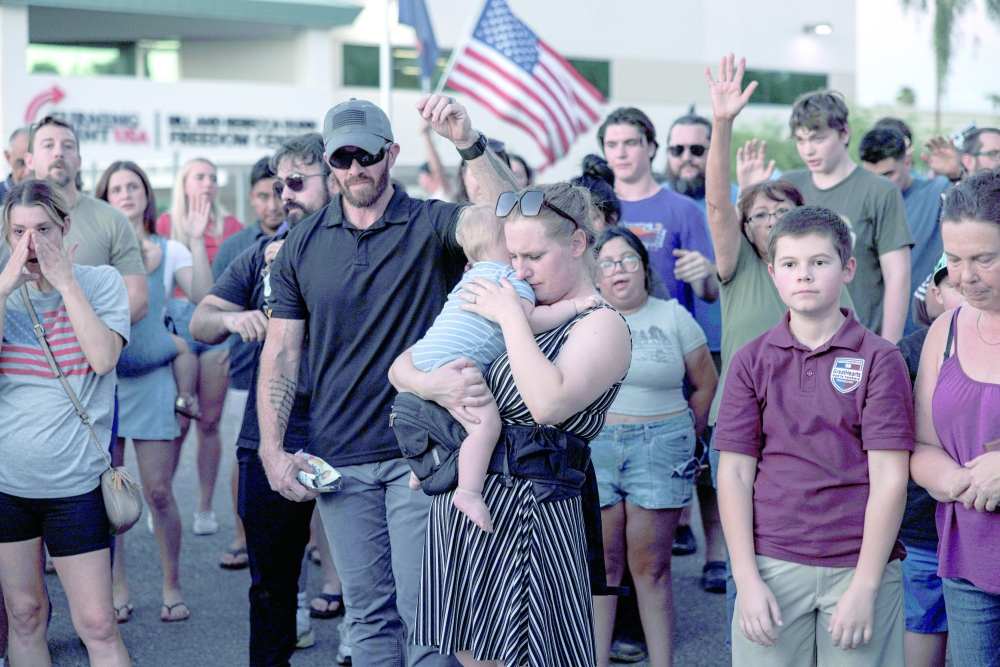
In Marietta, Georgia, Taylor Busch, 44, said the rancor over the Kirk shooting spilled into a Discord channel where he and other aficionados of the video game Destiny 2 regularly talk. Some of the members, he said, have known each other for 10 years. “We’ve always kept it very dry, stayed away from political events,” said Busch, who voted for Kamala Harris last year. But after one of his friends posted a video of the killing, an argument erupted. The gamers who supported Kirk bristled. They said, “‘Well, I like the things that he liked. I believed in things he believed in. You think I should be murdered?’” Busch recalled. “I’m like, no one’s saying that.” Busch said that he was trying to make the point that Kirk “said these horrible things, and at the same time, it’s horrible that he died.” Two people left the group, deeply offended. Several people on the right reported a similar rush of fear and vulnerability.
In Utah, Bryce Youngquist, 43, a software salesperson in Salt Lake City, said he was at a luncheon at his alma mater, Brigham Young University, when a host stood up and announced the news of the shooting. Amid the gasps and the prayers, he said, his sadness for Kirk’s family was mixed with “kind of a terrifying feeling” that the shooting had, in some way, threatened him as a conservative. “This feels like a turning point,” he said. “How are we going to move forward now?”
Some wondered whether Americans fully understood how rare it is to be able to peacefully exchange ideas — especially ones that provoke deep disagreement. In Michigan, Abdallah, the real estate agent, worried that the shooting would chill free speech, worsen polarization and incite people with “the wrong mental direction” to violent action, as had happened so often in Lebanon, where he was born. “I hope this type of thing does not discourage other people from going on campus and speaking,” he said, but the response to Kirk’s death made him fear for American discourse.
In Lacombe, Louisiana, Clifford Eugene, 74, also worried about political rhetoric. “Since the election of President Barack Obama, I feel like the country has gotten more and more divisive,” said Eugene, a retired bank examiner for the Treasury Department. “Now, you have leaders who demonize the other side and declare them enemies of the people.” But what could be done? Eugene, a Democrat, was at a loss to name a remedy for this angry and entrenched nation.
Oman Observer is now on the WhatsApp channel. Click here