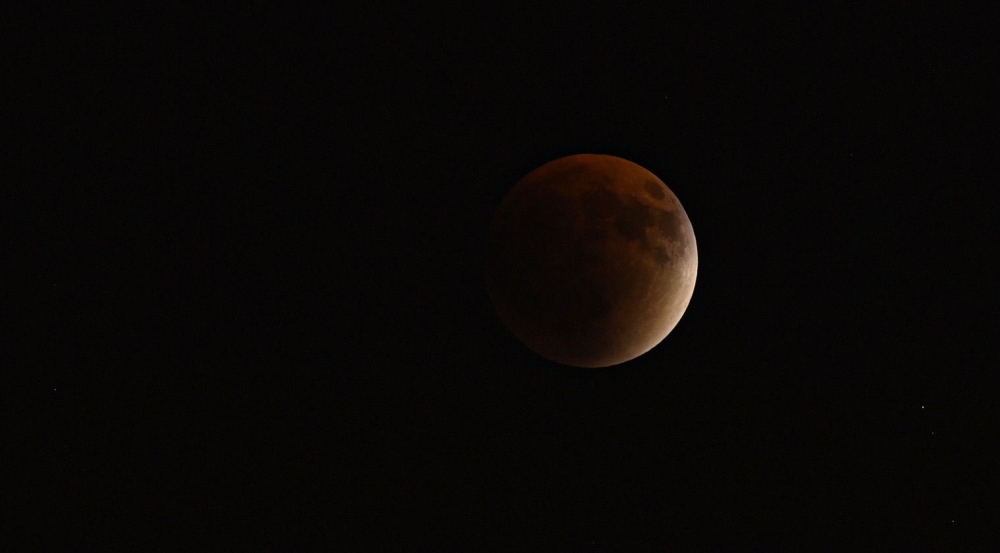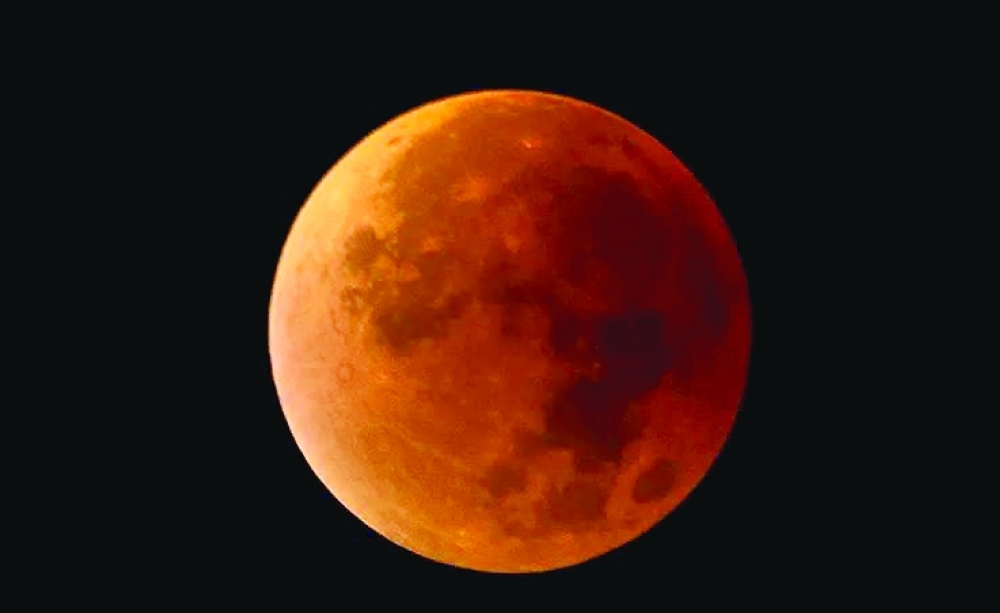





MUSCAT: The skies over the Sultanate of Oman will witness a rare total lunar eclipse on Sunday night. The eclipse will be clearly visible in all governorates of Oman, in addition to large areas of Asia, Europe, Australia, western North America, eastern South America, the Pacific, Atlantic and Indian oceans, and the North and South Poles.
Speaking about this phenomenon, Dr Ishaq bin Yahya al Shueili, Chairman of the Oman Astronomical and Space Society, said that the penumbral eclipse begins at 7:28 pm Muscat time, followed by the partial eclipse at 8:27 pm, while the moon enters the Earth’s shadow completely at 9:31 pm, announcing the beginning of the total eclipse.
He added in a statement to the Oman News Agency: “The phenomenon will reach its peak at 10:11 pm, before the total eclipse ends at 10:53 pm, followed by the moon gradually emerging from the shadow until the end of the partial eclipse at 11:56 pm, and the phenomenon will end completely with the moon emerging from the penumbra at 12:55 am.”
He said that the total eclipse will last for one hour and 22 minutes, while the partial eclipse will last for three hours and 29 minutes. The total eclipse, with all its phases, will last for five hours and 27 minutes. He added that the moon will be a full moon for the month of Rabee Al Awwal 1447 AH, appearing reddish during the peak of the eclipse as a result of the refraction of sunlight through the Earth's atmosphere.
He pointed out that a lunar eclipse is an astronomical phenomenon that occurs when the Earth's shadow blocks the sunlight reflected from the moon, adding: "The phenomenon occurs when the Earth, the sun and the moon are in a straight line. There are three types of eclipses: Total eclipse: This occurs when the entire moon enters the Earth's shadow. In this case, the entire disk of the moon is eclipsed, leading to a complete loss of visibility during the middle of the night, especially in desert areas."
He added: "A partial eclipse occurs when part of the moon enters the Earth's shadow, in which case part of the moon's disk is eclipsed. A penumbral eclipse occurs when the moon enters only the penumbral shadow, in which case the moon's light becomes dim without being eclipsed."
“At the beginning of a total eclipse, the moon’s colour tends to be reddish due to the red rays that cannot be absorbed by the top of the Earth’s atmosphere,” he said. — ONA
Oman Observer is now on the WhatsApp channel. Click here