




Tesla’s board Friday proposed a pay package that could make CEO Elon Musk the world’s first trillionaire as long as he meets a series of very ambitious corporate goals.
Musk, already the world’s richest person, would have to increase Tesla’s stock market value eightfold over the next decade to collect the full value of the package, according to a securities filing.
All the compensation would be in the form of Tesla shares. The package, which must be approved by the company’s shareholders, is expected to be put to a vote at an annual meeting Nov. 6.
Musk has a net worth of more than $400 billion, according to Forbes. The new pay could add around $900 billion to that fortune if he succeeds in raising Tesla’s stock market value to $8.5 trillion from about $1.1 trillion today. It would be by far the richest compensation of any executive in corporate history. And it could leave him owning nearly 29% of Tesla, an extraordinary level of control for a CEO.
Musk would have to remain at Tesla for at least 7 1/2 years to cash in any of the shares and 10 years to earn the full amount. He would also have to meet various very ambitious operational milestones, including overseeing the commercial deployment of 1 million autonomous taxis, 1 million robots and a more than 24-fold increase in profit.
Hitting many of those targets could be extremely hard. Many other companies around the world are racing to perfect self-driving cars and robots.
“Retaining and incentivizing Elon is fundamental to Tesla achieving these goals and becoming the most valuable company in history,” Robyn Denholm, chair of the Tesla board, and Kathleen Wilson-Thompson, a director on the board, said in a letter to shareholders.
The lavish pay plan will almost surely be criticized by some shareholders for excessively rewarding Musk. Some investors have said the CEO has performed poorly in recent years and engaged in behavior that has damaged the company. The package will increase the already intense scrutiny of Musk, who is regarded as a genius by his acolytes and a dangerous oligarch by his critics.
Tesla’s sales and profit have slumped over the last year as Musk has become immersed in right-wing politics. He worked for several months in the Trump administration, offending many liberal electric-vehicle buyers.
A critic of high executive compensation, Natalia Renta, associate director at Americans for Financial Reform, a progressive group, pointed out that the median compensation for a Tesla employee was less than $60,000 last year, according to the company’s securities filings.
“His own median worker is making $57,000 while he is awarded a pay package that could add up to $1 trillion by being a part-time CEO,” Renta said. “It’s just very outrageous.”
While exercising significant control over Tesla, Musk spends a lot of time overseeing other business interests. Among them are SpaceX, a rocket company, and xAI, an artificial intelligence venture that owns social platform X.
The plan announced Friday does not place restrictions on how much time he spends on other ventures or his political activities.
The compensation plan mirrors one from 2018 that awarded Musk millions of Tesla shares if he met goals that seemed far-fetched at the time. He achieved the milestones, but a Delaware judge struck down that pay package after shareholders claimed it was excessive and contended that the company’s board had not properly informed investors about the package. Tesla has appealed to the state’s Supreme Court.
The documents Tesla filed Friday contain measures that would replace Musk’s compensation from the 2018 plan if the company’s appeal of the Delaware case is unsuccessful. Tesla said Friday that awarding that compensation package would require it to record an expense of at least $56 billion on its financial statements based on the recent share price.
If shareholders approve the latest pay package, dissident investors would have more difficulty challenging it. This year, Tesla moved its corporate domicile from Delaware to Texas, where state law makes it harder for shareholders to sue companies in which they have only a small stake.
Tesla pioneered the market for electric cars, but has fallen behind Chinese carmakers BYD and Geely in the number of cars sold globally, and is in danger of being overtaken by Volkswagen, according to figures compiled by SNE Research, a South Korean firm.
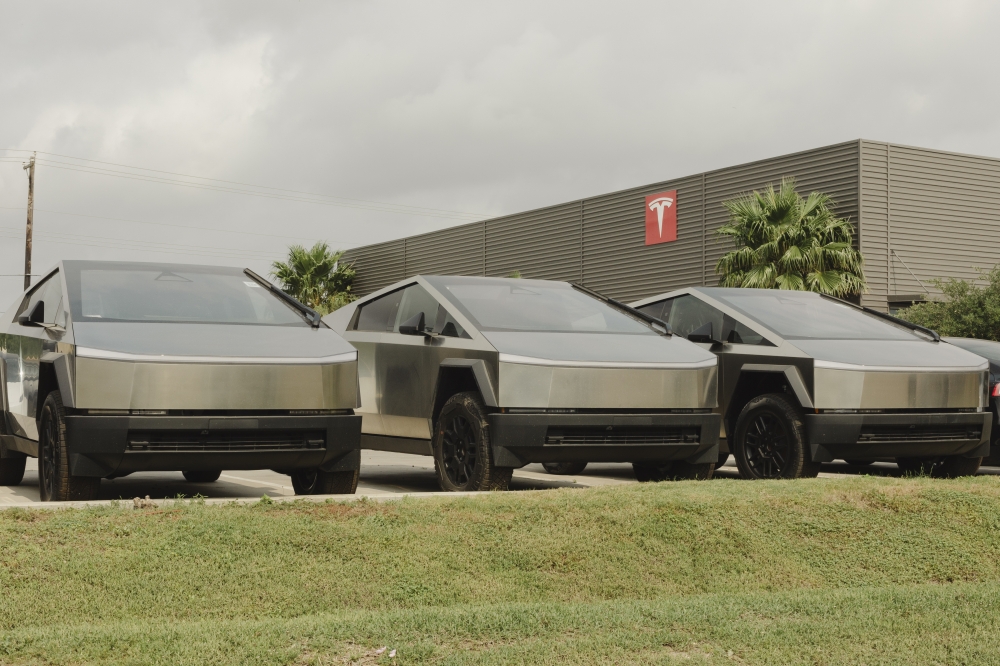
Some analysts blame Musk for the decline, saying he squandered resources developing the Cybertruck pickup, which has sold poorly, rather than new models with broader appeal. Chinese carmakers and established manufacturers such as General Motors and Hyundai have introduced dozens of electric cars that increasingly make Tesla’s main products, the Model 3 sedan and Model Y SUV, look dated.
Musk has played down the importance of car sales, saying Tesla’s future is in AI, self-driving cars and humanoid robots. The compensation plan calls for Tesla to have sold a total of 20 million cars by 2035, from 8 million today. That implies the company would need to sell only 1.2 million a year, far fewer than it sold last year.
Car sales alone would not propel Tesla’s stock market value to the stratospheric levels envisioned by the compensation plan, said Michael Lenox, a professor at the University of Virginia’s Darden School of Business. The announcement Friday sends “a very clear signal that they see their futures in these other businesses,” Lenox said.
But he added that robots and autonomous vehicles are not yet generating significant revenue for Tesla. “Knowing where that potential market is going to be in 10 years is highly speculative,” he said.
On Monday, the company unveiled what it called its Master Plan IV, which said the company would be at the forefront of an age of “sustainable abundance” when power will come from the sun, people will travel in self-driving cars and robots will take over menial tasks.
“Today we are on the cusp of a revolutionary period primed for unprecedented growth,” the plan, published on X, said.
In their letter to shareholders, Denholm and Wilson-Thompson said, “Elon’s singular vision is vital to navigating this critical inflection point.”
But they also hinted at a future without Musk, saying he would work with the board on “development of a framework for long-term CEO succession.” And the filing said Musk had to develop a succession “framework” to earn a portion of the new stock award.
According to the compensation plan, Musk would be eligible to receive 35 million shares if Tesla’s Wall Street value hit $2 trillion. He would receive additional shares if Tesla’s value increased until it reached $8.5 trillion. The plan is structured so that Musk would profit from gains in the share price only from $334, the closing price on Wednesday.
For Musk to collect the full award, Tesla’s operating profit will have to rise to $400 billion, from $17 billion last year.
Although Musk would not be allowed to sell any of the shares for years, he will immediately be able to exercise their votes in shareholder meetings, increasing his control of the company. If he collects all the shares and does not sell any, his stake in Tesla would rise from 13% now to about 29%. Taxes could reduce that amount.
Musk had threatened to leave the company if he didn’t get a much bigger share of the company. He “raised the possibility that he may pursue other interests that may afford him greater influence,” the board said.
There is a little doubt that the goals are ambitious. Tesla would have to become twice as valuable as Nvidia, the maker of chips for AI and currently the world’s most valuable public company.
Musk and his brother, Kimbal Musk, who is a member of the Tesla board, recused themselves from the decision on whether to approve the pay package, Denholm and Wilson-Thompson said. But Tesla said in its regulatory filing Friday that Texas law and stock market rules allowed both Musk to vote on the compensation package during the November shareholder vote.
Boards typically determine executive compensation by comparing the pay of other corporate leaders in similar industries. Benchmarking in Musk’s case would be “irrelevant,” Tesla’s board said.
“Chief executive officers at other comparably large companies are not being presented with performance goals comparable in scope, degree, or complexity to those being asked of Mr. Musk,” the board said.
Musk’s current shares in Tesla are worth nearly $180 billion. Renta, the critic of the new plan, said that investment gives him sufficient motivation to stay with the company and work for its success.
Tesla shareholders will also vote at the annual meeting on a proposal that would authorize Tesla to invest in xAI. Some Tesla shareholders may oppose the company’s cash being used to finance another company in Musk’s empire. But the shareholder who made the proposal said an investment would ”capitalize on the synergies between the two companies.”
Tesla’s shares closed up 3.6% Friday.
This article originally appeared in The New York Times.
Oman Observer is now on the WhatsApp channel. Click here