




Bangladesh — Just over a year ago, after Sheikh Hasina, the leader of Bangladesh, unleashed a brutal crackdown on protesting students, Abu Sayed stood defiantly in front of armed police officers in the city of Rangpur, his arms outstretched.
Moments later, he was hit by bullets and later died from his injuries, his family said. He was one of almost 1,400 to die in a mass uprising that eventually toppled Hasina’s 15-year rule.
Hasina later fled to India. She left behind a country on the brink of anarchy, but one also suffused with hope.
The students wanted to rebuild Bangladesh as a more equitable and less corrupt democracy. They helped install Muhammad Yunus, a Nobel Peace Prize-winning economist, atop an interim government tasked with leading the nation out of chaos into stability.
But many Bangladeshis are frustrated with the slow pace of change, wondering whether protesters like Sayed sacrificed their lives in vain.
Under Yunus, Bangladesh has struggled to dislodge systemic problems like corruption, inflation, a paucity of jobs and an entrenched bureaucracy, which partly fed people’s anger against Hasina.
Students have clamored for democratic reforms to kick in faster. They also want swifter punishment for Hasina and the perpetrators of last year’s attacks on protesters — including members of her political party and police officials.
“It pains me,” said Romjan Ali, Sayed’s older brother. “We thought the country would become morally better, inequality would end, there would be fair elections, the killers would be punished, and that punishment would make criminals afraid. But nothing like that has happened.”
Ali added that without Yunus, though, it would probably be worse.
A New Beginning
The burden of reforming one of the world’s poorest and most corrupt countries has fallen largely on Yunus’ shoulders, in a nation still divided and with nearly five dozen political parties.
Yunus’ first task was to restore law and order. Looting, rioting, and attacks on minorities had destabilized the country after the revolution. Although Bangladesh is more stable now, the government has been accused by human rights groups of not doing enough to control bouts of violence against minorities and supporters of Hasina, while hard-liners have tried to get a foothold.
His next goal was to get an extensive reform agenda going. Yunus appointed 11 commissions to propose reforms, including changes to the electoral system, the judiciary, and the police. The overarching goal was to make the country’s democratic institutions, which Hasina had bent to her will, more resilient against authoritarian rule.
But few of those changes have happened, and hope has turned to defeatism.
“Everything seems messy now,” said Abdullah Shaleheen Oyon, a student at the University of Dhaka. He was shot in the leg during the protests, which were set off by anger over a quota system for government jobs.
“Our dreams remain unfulfilled,” he added, saying the urgency with which student leaders had launched their plans is petering out.
Last week, Yunus announced that Bangladesh would hold elections under a reformed voting system in February, though many details need to be resolved before then amid disagreements among political parties. In an address for the anniversary of the overthrow of Hasina, Yunus said his government had inherited a “completely broken” country but that it was recovering. He said he was preparing to hand over the running of the country to an elected government.
More than half of his tenure has been dominated by discussions with political parties about the timing of those elections.
The Bangladesh Nationalist Party, which became the country’s largest political party after Hasina’s Awami League was decimated, has insisted that the interim government should implement only reforms necessary to hold free and fair elections, leaving further changes to an elected government.
But other political parties, including Bangladesh’s largest Islamist party, Jamaat-e-Islami, have backed Yunus on the need for more extensive reform first.
Some 30 political parties have been engaged on constitutional and governance issues for two months, said Ali Riaz, a political scientist and vice chair of the National Unity Council, a government body tasked with overseeing the commissions’ reform proposals.
He said they had done so without “any acrimonious exchange,” painting a sanguine picture of progress. The various parties have agreed on issues like the need for an independent judiciary and term limits on the prime ministerial role, he added.
Political Fracturing
Choosing its leaders through a fully democratic process would be a significant step for Bangladesh, a country of 171 million people.
Since Bangladesh became an independent nation in 1971, splitting from Pakistan where the ethnic Bengalis had faced violent suppression, its course has largely been shaped by two political dynasties. Hasina’s father, Sheikh Mujibur Rahman, one of the country’s founders, started the Awami League. Ziaur Rahman, who was a military officer central to the independence war and became president, founded the Bangladesh Nationalist Party, which is now led by his son from London.
The two dominant parties regularly passed the baton to each other before Hasina gripped power. The BNP boycotted the last election in January 2024, calling it rigged. At the coming election in February, it is the Awami League that may be absent from the ballot because the party’s activities are banned in the country.
Newer political parties have been trying to widen their reach by targeting populations in rural and semi-urban areas. Nahid Islam, a leader of the student uprising, started the National Citizen Party in February after he left Yunus’ government. To drum up support, he embarked on a “nation-building” walkathon in July.
Young voters are crucial for all parties: The median age in Bangladesh is around 26, and many of the country’s young people grew up knowing only Hasina’s rule.
“We, as a generation, have no good understanding of democracy because we haven’t seen it,” said Saeed Khan Shagor, a filmmaker who joined the protests last year. “So the state should make sure that citizens will live in peace, without any kind of fear.”
Thahitun Mariam, a Bangladeshi American who has been working with community groups in Dhaka, the capital, said she worried another common problem would not be addressed: the marginalization of women in the deeply traditional society. Without significant social change, she said, elections and reforms would simply re-create a “male-centric, male-dominated political reality.”
Many female students who were highly visible in the 2024 protests have retreated from their public roles. But Mariam said she was still hopeful Bangladesh’s new democracy would prove to be more inclusive.
Conflicted Emotions
As Bangladeshis took a moment Aug. 5 to note the anniversary of the downfall of the Hasina government, tens of thousands of people gathered in Dhaka, braving an evening drizzle to listen to Yunus’ address.
The audience cheered as Yunus said that those who died in last year’s mass uprising would be deemed national heroes, and Bangladesh would provide “legal protection to the families of the martyrs, the wounded fighters and the student protesters.”
But the celebrations masked growing acrimony from students about an as-yet unfulfilled promise of the revolution: bringing the perpetrators of the July 2024 killings to justice.
Ali, the brother of Sayed, said he had filed a case against those accused of shooting his brother in the International Crimes Tribunal, a domestic court set up by Hasina in 2009, but that there had been little movement.
“Abu Sayed is a well-known martyr of this uprising,” Ali said. “If even his case is not handled properly, then what justice will Bangladesh ever get?”
The tribunal is conducting a trial of Hasina in absentia for her role in the killings. She put out a statement from India last week in which she called the student revolution a “violent disruption of our hard-fought democracy.”
Bangladesh’s leaders have also elicited harsh criticism from rights activists who say the new Bangladesh lacks direction.
“The interim government appears stuck, juggling an unreformed security sector, sometimes violent religious hard-liners and political groups that seem more focused on extracting vengeance on Hasina’s supporters than protecting Bangladeshis’ rights,” Meenakshi Ganguly, deputy Asia director at Human Rights Watch, wrote in a recent report.
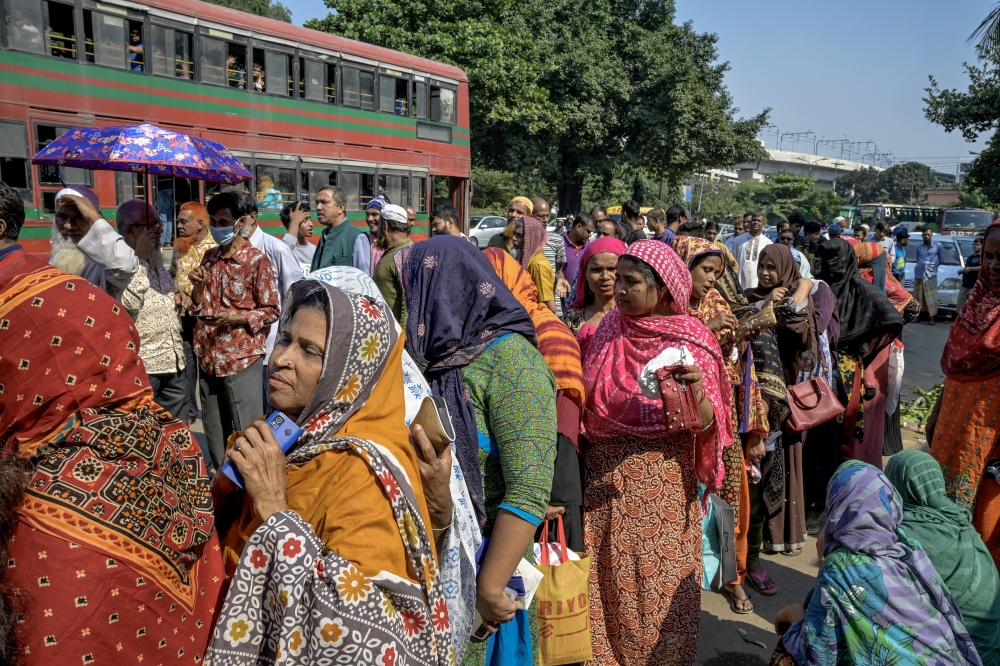
For most Bangladeshis, there are more everyday concerns, as the economy has sputtered. Economic growth slowed to 4.2% last year, down from 5.8% in 2023, according to the World Bank.
Abdul Kader, 37, said income from his air conditioner and refrigerator repair store in Dhaka has dropped 10% since the uprising. Customers are being cautious because of the uncertainty, he said, adding that he hoped an elected government might bring some relief.
“It seems people don’t have enough money,” he said, “or those who have money don’t want to spend.”
This article originally appeared in The New York Times.
Oman Observer is now on the WhatsApp channel. Click here