Although the International Court of Justice turned 80 this year, there is a sense in which it has never felt younger. In a David-versus-Goliath moment, the tiny Pacific Island state of Vanuatu recently changed international law forever by bringing the world’s most important issue before its highest court. The result is an ICJ advisory opinion on “the legal obligations of states in respect of climate change”, as requested — at Vanuatu’s urging — by the United Nations General Assembly (with 132 states co-sponsoring the resolution).
The questions posed to the ICJ were as simple as they were seismic: What obligations, under international law, do states have to tackle climate change? And what are the legal consequences if they fail to do so?
The ICJ’s answer was unequivocal. States have a duty to protect their citizens from climate change — a duty rooted not only in treaties like the Paris climate agreement, but also in environmental law, human-rights law and customary international law. “Climate change”, said the court’s president, Yuji Iwasawa, speaking from the Peace Palace in The Hague, “is an urgent and existential threat of planetary proportions”. “The science is clear”. notes John Silk, the Marshall Islands’ representative to the UN, “and now the law is, too”.
The fact that this bold message was delivered unanimously by the highest court in the international system would have been extraordinary enough. But the path that led to this outcome is even more remarkable.
The most significant climate case ever heard by the ICJ began not in a ministry or a think tank, but in a classroom. It was conceived by a group of 27 Pacific Islands law students who formed the Pacific Islands Students Fighting Climate Change (PISFCC), led initially by Solomon Yeo and then by Cynthia Houniuhi, both from the Solomon Islands, as well as Vishal Prasad from Fiji, Siosiua Veikune from Tonga and others. These were not seasoned diplomats, nor were they backed by billionaires. But they were determined. “Whether you win or lose, some fights are worth fighting”, argued Justin Rose, a former lecturer at the University of the South Pacific (in Fiji), whose classroom exercise first planted the seed of this unlikely revolution in 2019.
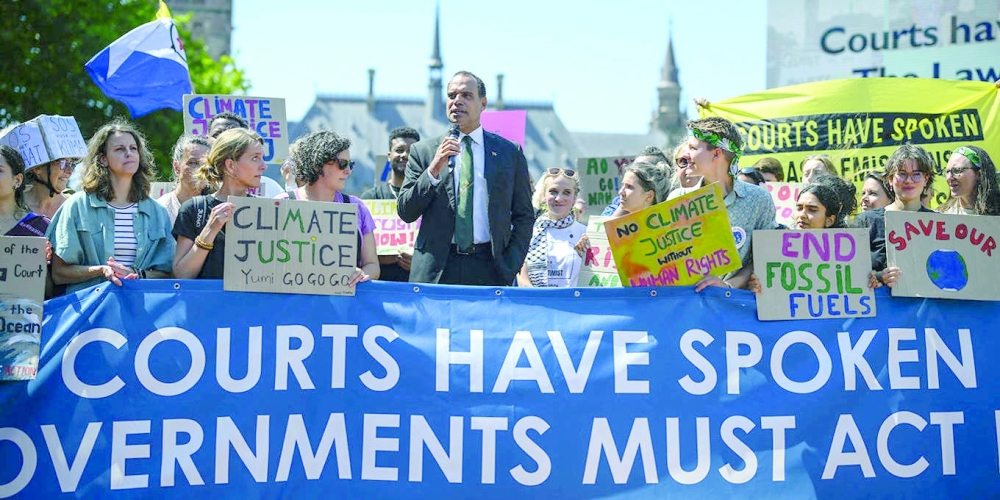
The ruling delivers a resounding victory for the climate-justice movement that has been gaining momentum ever since the Swedish activist Greta Thunberg staged her first solo protest. Now, for the first time, the movement’s inter-generational demand for dignity and legal recognition has a concrete judicial imprimatur.
It is also a triumph for the Global South. For decades, developing countries have called attention to the injustice of being exposed to the gravest consequences of a problem they did not cause. Now, the ICJ has acknowledged this asymmetry and taken the first step towards correcting it, vindicating, in particular, the countries most vulnerable to the effects of climate change: small island states with vanishing coastlines, salinising freshwater and intensifying cyclones. Countries long treated as voiceless victims have become the protagonists in a world-spanning legal story.
This was not the first attempt to bring climate justice to The Hague. Palau and the Marshall Islands made a similar effort in 2012, but it stalled for lack of political backing. The difference this time lay not just in the Pacific Islanders’ persistence, but also in their strategy for building solidarity. Refusing to follow the usual, stodgy diplomatic script, they brought the warmth of the South Pacific to international law. Houniuhi always wore a rorodara (a seashell-studded ceremonial headdress) to address the UN and her group treated the courtroom drama as occasion for song and dance. Hearings were celebrated as watch parties.
The Pacific Islanders also built coalitions across oceans and generations — working with Vanuatu’s then-Foreign Minister Ralph Regenvanu, Caribbean allies and youth activists worldwide. With some countries even calling for financial reparations, the ICJ process became a movement in itself.
The ICJ’s ruling comes at a time when other international courts are converging on similar conclusions. The International Tribunal for the Law of the Sea has just affirmed that states must curb marine pollution from greenhouse-gas emissions; the Inter-American Court of Human Rights has, in an opinion on climate obligations, recognised the right to a healthy climate as a human right; and the African Court on Human and Peoples’ Rights is in the process of weighing in on the matter.
The ICJ’s opinion is not legally binding, but it is far from toothless. Its authority comes not from enforcement, but from amplification. It crystallises a set of norms for courts, lawmakers and activists around the world; and it sharpens the tools of transnational litigation. Hence, the ICJ decision is already expected to influence domestic cases, such as Greenpeace’s suit against the Italian oil company Eni. It may also mean that countries can sue each other over climate change.
The evolution of climate justice from a slogan into a legal standard may be the most important signal yet that a genuinely global legal system is emerging. By that I do not mean a world government, but rather a legal system defined by what the legal theorist HLA Hart called “the union of primary and secondary rules” recognised across jurisdictions. Climate law, once a patchwork of soft pledges and nonbinding resolutions, is being stitched into something more cohesive and robust.
@Project Syndicate, 2025
Oman Observer is now on the WhatsApp channel. Click here