The leading feature in the recent free trade agreement signed by the United Kingdom and India, during the visit by India’s Prime Minister Narendra Modi to the UK, is the reduction of tariffs on a variety of goods from textiles to cars and furthermore, the deal allows market access for businesses.
Talks on the trade agreement had already taken place in early May after three years of stop-start negotiations and both sides have been keen to seal the deal amid a turmoil of tariffs created over the months, by US President Donald Trump.
This agreement between the world’s fifth and sixth largest economies aims to increase bilateral trade by a further £25.5bn ($34bn) by 2040.
It is the UK’s biggest trade deal since it left the European Union in 2020. It is also India’s biggest strategic partnership with an advanced economy and it could provide a template for a long-desired deal with the EU as well as for talks with other regions.
Both sides hailed as historic a deal which will take effect following a ratification process, likely within a year after which firms such as drinks-maker Diageo and car companies such as BMW, Nissan, Aston Martin and Indian (Tata)-owned Jaguar Land Rover could benefit from lower duties.
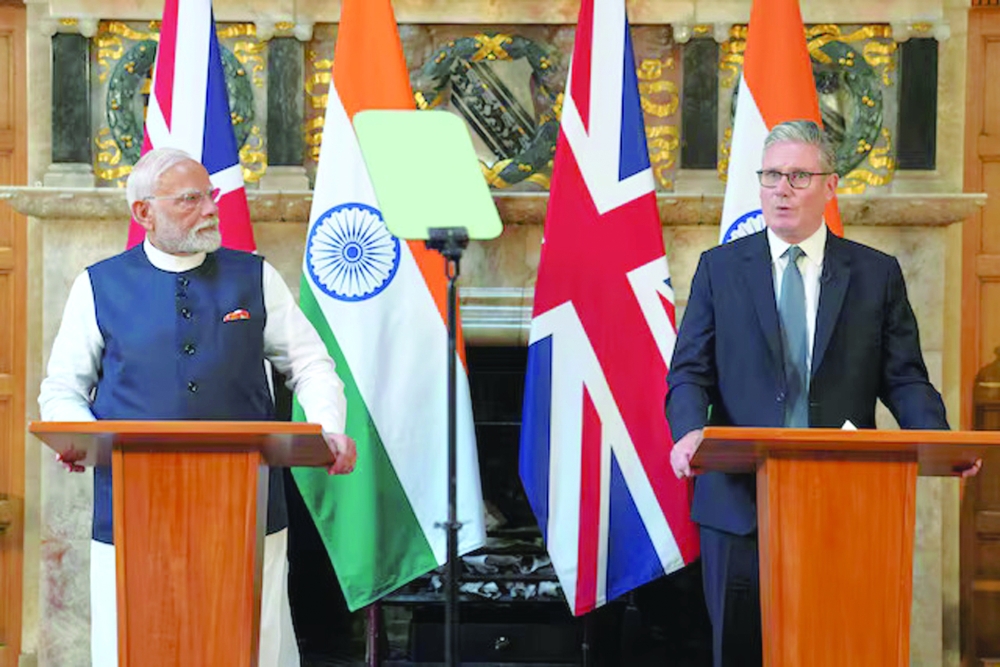
UK Prime Minister Keir Starmer said there would be huge benefits for both countries, making trade cheaper, quicker and easier.
“We’ve entered a new global era, and that is one that requires us to step up, not to stand aside, by building deeper partnerships and alliances,” Starmer said in a statement.
Modi called the agreement “a blueprint for shared prosperity”, highlighting how Indian goods from textiles to jewellery and seafood would secure better market access. The countries also agreed on a partnership covering areas such as defence and climate, and aim to strengthen co-operation on tackling crime. After spending three hours in talks with Starmer, Modi went to meet King Charles at his Sandringham estate.
Under the trade agreement, tariffs on Scotch beverage will drop to 75 per cent from 150 per cent immediately, and slide to 40 per cent over the next decade. Tariffs on drinks such as brandy and rum will be cut to 110 per cent initially and end up at 75 per cent.
On cars, India will cut duties to 10 per cent within five years from current level of up to 110 per cent under a quota system that will be gradually liberalised. In return, Indian manufacturers will gain access to the UK market for electric and hybrid vehicles, also under a quota system.
Under the deal, 99 per cent of Indian exports to the UK will benefit from zero duties, including textiles, and Britain will have reductions on 90 per cent of its tariff lines, with the average tariff UK firms face dropping to 3 per cent from 15 per cent.
But the projected boost to the UK economic output, of 4.8bn a year by 2040, is small compared to Britain’s gross domestic product of 2.6bn in 2024. The Office for Budget Responsibility (OBR) has forecast that UK exports and imports will be about 15 per cent lower in the long run if Britain had stayed in the EU.
The UK’s Labour government, having been in power now for a year, has launched a reset of ties with the EU to smooth trade friction and won some tariff relief from the United States. The Confederation of Indian Industry called it a “strong foundation for deeper market access.”
Oman Observer is now on the WhatsApp channel. Click here