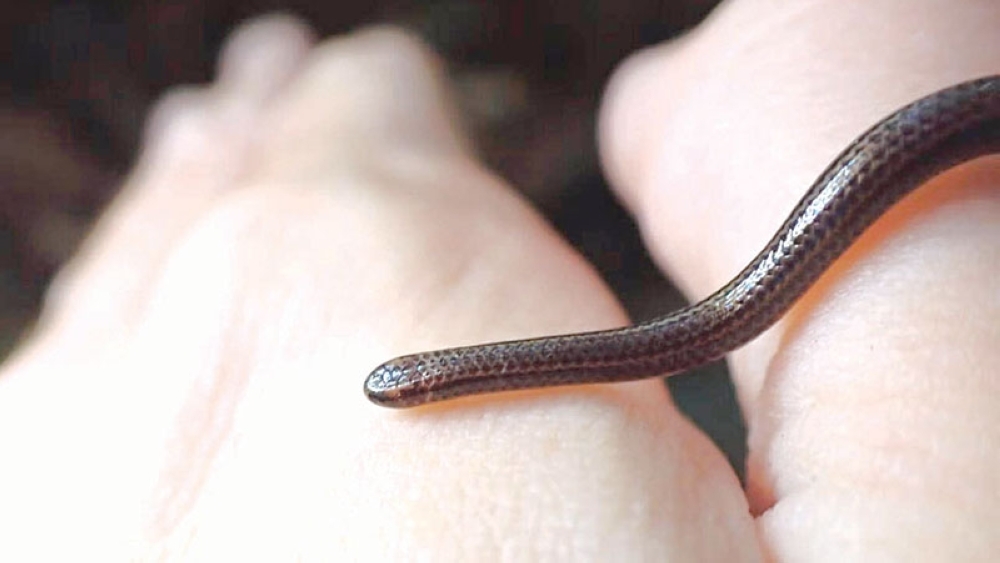





A snake so small it could be mistaken for a worm has been spotted in Barbados, nearly two decades after it was thought to have been “lost” to science.
The Barbados threadsnake (Tetracheilostoma carlae) was found hiding under a rock in central Barbados during an ecological survey in March by the Barbados Ministry of the Environment and National Beautification and conservation group Re:wild.
“Barbados threadsnakes are blind snakes, so they’re very cryptic”, said Connor Blades, a project officer with the Ministry of Environment in Barbados who helped make the finding, in a statement.
“They’re quite rare also, it seems. There have only been a handful of confirmed sightings since 1889, so there are not many people who have ever seen it, unfortunately”.
Measuring just three to four inches long (eight to 10 centimetres) when fully grown — tiny enough to almost fit on a US quarter coin — the Barbados threadsnake is the world’s smallest species of snake.
It is distinguished by orange stripes along its back, eyes on the sides of its head and a small scale on its snout.
“When you are so accustomed to looking for things and you don’t see them, you are shocked when you actually find it”, said Justin Springer of Re:wild, who made the discovery alongside Blades.
“You can’t believe it. That’s how I felt. You don’t want to get your hopes up too high”. The breakthrough came after more than a year of searching, as the pair upturned rocks trapped beneath a tree root.
The tiny snake, which was found alongside an earthworm, was taken to the University of West Indies for careful examination under a microscope — it closely resembles the Brahminy blind snake, an invasive species, so the finding had to be validated — before it was returned to the forest. Only two per cent of the Caribbean island’s primary forest remains intact, with the rest cleared for agriculture since the start of the colonial era 400 years ago. — AFP
Oman Observer is now on the WhatsApp channel. Click here