


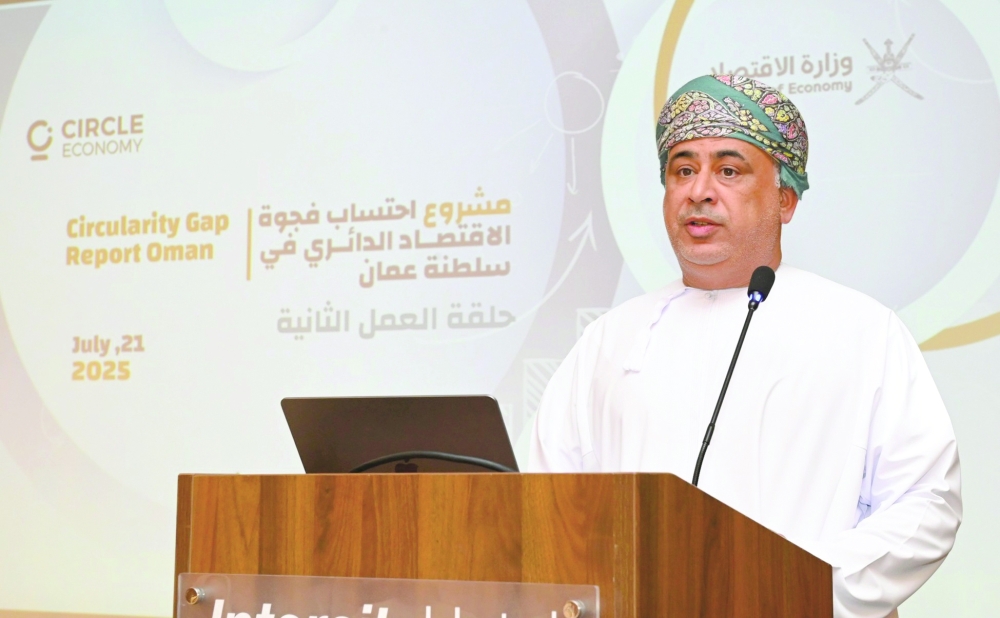





MUSCAT: The Ministry of Economy on Monday hosted the second workshop on the “Circular Economy Gap Calculation Project,” an ambitious national initiative designed to pave the way for Oman’s transition towards a circular economy. The project will culminate in the development of a comprehensive roadmap, reinforcing the Sultanate of Oman’s long-term sustainability goals.
Dr Nasser bin Rashid al Maawali, Under-Secretary of the Ministry of Economy, described the project as the first of its kind in the Middle East and North Africa. He said it aligns with Oman’s commitment to achieving net-zero carbon emissions by 2050. “This vital initiative is centred on three main goals,” he noted. “Establishing a national baseline to measure our circular economy gap, benchmarking against other countries, and designing a tailored roadmap to empower national capacities in both public and private sectors.”
Al Maawali underlined the strategic value of this project in achieving sustainable, low-carbon economic growth. He said it would also open new investment avenues in green sectors such as renewable energy and the wider green economy.
Ahmed bin Saeed al Siyabi, Director General of Economic Policies and Programs, opened the workshop with a detailed presentation on the project’s preliminary findings. He explained that the workshop aimed to assess the initial baseline calculations for various sectors and introduced related initiatives such as training programmes and an interactive platform to showcase results. These insights were complemented by early modelling on how circular economy policies could affect environmental and economic indicators—including job creation.
Attendees participated in breakout discussions, exploring real-life scenarios and modelling the possible outcomes of implementing circular economy strategies. Visual presentations also highlighted the progress made in assessing the circular economy gap, sparking dialogue among participants from government, private industry, academia, and civil society.
The Ministry of Economy is leading the project in collaboration with Oman Environmental Services Holding Company (be’ah), the Netherlands-based Circle Economy, and other technical partners. The initiative underscores the strategic importance of shifting away from a traditional, linear model of economic growth toward one rooted in efficiency, resource recycling, and waste minimisation.
As Oman continues to diversify its economy, the circular model is expected to play a critical role in shaping a more sustainable and resilient future. — ONA
Oman Observer is now on the WhatsApp channel. Click here




