


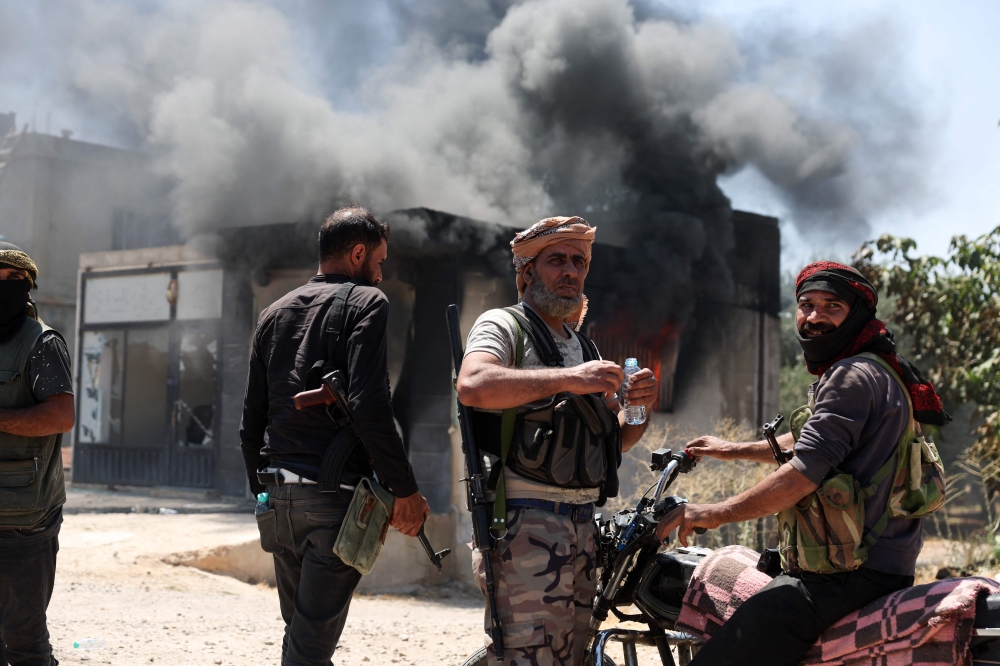





Nearly 80,000 people have been displaced by sectarian violence in southern Syria that began last week, the UN's migration agency said on Friday.
In a statement, the International Organization for Migration said "79,339 people have been displaced since July 13, including 20,019 on July 17", adding that water, electricity and telecomms services in Sweida had 'collapsed' and fuel shortages had crippled transportation and emergency logistics.
Armed tribes supported by Syria's government clashed with Druze fighters in the community's Sweida heartland on Friday, a day after the army withdrew under Israeli bombardment and diplomatic pressure.
The United Nations called for an end to the 'bloodshed' and demanded an 'independent' investigation of the violence, which has claimed nearly 600 lives since Sunday, according to the Syrian Observatory for Human Rights.
The renewed fighting raised questions over the authority of interim leader Ahmed al Sharaa, whose interim government also has difficult relations with the Kurdish minority in the northeast and the Alawite minority on the Mediterranean coast.
It was Al Sharaa who ordered government forces to pull out, saying that mediation by the United States and others had helped avert a "large-scale escalation" with Israel. In the corridors of the Sweida National Hospital, a foul odour emanated from the swollen and disfigured bodies piled up in refrigerated storage units, a correspondent reported.
A small number of doctors and nurses at the hospital worked to treat the wounded arriving from the ongoing clashes, some in the hallways.
Omar Obeid, a doctor at the government hospital, said that the facility has received "more than 400 bodies since Monday morning".
"There is no more room in the morgue, the bodies are in the street" in front of the hospital, added Obeid, president of the Sweida branch of the Order of Physicians.
Tribal reinforcements from across Syria gathered in villages around Sweida on Friday to reinforce local Bedouin, whose longstanding enmity towards the Druze erupted into violence last weekend.
Anas al Enad, a tribal chief from the central city of Hama, said he and his men had made the journey to the village of Walgha, northwest of Sweida, because "the Bedouin called for our help and we came to support them".
The Britain-based Observatory said "the deployment of tribal fighters to Sweida province was facilitated by government forces, because government forces are unable to deploy to Sweida under the terms of the security agreement with Israel".
Israel, which bombed the Syrian military in Sweida and Damascus earlier this week to put pressure on the government to withdraw, said on Friday that it was sending aid to the Druze community in Sweida.
"In light of the recent attacks targeting the Druze community in Sweida and the severe humanitarian situation in the area, Foreign Minister Gideon Saar has ordered the urgent transfer of humanitarian aid to the Druze population in the region", the foreign ministry said. The nearly $600,000 package includes food parcels and medical supplies, the ministry said.
A ceasefire was supposed to take effect on Thursday, but Al Sharaa's office accused Druze fighters of violating it. Sweida has been heavily damaged in the fighting and its mainly Druze inhabitants have been deprived of water and electricity, while communication lines have been cut. — AFP
Oman Observer is now on the WhatsApp channel. Click here


