




SALALAH, JULY 13
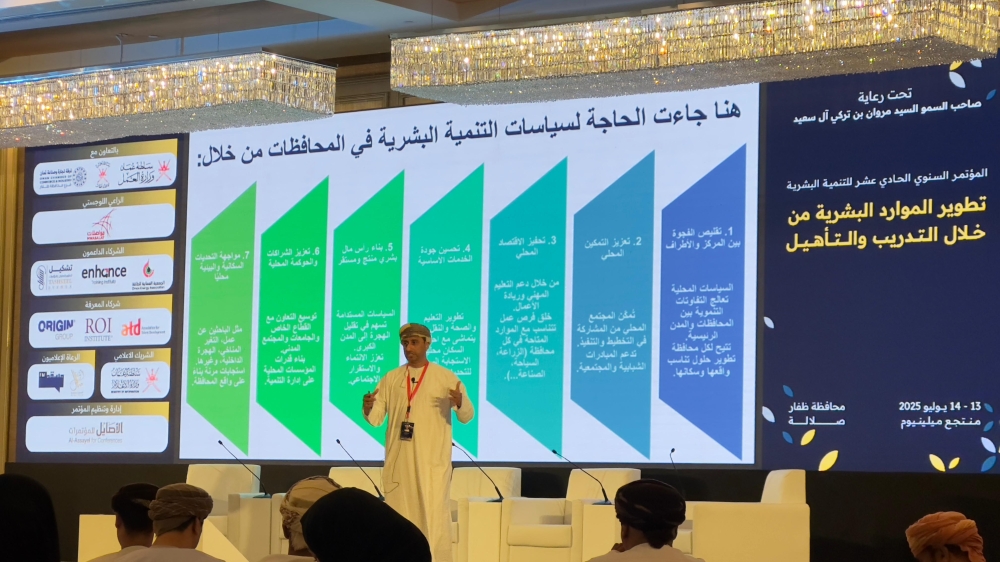
Shaikh Mohammed bin Sulaiman al Kindi, Governor of North Al Batinah, delivered a keynote presentation during the 11th Annual Human Development Conference held in Salalah, calling for a more decentralised and localised approach to development planning in Oman.
In his presentation, Al Kindi highlighted a number of persistent challenges facing development at the governorate level. He pointed to the disparity in infrastructure and development opportunities between governorates, noting that weak alignment between educational outcomes and local labour market needs continues to hinder inclusive growth. He also emphasised that limited resources pose a serious obstacle to skills development, particularly in the face of rising demand for technical and vocational competencies.
The Governor further identified the slow activation of local partnerships as a constraint on development, citing the need for improved coordination among government agencies, the private sector, and civil society. Youth unemployment, particularly among new graduates, remains high in many governorates, which Al Kindi attributed to a lack of training programmes that are closely aligned with the demands of local economies.
He also addressed the growing trend of internal migration from rural areas to urban centres, which, he warned, is weakening the social and economic fabric of many local communities. Finally, he noted that the absence of accurate local-level data makes it difficult to measure the impact of public policies and to base decisions on reliable information.
To address these challenges, Al Kindi presented six key policy recommendations. First, he called for the design of localised development programmes tailored to the specific needs of each governorate. This includes developing micro-level development plans that take into account local strengths, weaknesses, and priorities.
Second, he advocated for empowering local leadership by transferring certain policy-making powers to governorates. This would allow decision-making to become more responsive and context-driven. Third, he encouraged the strengthening of partnerships with local companies and non-governmental organisations, arguing that such collaborations are essential for delivering targeted development outcomes.
Fourth, Al Kindi recommended greater investment in technical and vocational education as well as support for local innovation and entrepreneurship. He stressed the importance of preparing youth for emerging sectors in the local economy. Fifth, he called for improvements in the quality of public services, including the introduction of clearer performance standards, institutional accountability, and continuous evaluation of service delivery.
Finally, he proposed the development of localised data platforms that would allow for better monitoring of key development indicators. These platforms would support more informed policy-making and help track the effectiveness of government interventions on the ground.
Al Kindi’s presentation aligned closely with Oman Vision 2040’s emphasis on decentralisation, citizen empowerment, and regional development. His remarks underscored the urgency of building governance models that respond to local realities while contributing to national goals. The conference, which continues through July 14 at Millennium Resort Salalah, provides a platform for exchanging ideas and forging partnerships to advance human development across the Sultanate of Oman.
Oman Observer is now on the WhatsApp channel. Click here