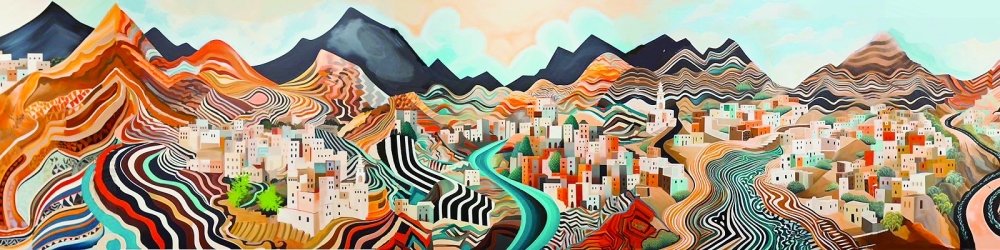
What if you were offered $232 billion to shape the future of your region? No contest. No catch. Only a choice. To act with care, with courage and with creativity.
That figure is real. It is the projected gain for the Middle East by 2035 if climate action and artificial intelligence are pursued in tandem. Alone, they offer progress. Together, they reshape how we live, work and adapt. Technology that learns. Environments that recover. Societies that grow with more clarity, more fairness and more resilience.
It can be easy to treat numbers like that as distant. But their meaning lives close to the ground. In how much food costs. In whether air conditioning becomes a necessity or a lifeline. In how many young people feel they have a place in the future that is arriving. And something is beginning to shift.
In Riyadh, national investments are nurturing local AI talent. In the UAE, machine learning is already managing how energy flows through the grid. Algorithms forecast electricity demand and reduce waste. In coastal cities, AI tools help predict floods and alert responders. These are not future possibilities. They are happening now, across the region. In Cairo, a public school turned its courtyard into a garden. Teachers and students built shade from scrap wood, planted citrus trees in cracked pots and coded moisture sensors using secondhand tools. No fanfare. Just steady hands working in the heat, trusting that care can create change.
In Muscat, a group of university students recently led a climate storytelling workshop. They gathered poems, field notes and oral histories. This was not data analysis, but its own kind of intelligence. One rooted in memory, place and attention. Their work moved through the room like wind through tall grass, soft but certain, mapping what still matters. Across the region, the conditions are here. The sun. The wind. The ambition. The memory of how to thrive with limits.
Beyond the region, momentum is building. At the BRICS summit this week, Brazil proposed a global climate fund. The UAE, Saudi Arabia and China responded. The Global South is no longer waiting for signals from others. It is offering direction on its own terms. As the world looks towards COP30 in Belém later this year, more of the agenda will rise from places long underestimated. Still, money is just one tool. Code can calculate, but it cannot care. The rise of artificial intelligence also brings a cost few see. It devours energy to operate and learn. Progress calls for more than programming. It asks for discernment. For design that honours both people and planet. For the will to build systems for lives we may never live, in climates we may never feel. Artificial intelligence can optimise. Climate action demands vision. Together, they offer more than solutions. They offer a new way of seeing. One that centres relationships as much as results.
A child sketching a wind turbine in a school notebook deserves more than a gesture. So does the grandmother who watches the patterns of heat shift year by year. So does the young woman building Arabic-language AI tools because she believes her voice belongs in the systems shaping tomorrow.
This region has always known how to endure. But this is not only about survival. It is about imagination. The kind that led our ancestors to read wind, carve shade from stone and follow stars before maps had names. That instinct has not disappeared. It is still waiting.
So what would you do with $232 billion? Build another skyline? Or rewrite the horizon itself?
Rumaitha al Busaidi
The writer is environmental strategist and advocate for sustainable development
Oman Observer is now on the WhatsApp channel. Click here