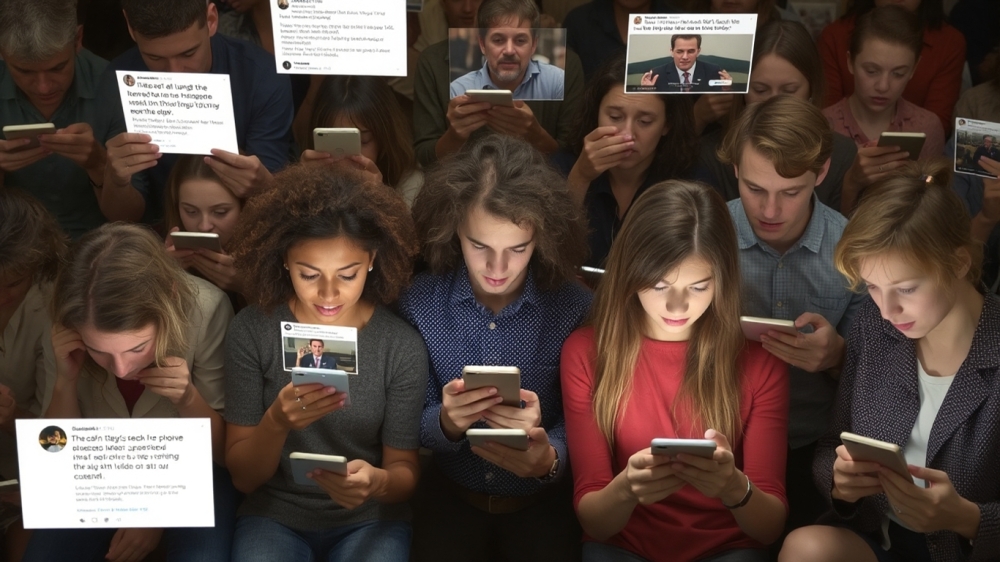





Sharing online content is an integral part of modern life. Social transmission is both frequent and significant. It has its positive and negative aspects. Less is documented about why some content goes viral while others don’t. One of the earliest indicators is that emotion influences social transmission.
Viral communication of all kinds – from Gifs, memes, to hashtags and entertaining videos – is similar to a wildfire. It spreads at a rapid pace and can impact large communities. Virality occurs due to both individual choices and the infrastructure of the internet, while each platform has distinctive user bases and algorithmic features that influence how content spreads and engages users.
Lessons can be learned when examining virality online, including the threats it poses to governments and society due to psychological impacts, division, lack of accountability, and incitement of violence. Research on online virality has found that divisive posts criticising or mocking political opponents drive engagement on social media and are an effective means of going viral.
Online virality is a field with broad implications. It began in the mid-1990s and has grown stronger, possibly due to the rise of applications such as TikTok, Reddit, YouTube, and Facebook, which facilitate easier mass sharing and prioritise sensationalist content. Technological features like ‘one-click sharing’ buttons have simplified the process of copying and disseminating messages, making it an easy and virtually cost-free endeavour for individuals.
The topic of ‘the dangers of virality without accountability’ has multiple dimensions. It encompasses the technical aspects of creating emotional, engaging content within fields such as media sociology, popular culture, types of content, future challenges posed by artificial intelligence capabilities, and the responsibilities of big tech companies, as well as those of governments and society. Depending on how specific fields examine the issue, it provides the foundation for a wide range of debates.
Digital Media and Hate Speech
According to the United Nations’ article, Hate Speech is Rising Around the World (2024), hate speech via digital channels is becoming a global phenomenon. It affects all societies, whether liberal or authoritarian. It has been linked to an increase in violence, including mass shootings, lynchings, and ethnic cleansing.
Online hate speech has been responsible for violent attacks such as the Pittsburgh synagogue shooting in 2018. Sri Lanka experienced a spate of violence in March 2018 caused by rumours spread online.
Recent studies indicate that hate speech is currently intertwined with global events.
Decoding a Meme
Memes spread information and influence public opinion due to their simplicity, visual impact, and shareability. They can enhance activism and public discourse by making political representations humorous, perplexing, or offensive.
Through humour and irony drawn from popular culture, memes can serve as tools of political satire or parody, challenging the status quo and offering alternative viewpoints.
It is vital to recognise that memes can also propagate misinformation and propaganda.
Online Pop Culture
To better contextualise current digital phenomena, we should examine the heritage of viral content, with examples such as the Harlem Shake (2013) and the dress (2015). There are also earlier examples, such as the Dancing Baby (1996), which became viral thanks to popular email chains. Various shorter animations based on the Dancing Baby emerged, including Kung Fu Baby and Samurai Baby. These became part of popular culture.
Derp (1998), comic cartoon characters with eyes pointing in opposite directions, gained popularity around 2010. The ‘Selfie’ (2002) was first used in 2002, with its virality peaking around 2012, coinciding with the rise of social platforms like Instagram and Snapchat. The Disaster Girl (2005) meme spread rapidly online and has been the subject of edits placing the girl in front of historical disaster scenes.
Pop culture acts as a social glue for individuals sharing interests. It encompasses behaviours and norms that have arisen through digital interactions, highlighting shared values. From a commercial perspective, it aligns with capitalism: being mass-produced, widely consumed, and driven by profit motives.
Violent Content
Outrageous content is a multifaceted and evolving aspect of the internet. Platforms relying on user-generated material, such as social media, serve as conduits for online abuse.
Recently, criminals have escalated online harm by posting or livestreaming their criminal acts and victims, thereby broadening harm beyond immediate targets and showcasing their acts online. For instance, a Mexican influencer was shot dead during a TikTok livestream.
In March 2019, the Christchurch Massacre in New Zealand was livestreamed on Facebook.
Violent imagery is not only physiologically stimulating but also psychologically intriguing. Studies show that fascination with violence and death appears to be an innate human trait that often promotes social transmission.
Blame Game
People condemn and blame others for various reasons. Punishing individuals or calling them immature or irresponsible doesn’t address the harmful and offensive virality ecosystem of social media.
Rather than acknowledging structural issues such as the role of social media platforms and commercial interests, the prevalent culture of blame attributes failures to individual flaws.
Moral authorities, stressing personal responsibility for one’s actions, often neglect the importance of shared responsibility in tackling the problem and finding collective solutions. It is essential to recognise that addressing virality and its consequences requires systemic change, including platform accountability, media literacy education, and collaborative efforts between governments, tech companies, and civil society.
Drawbacks of Virality
Too often, we overlook the broader consequences of virality by ignoring the linguistic and psychological factors that motivate users to share content. Some serious issues associated with virality include hate-sharing, screen-grabbing, and reputational harm.
Certain human traits—such as emotional sensitivity, mental health conditions, limited civic, media, and digital literacy, and pre-existing extremist views—are identified as risk factors for online radicalisation. These factors make individuals more susceptible to engaging with harmful content and perpetuating its spread.
The Future of Virality in the Age of AI-Enabled Technologies
Artificial intelligence (AI) can amplify the virality of content by automating sharing at incredible speeds. With AI and machine learning (ML), bots can interact socially with users, providing mutual reinforcement that influences the dissemination of information. As AI capabilities evolve, new criminal and harmful threats arise.
Furthermore, digital technologies like social media, encrypted messaging, and AI can intensify polarisation by enabling like-minded groups to connect more easily. Extremism often results from this polarisation, and digital tools have shifted extremist strategies, making them more sophisticated and harder to combat.
Holding Platforms Accountable
The social media business model, which emphasises clicks and advertising revenue, deeply impacts society. Content curation is driven by algorithms designed to maximise engagement.
Social media companies are among the most powerful and well-resourced entities globally, possessing advanced networks for information transfer. They have the technological expertise necessary to address issues such as political polarisation, violence, misinformation, and hate speech.
Regulators must scrutinise the internal workings of these platforms, as the influence of structural factors and algorithmic design is often overlooked. Young people and children are particularly vulnerable in this largely unregulated virtual environment, highlighting the need for stricter oversight and protective measures.
Afterthought
It is important to recognise that virality extends beyond the digital domain. This phenomenon is shaped by properties that allow content to circulate across diverse cultural communities, often influenced by tensions, antagonism, or shared narratives. Sometimes content goes viral to raise awareness or warn others about societal issues, not just for entertainment or sensationalism.
Echo chambers, where people hold more radical political views and dismiss violence, also play a significant role. Certain communication tools popular among gamers and young audiences enable compartmentalised, focused discussions offline or within specific channels, often avoiding scrutiny.
Studies suggest that digital virality is not only about offensive or sensational content but also about its potential to influence attitudes and actions—such as videos depicting atrocities like those in Gaza. Platforms face the challenge of managing the viral spread of violent content, misinformation, and divisive content that capitalise on clicks and ad revenue.
Finally, since social platforms derive income from maximising user engagement and advertising, their algorithms tend to promote content that increases time spent on platforms. This creates a complex landscape where community discovery and user interaction are driven by algorithms designed to keep users hooked, often at the expense of societal well-being.
Oman Observer is now on the WhatsApp channel. Click here