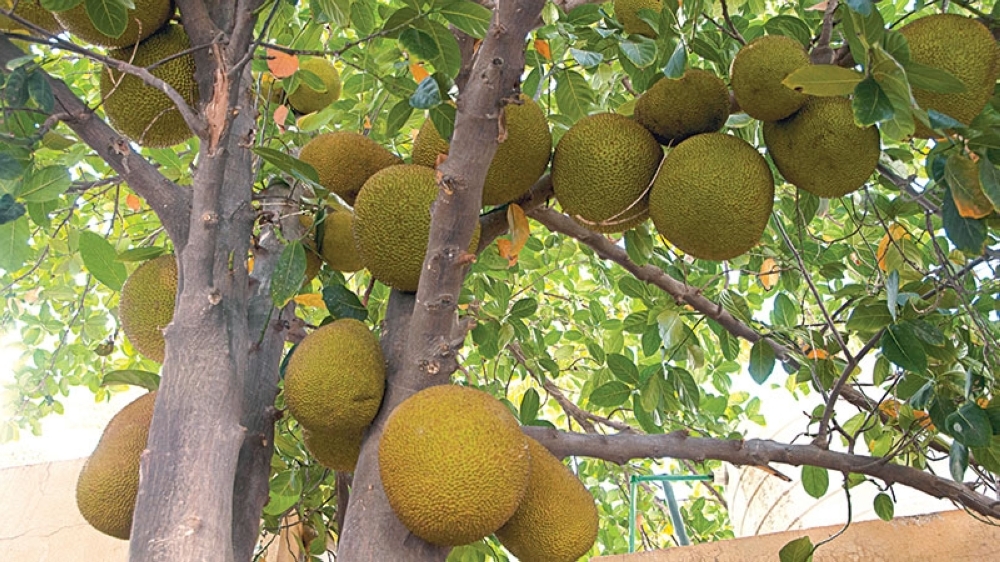





Summer marks the harvest season for dozens of fruits and vegetables across Oman, with fresh dates and mangoes taking centre stage. Yet, hidden among these seasonal staples is a rare gem - the jackfruit, locally known as 'Al Fans.'
Classified as a rare species in Oman the 'Al Fans' tree is an evergreen giant, reaching up to 10 metres in height, with egg-shaped leaves. Its large, edible fruits grow close to the trunk and main branches.
This fruit can be found in areas such as the wilayats of Al Awabi and Wadi Al Maawil in Al Batinah South Governorate and more recently in Dhofar Governorate, where farmer Ahmed al Kathiri introduced nine jackfruit varieties from Singapore, Malaysia and Thailand. Since 2017, he has successfully harvested and sold tonnes of jackfruit in local markets.
In Al Awabi and Wadi Al Maawil, some trees are believed to be over 200 years old. Historical accounts mention a single tree in each of the villages of ‘Afi’ and ‘Al Alia’, which locals claim were brought from Zanzibar in the 17th century and planted near the ‘falaj’ irrigation system to ensure access to fresh water.
According to local residents, the fruits typically ripen and are ready to eat from early June. Villagers have expressed strong interest in replanting and preserving this rare tree, noting that only a few remain today. Sadly, parts of these trees have started to dry out and gradually disappear. Villagers are urging authorities to conduct scientific surveys to support efforts to propagate and conserve the species.
Agricultural sources explain that jackfruit (Artocarpus heterophyllus) originated in the rainforests of Southeast Asia but is now cultivated in many tropical regions worldwide. Ripe jackfruit has a sweet, tropical flavour reminiscent of banana, mango, and pineapple, with a firm, dense texture.
Nutritionally, jackfruit is rich in flavour and packed with essential vitamins and minerals. It offers more protein than many similar fruits and contains a good amount of fibre. A one-cup (165-gram) serving provides about 155 calories, primarily from carbohydrates, along with moderate protein and minimal fat.
In Al Alia village, a lone tree stands beside the ‘falaj’ canal, and its harvest is traditionally sold at auction. The proceeds from these sales are used to maintain the village’s historic mosque, linking the fruit to both cultural and community preservation.
Oman Observer is now on the WhatsApp channel. Click here