


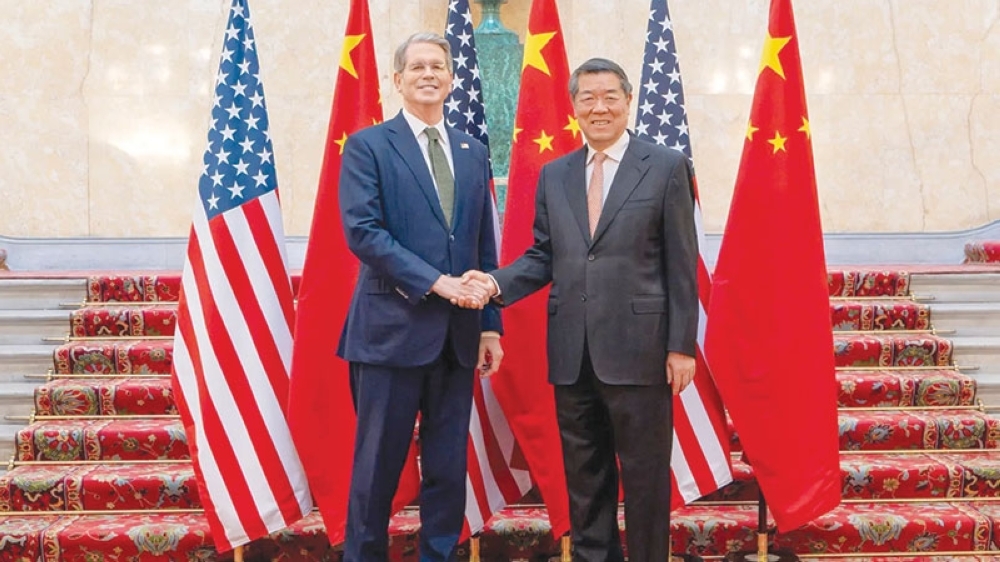





China and the United States have agreed to ease some trade restrictions, according to statements from both sides.
China's Ministry of Commerce announced on Friday that it will review and approve applications for the export of 'controlled goods' that comply with regulations, while the US would lift a series of 'restrictive measures' against China.
US President Donald Trump previously mentioned a signed agreement with China but left many questions unanswered. "We just signed with China yesterday," the Republican said at an event at the White House while talking about making deals with other countries.
Trump also suggested that there could 'maybe' be a 'very big' deal with India.
US Commerce Secretary Howard Lutnick later confirmed in an interview with financial news agency Bloomberg that the deal with China had been signed. He said China would supply rare earths, while the US will end its countermeasures.
Since Trump launched a trade war with Beijing in February, the world's two largest economies have been locked in a tit-for-tat tariff fight that has unnerved global markets. In April, Trump increased tariffs on goods from China to as much as 145 per cent.
In response, Beijing imposed counter-tariffs of 125 per cent and introduced export controls on industrially important rare earths and magnets made from them, on which China holds a near-monopoly.
At the height of the tariff dispute in May, high-level delegations from both sides agreed in Geneva to significantly reduce tariffs for 90 days while continuing negotiations.
It remains unclear, however, what will happen after the August deadline.
The US has since imposed further restrictions on the export of important technology, such as software for computer chips and aviation components, for which China still relies on foreign manufacturers.
Another meeting between the two sides, in London in early June, focused on the trade restrictions.
US representatives eventually agreed with their Chinese counterparts on a reduction, although for a long time no details emerged.
Observers interpreted the outcome as a return to the state of play after the Geneva meeting. Both countries' presidents were expected to approve the decisions following the London talks.
Beijing's export restrictions on rare earths has put significant pressure on industries outside of China. The measures affected all countries, not just the US.
In Germany's important automotive and mechanical engineering sectors, companies are concerned about the supply of important metals used in sensors or electric motors.
China justified the controls by stating that the raw materials can have both civilian and military uses. Companies said it was taking along time for China's Ministry of Commerce to process applications, without certainty of approval.
Concerns have grown about potential production halts. The Ministry of Commerce in Beijing has repeatedly said it has approved applications for companies in the EU and intends to speed up the process. — dpa
Oman Observer is now on the WhatsApp channel. Click here


