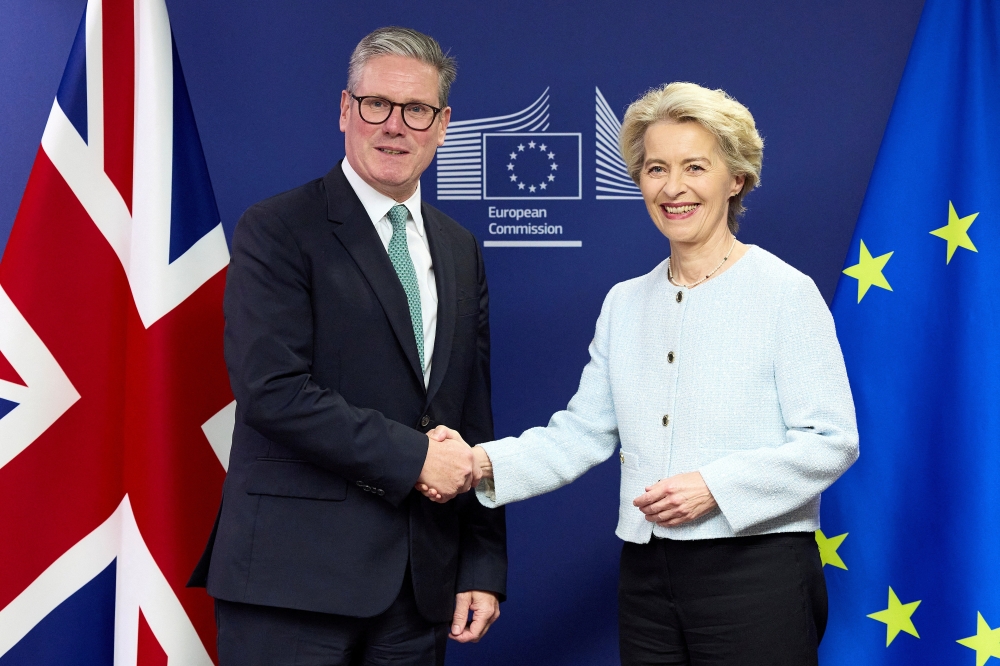
Prime Minister Kier Starmer will be pleased about his catch in international diplomacy: a trade deal with the European Union, which the government hopes will boost the chances of achieving higher growth.
In an agreement that hands EU boats continued rights in British seas until 2038, slashing red tape on food checks and increasing cooperation on defence and migration, businesses are getting a sense of whether this deal may be sweet – or sound all too fishy.
For the opposition political parties, the Conservatives and Reform Party, the Prime Minister has utterly betrayed Britain’s fishing industry. The right to control Britain’s waters was a clear prize of Brexit. Yet, under this deal, British fishermen will never know what it means to manage the fisheries of an independent country. EU excess has been extended and the economic future of Britain’s coastal communities has once again been sacrificed, the opposition say.
Furthermore, the UK has a once-in-a-generation opportunity to sweep away the EU- originated rules that suppress innovation, productivity and growth. Yet, this deal binds Britain back into precisely those constraints on agriculture, preventing the regulatory freedom that would allow Britain to thrive as an agile, competitive economy.
However, Business groups and their members have welcomed the deal, but professor Stephen Miller, director at the National Institute of Economic Social Research, said that, economically the cuts in red tape secured were not likely to put much additional cash in people’s pockets.
“This agreement is unlikely to ‘shift the dial’ in the sense that the gains are small relative to the single market or customs union,” he said. While the gains may be “small”, and despite agreements on areas such as a youth mobility scheme or defence lacking detail, industry groups are largely upbeat about the opportunities presented by EU and UK officials.
The chief executive of Britain’s biggest business lobby, the Confederation of British Industry, suggested the new deal was a “leap forward” amid difficult times.
“The bleak global trading environment – from escalating geopolitical tensions to sluggish growth – has underscored the importance of deepening ties with trusted, like-minded partners,” Rain Newton-Smith said.
This sentiment has been repeated by leading executives at the British Retail Consortium (BRC) and the Federation of Small Businesses (FSB) where leaders have said agreements will keep costs down and enrich British companies looking to import cheaper produce or export goods to European markets.
BRC chief executive Helen Dickenson said the removal of veterinary checks on food would help secure supply chains and support UK competitiveness while FSB policy chair Tina McKenzie suggested that “bottleneck at the border” could be cleared as a result of fewer checks being made. Managing director of M&S Food, Alex Freudmann also said “pointless” bureaucracy in trade within the UK – between Great Britain and Northern Ireland – would be removed.
But some elements of the trade deal were conspicuously absent. As well as the absence of progress of youth mobility, demands made by the Institute of Chartered Accountants in England and Wales (ICAEW) over the recognition of British qualifications, which are supported by other leading business groups, fell on deaf years.
“With elements not yet set in stone, there will be further effort required to ensure that what has been promised is delivered for the benefit of the UK economy, the business environment and wider business society,” said Emma Rowland, trade policy advisor at Institute of Directors (IoD).
ING’s James Smith suggested more negotiations on goods trade would have to be done for the OBR to raise its growth forecasts for the UK thereby easing concerns about extra tax hikes coming. “Generally, we doubt this deal on its own will convince the OBR to change its outlook in any meaningful way,” he said.
Oman Observer is now on the WhatsApp channel. Click here