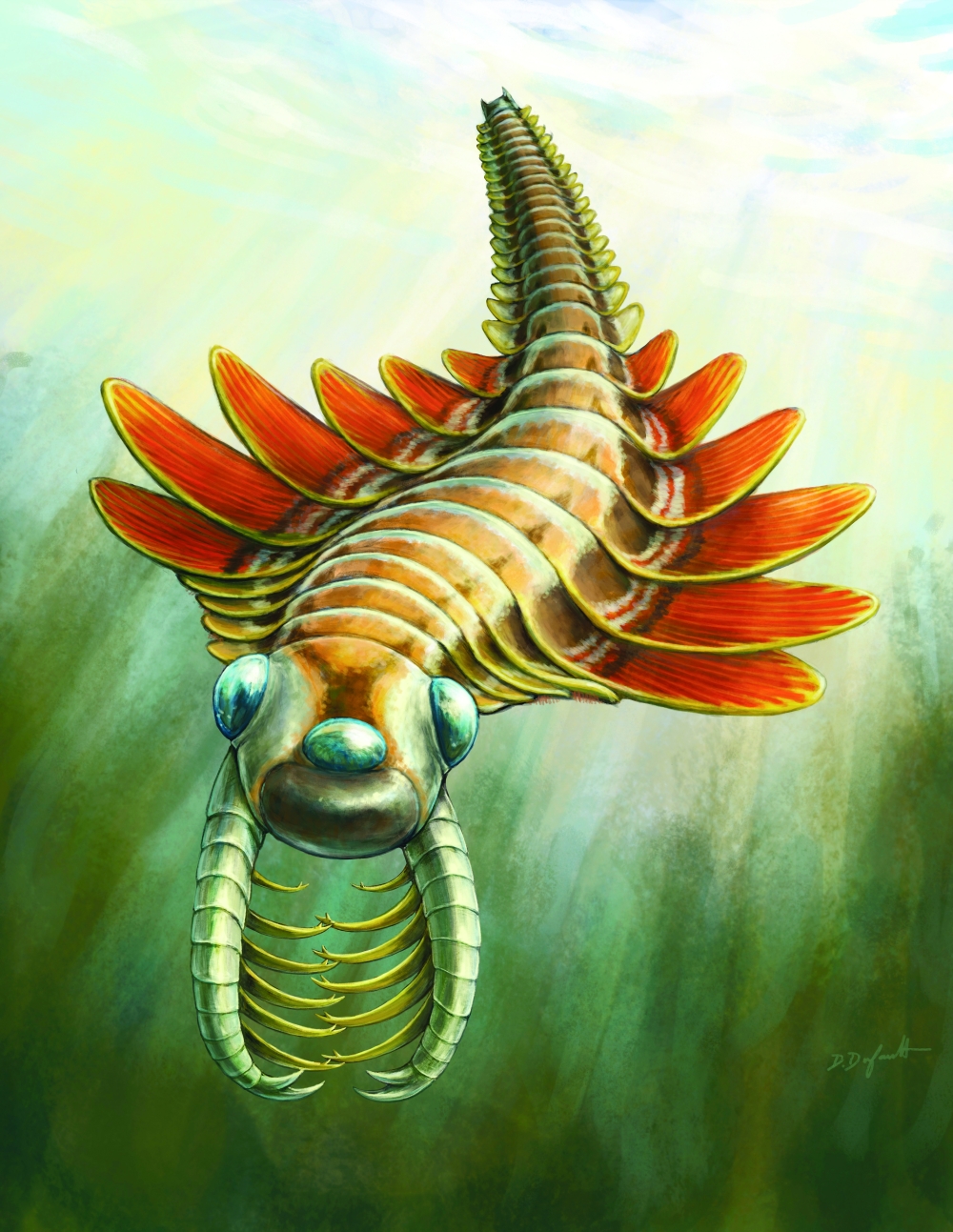





More than 500 million years before “The Simpsons” introduced us to Blinky, a fish with an extra eye swimming through Springfield’s Old Fishin’ Hole, a three-eyed predator chased prey through seas of the Cambrian Period.
Known as Mosura fentoni, this creature is a worthy addition to the bizarre bestiary preserved in the Burgess Shale, a fossil deposit in the Canadian Rockies. But the animal’s anatomy, described in the journal Royal Society Open Science, shows it may not be as alien as it looks.
The first Mosura specimen was unearthed by a paleontologist more than a century ago. Over recent decades, paleontologists at the Royal Ontario Museum in Toronto have uncovered many more Mosura fossils, which they nicknamed “sea moths” because of flaps that help them swim.
Sea moths were not fish, but they were related to radiodonts, a group of arthropods that dominated Cambrian food chains. But a closer inspection would not occur until Mosura specimens were unearthed in 2012 in a Burgess Shale outcrop. Having both old and new specimens encouraged researchers to “finally figure this animal out,” said Joseph Moysiuk, who studied the Marble Canyon fossils as a doctoral student. Moysiuk teamed up with his adviser at the Royal Ontario Museum, Jean-Bernard Caron, to examine 60 sea moth specimens. The specimens were photographed under polarized light to capture the flattened fossils’ detailed anatomy.
A defining feature of living arthropods is the division of their bodies into specialized parts. For example, crustaceans like crabs have different appendages adapted to perform certain functions like feeding or walking. Fossils of many early arthropod ancestors reveal relatively simple body plans. Researchers have therefore long proposed that segmentation took a long time to evolve.
Mosura bucks this trend. Despite measuring only 2.5 inches long, the creature’s body was divided into as many as 26 segments. “It’s something that we’ve never seen in this group of animals before,” said Moysiuk, who is now at the Manitoba Museum in Winnipeg.
In addition to its wide swimming flaps, the animal possessed a highly segmented trunk at the back of its body brimming with gills, resembling the abdomenlike structures that horseshoe crabs, woodlice and some insects use to breathe. — JACK TAMISIEA / NYT
Oman Observer is now on the WhatsApp channel. Click here