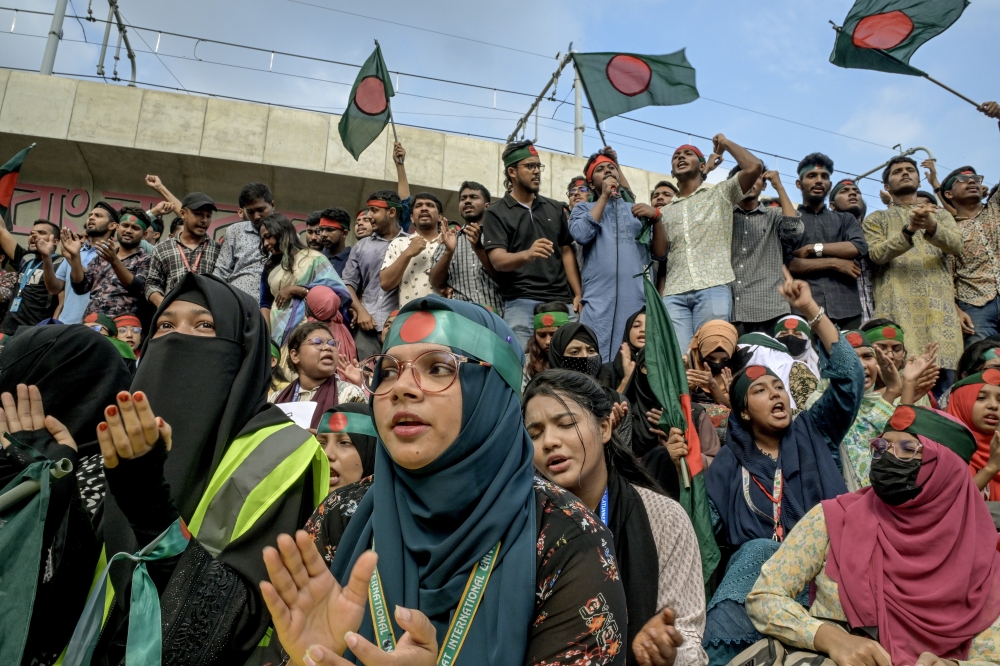





DHAKA, Bangladesh—In August, an idealistic movement led by students toppled Sheikh Hasina's increasingly autocratic government, and millions of Bangladeshis celebrated the imminent revival of democracy.
Almost nine months later, an appointed interim government is frustrating everyone who wants to vote for new leaders right away. Now its celebrated leader, Nobel Peace Prize laureate Muhammad Yunus, is threatening to quit if he is not allowed to get on with his job and prepare the country for elections at a slower pace.
Yunus, an internationally respected technocrat, was seen as Bangladesh’s best chance to pull things together until fair elections could be held. He was appointed to lead an interim government while there was still blood in the streets.
But his aides say he feels thwarted by an emerging alliance between the country’s largest remaining political party and the army, which have criticized his policies and say he is being too slow to plan elections.
On Thursday, Yunus threatened to resign if he did not get political and military backing to carry on unfettered.
Yunus went as far as drafting a speech announcing his resignation, according to a senior official in his government. Other advisers managed to persuade him that his resignation would further destabilize Bangladesh. The official said by phone that his boss was especially unhappy with statements recently made by the army chief calling for elections this year, and felt worn down by criticism from political opponents.
Hasina’s old enemies stand to gain in any election, the sooner the more so. With her party in disgrace and more recently banned outright, the country has been stranded without meaningful political competition.
Bangladesh has also been plagued by a breakdown in law and order and haphazard efforts to fix it. Yunus, who has personally come under increasing pressure from the country’s army and the Bangladesh Nationalist Party, lacks political support of his own.
Mubashar Hasan, a political scientist and research fellow at the University of Oslo, said that Yunus “could be a great banker, he could be a great leader in leading institutions, but what he lacks, and it appears day by day, is that he doesn’t have a firm and strong persona.” Instead, Hasan thinks, Yunus can be overly influenced by his advisers.
Yunus feels sidelined by some of the people who are supposed to be helping him get the country’s democracy back on track, said the official who works closely with him. He seemed to reach his breaking point after the leader of Bangladesh’s army, Gen. Waker-uz-Zaman, said Wednesday that an election should be held by December.
Yunus previously suggested that the country might be ready for an election by June 2026, but has given no clear timeline. He has told his Cabinet he doesn’t believe the current political climate is suitable for a fair election.
In an address to the nation in November, Yunus said, “The election train has started its journey. It will not stop. But we have to complete many tasks on the way.”
The Bangladesh Nationalist Party has been insisting that a democratic mandate is needed before the future course of the country can be decided. After the banning of its traditional nemesis, Hasina’s Awami League, the former opposition party wants to seize its chance to win power.
The Bangladesh Nationalist Party was initially supportive of Yunus’ government, but in recent months, it has stopped cooperating over a series of policy disagreements. Yunus and his officials, for instance, want to privatize the country’s largest seaport at Chattogram; to open an aid corridor to war-torn parts of Myanmar; and to split up Bangladesh’s main tax authority.
Stabilizing the political turmoil has proved a challenging — and at times, almost insurmountable — task for the 84-year-old economist. With one of Bangladesh’s two broad-based parties outlawed and the other urging haste, Yunus seems to want to buy time.
That annoys even sympathetic analysts. “There is no reason this election cannot be held by December,” Hasan said. “It completely depends on the willingness of the government.”
Members of the student protest movement that overthrew Hasina’s government have clashed violently with her supporters since. But they dread letting her old enemies in the Bangladesh Nationalist Party take her place. Most still put their faith in Yunus.
In February, one of Yunus’ former advisers, Nahid Islam, launched a political party called the National Citizens Party, hoping to attract students into its fold.
Islam said he has urged Yunus not to resign. On Thursday, they spoke, and Yunus told him that the promises he had made when he took office are being broken.
“With different groups creating instability, disorder, and pressuring the government, he feels it is no longer possible for him to carry out his responsibilities in an effective way,” Islam said.
This article originally appeared in The New York Times.
Oman Observer is now on the WhatsApp channel. Click here