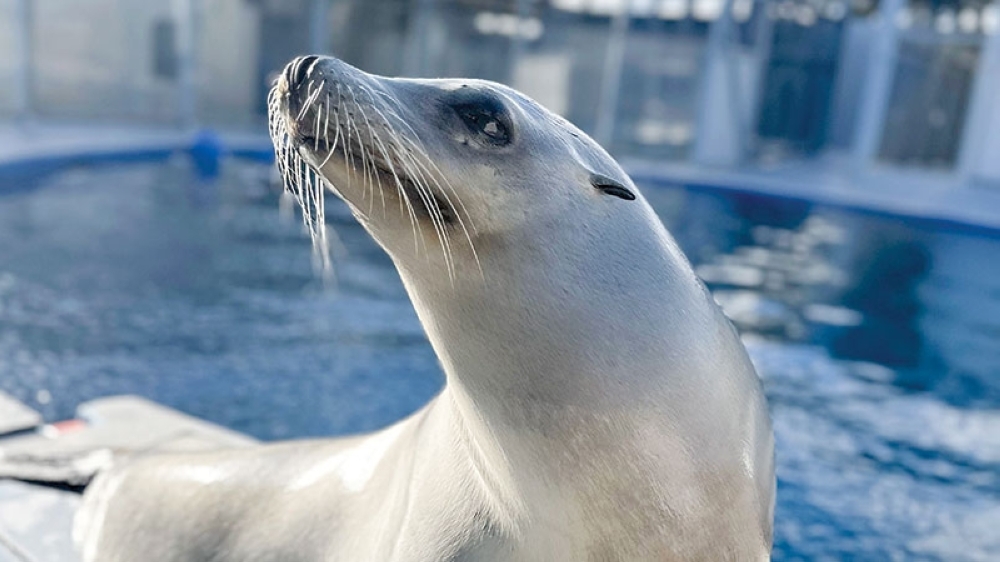





The California sea lion Ronan probably has better rhythm than you.
Scientists earlier showed that Ronan, a resident of the Long Marine Laboratory at the University of California, Santa Cruz, was the first nonhuman mammal who could be trained to keep a beat, including moving in time with music. That was in 2013, when Ronan was young, so researchers recently decided to test the 15-year-old sea lion’s skills again.
It shows “that humans are not the only mammals able to keep a beat,” said Tecumseh Fitch, a cognitive biologist at the University of Vienna who wasn’t involved in a new study published in the journal Scientific Reports.
Parrots keep a beat by moving their bodies. And other studies highlighted the beat-keeping capabilities of monkeys and rats. But after more than a decade, “Ronan the sea lion’s rhythmic entrainment is clearly the best known in nonhuman vertebrates,” Fitch said. The researchers trained Ronan for a few months and then compared Ronan’s skills to those she had when she was 3 — showing that she had improved her skills as she matured.
Then, the team tested Ronan’s ability to move her head in time with tempos of 112, 120 and 128 beats per minute and compared it with the ability of 10 people age 18-23 to move their arm in time with those same tempos. In every parameter tested, Ronan was head of the class. “There was no human that was better than Ronan on every measure of precision and consistency,” said Peter Cook, a cognitive neuroscientist at New College of Florida. “And she was better than most humans on all measures, so she really rose to the top.” — GENNARO TOMMA / NYT
Oman Observer is now on the WhatsApp channel. Click here