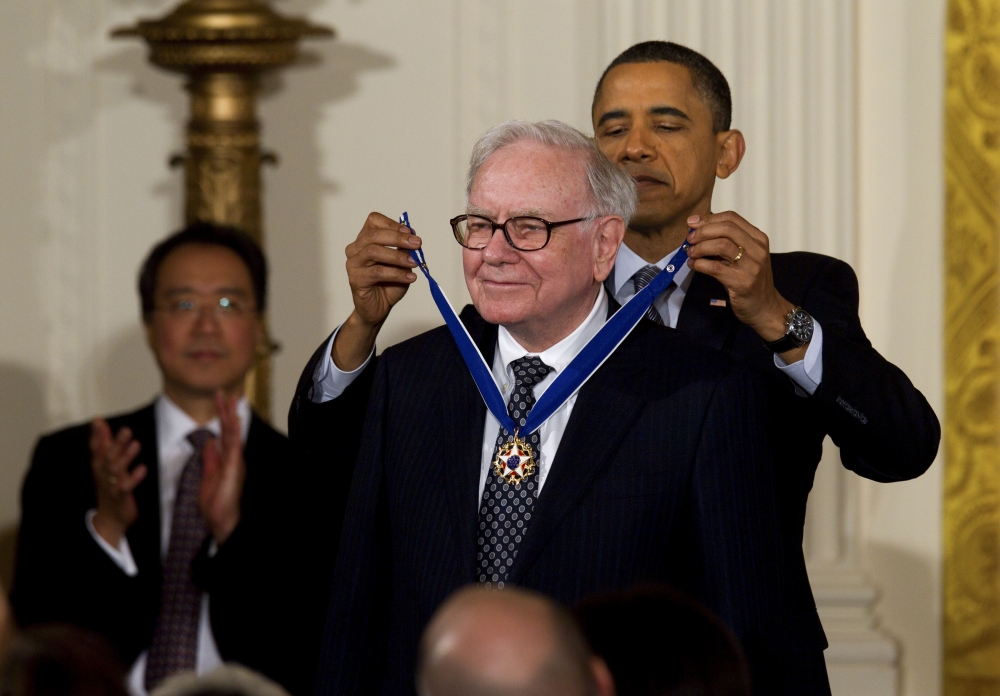





Warren E. Buffett has been at the forefront of American capitalism for decades as the CEO of Berkshire Hathaway, the conglomerate he built into a $1.1 trillion colossus.
By the end of the year, he is preparing to give up that role.
Buffett said at Berkshire’s annual shareholder meeting Saturday that he plans to ask the company’s board to approve making Gregory Abel, his heir apparent, the CEO by the end of the year.
Abel would have “the final word” when it comes to the company’s operations, how it invests and more, Buffett, 94, told the tens of thousands of Berkshire shareholders at the meeting in Omaha, Nebraska.
But Buffett added that he “would still hang around and conceivably be useful in a few cases.” He will remain chair of Berkshire — turning that role over to his son Howard Buffett upon his death — and remains the company’s single biggest shareholder, with a roughly 14% stake that is worth about $164 billion.
Buffett’s plan, which he said had been known only to two of his children who sit on the company’s board, Howard and Susan Buffett, was greeted by a minute-long standing ovation by Berkshire shareholders. Abel, 62, appeared surprised by his boss’s announcement. After the announcement, several board members attending Berkshire’s meeting hugged one another.
Although Buffett looked in good health, having led several hours of questions from investors Saturday, changes to this year’s annual meeting — his 60th at Berkshire — reflected his advancing age. He used a cane, which he first mentioned in the company’s annual letter in February, and shortened the shareholder question session by several hours.
If the board approves the plan, it would signify the end of an era for one of the most successful companies in modern capitalist history and one of its most famous investors. Buffett has amassed a Midas-like fortune by being a savvy stock picker, buying up companies and holding them for the long term.
Through that investing philosophy, he assembled a conglomerate that runs a huge insurance operation, a major railroad, and dozens of consumer companies and oversees a vast stock portfolio.
Among Berkshire’s most notable holdings are names that many consumers recognize: auto insurer Geico, the BNSF railroad, power utility Berkshire Hathaway Energy, Dairy Queen, See’s Candies, Fruit of the Loom, paint company Benjamin Moore, and private jet company NetJets. Together, those businesses helped Berkshire grow a cash hoard that now sits at nearly $348 billion, more than the stock market valuation of McDonald’s.
Berkshire’s financial firepower has made Buffett one of the most influential businesspeople in the world, giving his pronouncements on many topics, including politics, great weight. That included his criticism of President Donald Trump’s trade policies, which Buffett took aim at Saturday.
“Trade should not be a weapon,” Buffett said at the annual meeting. “I don’t think it’s right, and I don’t think it’s wise.”
Buffett’s comments on tariffs were far from his first foray into politics. A Democratic supporter, his name was attached to a proposal years ago by President Barack Obama that would have raised taxes on millionaires. But Buffett has kept a low profile for months, and even on Saturday, he did not mention Trump by name.
Buffett’s plan to step down would complete one of the most-watched leadership transitions in corporate America. For years, he faced questions about who could take over Berkshire, a uniquely complicated business, and many executives had been floated as his successor.
But in 2021, Buffett finally confirmed that it would be Abel, who joined the Berkshire fold when the company bought his energy business in 2000. Since then, the Canadian executive has risen through the ranks, turning what is now called Berkshire Hathaway Energy into one of America’s biggest power producers.
Abel is currently the vice chair of Berkshire’s businesses other than insurance. Oversight of the conglomerate’s behemoth insurance operations has remained with Ajit Jain, a longtime Buffett lieutenant. Buffett and other executives have professed their belief that Abel could maintain Berkshire’s culture.
“Greg is ready,” Ronald L. Olson, a longtime Berkshire director who is also stepping down, told CNBC after Buffett’s announcement Saturday.
Olson added that he hoped Buffett could serve as a valuable sounding board for Abel, much as Charles T. Munger, Buffett’s longtime business partner who died in 2023, did.
Together, Buffett and Munger entertained investors and more — notably at the Berkshire annual meetings — with a sort of vaudeville act, Buffett as the wry optimist and Munger as the sharp-tongued pessimist.
Berkshire’s latest financial report card underscored the complications that Abel will confront as CEO.
The company reported a sharp drop in first-quarter earnings, with operating income — Buffett’s preferred measure — down 14% from the same time a year ago to $9.6 billion. Using generally accepted accounting principles, Berkshire reported a nearly 64% drop in net income, largely because of paper investment losses.
But while markets have grown more volatile in response to Trump’s whipsawing approach to trade, Buffett professed little worry about the effects of that volatility on Berkshire.
“It’s nothing,” he told shareholders, suggesting that riding out market vicissitudes was part of stock investing.
The company reported that a “majority” of its businesses had lower sales and earnings in the first three months of the year, particularly in insurance underwriting income, which was hit by losses tied to the California wildfires.
In a regulatory filing Saturday, Berkshire warned that Trump’s trade policies were generating “considerable uncertainty,” which could affect the company’s operating results. “We are currently unable to reliably predict the potential impact on our businesses, whether through changes in product costs, supply chain costs and efficiency, and customer demand for our products and services.”
Berkshire’s cash pile grew to $347.7 billion, a record, reflecting that Buffett has not found the kind of blockbuster investment opportunities that helped put the company on the map. In the past, he has acknowledged that given Berkshire’s size, it is nearly impossible now for Berkshire to find deals that could meaningfully augment its earnings.
During his question-and-answer session with shareholders at the annual meeting Saturday, Buffett acknowledged stocking up on cash to prepare for any potential buying opportunity. He revealed that he had weighed a potential $10 billion investment but later refused to elaborate.
Berkshire continued to be a net seller of stocks, selling $4.68 billion worth of equity in the quarter, compared with $3.18 billion in purchases.
One matter that Buffett did not directly address Saturday is what would happen to Todd Combs and Ted Weschler, whom he hired more than a decade ago to help pick stocks for Berkshire. The two have been widely expected to become Berkshire’s stock pickers after Buffett steps away, though Combs has also become the CEO of Geico.
A number of prominent corporate and business leaders were on hand Saturday, including Microsoft co-founder Bill Gates, Tim Cook of Apple (which is one of Berkshire’s biggest stock holdings) and billionaire financier William A. Ackman. Two first-timers, Hillary Clinton and Priscilla Chan, the wife of Meta’s CEO Mark Zuckerberg, were also present.
This article originally appeared in The New York Times.
Oman Observer is now on the WhatsApp channel. Click here