




Two hikers were strolling in the foothills of the Krkonose Mountains in the Czech Republic in early February when they noticed something shiny peeking out of a stone wall. They pulled out what turned out to be an aluminum can, looked inside, and found a small fortune.
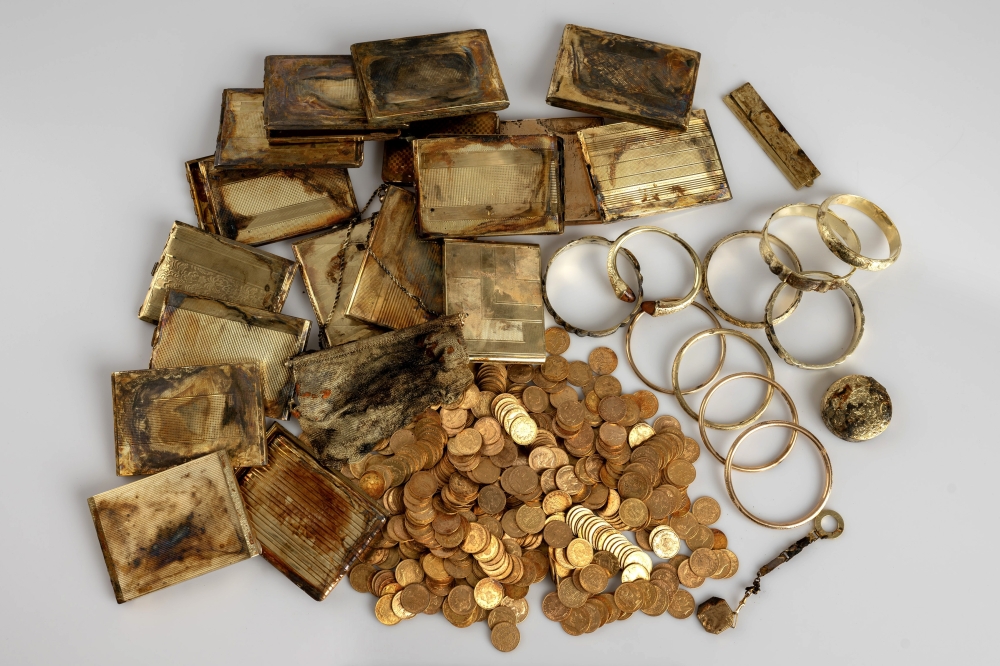
Inside was a treasure trove of 598 gold coins, neatly organized into columns and wrapped in black fabric, said Miroslav Novak, head of the archaeological department of the Museum of Eastern Bohemia, which later took possession of the stash.
A few feet away, the hikers unearthed a second cache: a metal box containing gold items, including 16 snuffboxes, 10 bracelets, a comb, a chain with a small key and a powder compact.
The discovery of the treasure, worth as much as $680,000, has set off a search among historians and amateur sleuths to figure out who might have hidden the riches.
“What is exceptional in this case is the volume,” Novak said.
He estimated that the gold coins were worth about 7.5 million Czech Koruna (about $340,000). The other items, if they are solid gold and not merely gold plated, could be worth another $340,000, he said.
But what was intriguing, he said, was how recently the items were buried.
Although archaeological discoveries are fairly common in the region, with many dating back to the Bronze Age or medieval times, the newest coin in this collection was from 1921, indicating that the treasure had been hidden within the past century.
That relative recency has offered a tantalizing lead to researchers, who think they may be able to track down the owner of the treasure through archival research and solve the mystery of why it was hidden.
“Someone might come across some information, perhaps in the newspapers of the time, that someone robbed a jewelry store or something like that, and suddenly it might lead us to a clue,” Novak said.
He said he had received a steady stream of suggestions — and a few conspiracy theories — about who the owner might be.
Was it a soldier returning from a war? A merchant fleeing the area during conflict? Or perhaps the wealthy heiress of a nearby family?
The coins offer perhaps the best yet most confounding clues.
None of the money circulated in the area where it was discovered. Roughly half the coins are from Western European countries, including France and Belgium. The rest are from regions around the world, including the Balkans, the Ottoman Empire, Russia, Tunisia, and other parts of Africa.
The Balkan coins have holes drilled in them, indicating that they were most likely used to adorn the headbands or necklaces that were part of folk costumes or wedding attire, Novak said.
Online, some suggested the gold could have been the collection of a guard at a prisoner-of-war camp, while others were sure it was hidden by a local dentist.
Experts at the museum and other historians have looked to the region’s tumultuous history for explanations. Bohemia, what is today the western Czech Republic, witnessed huge waves of migration and forced expulsions after 1938.
Oman Observer is now on the WhatsApp channel. Click here